In the high-stakes industrial environments of Saudi Arabia, from demanding petrochemical plants to remote oil and gas operations, the risk of a diesel engine becoming an ignition source is a critical concern. The threat of a catastrophic engine runaway, combined with the immense pressure to comply with stringent safety standards like ATEX, places a heavy burden on operations managers. Finding a local partner with the specialized expertise to mitigate these risks-without compromising engine performance or causing costly downtime-can be a significant challenge. This is where partnering with an expert diesel engine safety solutions provider becomes an essential investment in your operational integrity.
This article provides a clear, comprehensive guide to safeguarding your critical equipment. We will explore the essential components of a reliable safety system, from air intake shutoff valves to spark arrestors, and outline how to select the right solutions for your specific hazardous area application. Discover how to protect your most valuable assets-your personnel and your machinery-while ensuring full compliance and enhancing the long-term reliability of your operations with an expert partner right here in the Kingdom.
Key Takeaways
- Understand the two primary ignition risks-engine runaway and hot surface sparks-that make standard diesel engines a significant liability in hazardous environments.
- Discover the core technologies, from automatic overspeed shutdown systems to exhaust spark arrestors, that form a comprehensive engine safety solution.
- Learn how safety systems are tailored to meet the unique operational and regulatory demands of key industries within Saudi Arabia, such as oil & gas and petrochemicals.
- See how an expert diesel engine safety solutions provider utilizes a structured, consultative process to guarantee optimal system design, installation, and performance for your assets.
The Critical Need for Diesel Engine Safety in Hazardous Environments
Diesel engines are the workhorses of modern industry, valued for their power and reliability. However, when operated in hazardous environments, a standard engine transforms from a vital asset into a significant liability. In critical sectors across Saudi Arabia, including Oil & Gas, Petrochemical, and Marine operations, the presence of flammable gases or combustible dust creates an environment where a single spark can lead to disaster. The consequences are severe, ranging from catastrophic accidents and loss of life to immense asset damage and crippling operational downtime. Mitigating these risks requires a proactive approach and the expertise of a dedicated diesel engine safety solutions provider.
Understanding Diesel Engine Runaway
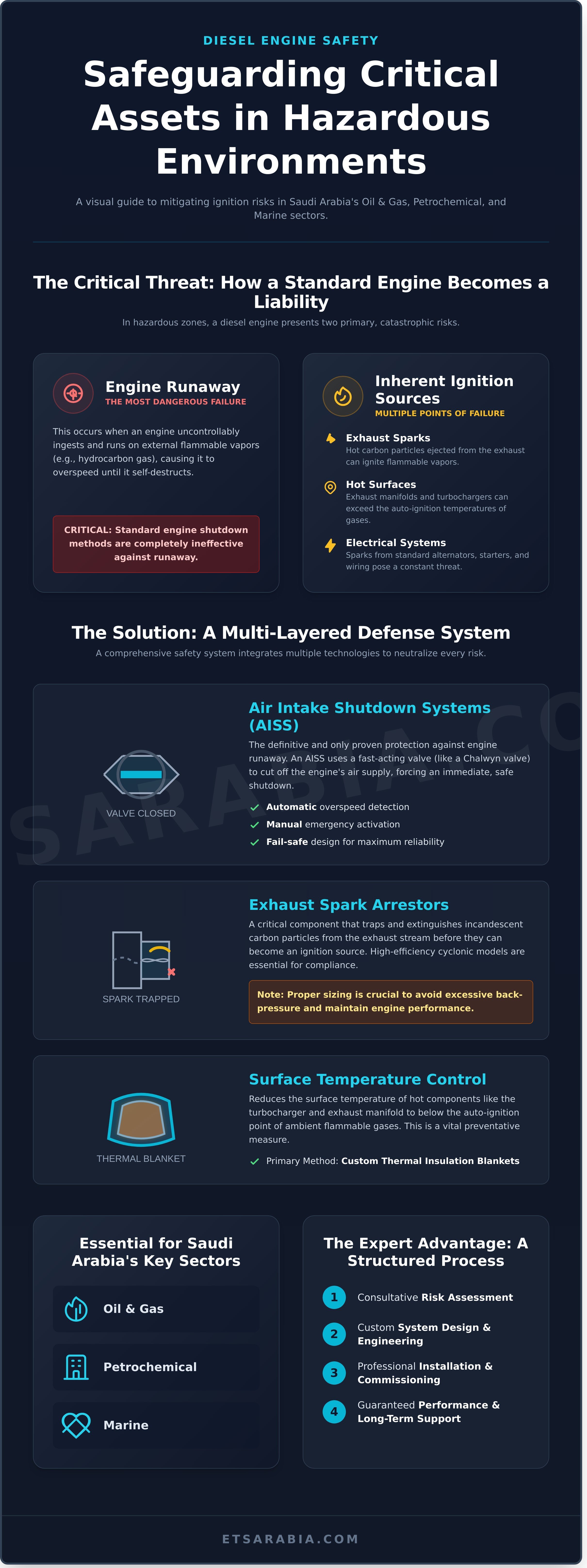
One of the most dangerous failure modes is engine runaway. This occurs when a diesel engine draws in an external fuel source, such as hydrocarbon vapors from the surrounding atmosphere, and begins to overspeed uncontrollably. Because the engine is now fueled by the air it ingests, standard shutdown methods that cut the primary diesel supply are completely ineffective. This critical failure mode, known as diesel engine runaway, can cause the engine to self-destruct, creating a potent ignition source in a volatile environment.
Identifying Ignition Sources on a Standard Engine
Beyond runaway, a standard diesel engine presents numerous inherent ignition points that must be controlled. Without specialized modifications, these sources pose a direct threat in hazardous locations. Key risks include:
- Exhaust Sparks: Hot carbon particles can be ejected from the exhaust system, acting as flying embers capable of igniting flammable vapors.
- Hot Surfaces: Components like the exhaust manifold, turbocharger, and associated piping can reach temperatures exceeding the auto-ignition point of many industrial gases and vapors.
- Electrical Systems: Standard, non-certified electrical components such as alternators, starters, and wiring can produce sparks during normal operation.
Effectively neutralizing these ignition sources is not optional-it is a fundamental requirement for safe operation. Partnering with an expert diesel engine safety solutions provider ensures that your equipment is properly assessed and fortified, guaranteeing compliance and protecting your people and assets.
Core Technologies in a Diesel Engine Safety System
A robust diesel engine safety system is not a single component, but a suite of integrated technologies designed to mitigate specific, high-stakes risks. Each piece of equipment addresses a distinct ignition source-overspeed, sparks, or excessive heat. As an expert diesel engine safety solutions provider, we ensure these components work in unison to provide guaranteed, reliable protection for your assets and personnel in hazardous environments across Saudi Arabia.
Air Intake Shutdown Systems (AISS)
Engine runaway, caused by the engine consuming an external fuel source like flammable gas, is a critical failure event. An Air Intake Shutdown System (AISS) is the only proven method to stop it. This system uses an automatic air intake shut-off valve, often called a Chalwyn valve, to cut off the engine's air supply, forcing an immediate and safe shutdown. Activation can be triggered automatically by an overspeed sensor or manually by an operator. For maximum reliability, we engineer our systems with 'fail-safe' designs, ensuring they activate even in the event of a power loss.
Exhaust Spark Arrestors
The exhaust stream of a diesel engine can eject hot carbon particles capable of igniting flammable materials. A spark arrestor is a critical safety device designed to trap and extinguish these incandescent sparks before they can exit the exhaust pipe. High-efficiency cyclonic or silencer-type arrestors are mandatory in many hazardous zones, including oil and gas facilities. Proper sizing is crucial to prevent excessive engine back-pressure, which can reduce performance and efficiency. Beyond sparks, managing exhaust is vital for compliance and worker safety, as the hazards of diesel exhaust are a significant concern in industrial settings.
Engine Surface Temperature Control
In environments with flammable gases or vapors, the hot surfaces of a diesel engine, such as the exhaust manifold and turbocharger, can become an auto-ignition source. Effective temperature control is essential to keep surface temperatures below the ignition point of ambient hazards. This is achieved through several proven methods:
- Thermal Insulation Blankets: Custom-fitted to contain heat around high-temperature components.
- Water-Cooled Manifolds: Circulate coolant to actively reduce surface temperatures.
- Heat Shields: Provide a physical barrier between hot surfaces and the surrounding atmosphere.
This level of protection is especially important for engines operating in enclosed or poorly ventilated spaces, ensuring operational safety is never compromised.
Tailoring Safety Solutions for Key Industries in Saudi Arabia
In the demanding industrial landscape of Saudi Arabia, a one-size-fits-all approach to safety is insufficient. As a specialized diesel engine safety solutions provider, ETS understands that each sector faces unique operational hazards and regulatory pressures. We engineer and supply systems that are not just compliant, but are precision-matched to the environmental and application-specific challenges of your industry, ensuring the protection of your personnel, assets, and productivity.
Oil & Gas and Petrochemical Requirements
For upstream and downstream facilities, the constant presence of hydrocarbon gas creates a high-risk environment. Preventing diesel engine runaway is non-negotiable. We provide automatic air intake shutdown systems and fuel shut-off valves that are essential for equipment operating in hazardous locations like ATEX Zone 2 or Class I, Div 2 areas. Our certified solutions are critical for ensuring the safety of well service equipment, mobile generators, and compressors.
Marine & Offshore Applications
The challenges in the Arabian Gulf and Red Sea are twofold: confined engine rooms and the highly corrosive saltwater environment. Our solutions for marine applications include integrated engine overspeed protection and certified fire suppression systems, designed to meet stringent classification society standards from bodies like ABS and DNV. We utilize corrosion-resistant materials, including 316 stainless steel, to guarantee system longevity and reliable performance in harsh maritime conditions.
Mining and Construction Site Safety
On large-scale construction sites and in mining operations, the risks shift to combustible dust and engine exhaust hazards. Protecting heavy machinery like haul trucks, loaders, and on-site generators requires robust systems that can withstand extreme dust and vibration. We provide essential components like spark arrestors to prevent ignition of flammable materials. Effective exhaust management, aligned with principles found in international guidelines like the OSHA standards for diesel exhaust, is critical for mitigating fire risk and ensuring a safer worksite.
Understanding the specific regulations and risks for your operation is the first step towards comprehensive safety. Not sure what your facility needs? Request a complimentary safety consultation.
The ETS Advantage: Your Process-Driven Safety Partner
Understanding the critical safety systems your diesel engines require is only the first step. At ETS, our true value lies in how we deliver these solutions. We move beyond being a mere supplier to become your dedicated safety partner, following a structured, transparent process designed to build trust, manage expectations, and deliver guaranteed performance with minimal disruption to your operations in Saudi Arabia.
Step 1: Comprehensive On-Site Risk Assessment
Our engagement begins with a thorough on-site consultation and risk assessment at your facility. Our expert engineers evaluate your specific operational environment, identifying potential fire hazards, engine overspeed risks, and other critical failure points. We review your existing equipment and ensure any proposed solution aligns with both your internal standards and stringent Saudi Arabian regulatory requirements. The result is a detailed report outlining our findings and providing clear, actionable recommendations for enhancing safety and reliability.
Step 2: Custom System Design & Component Sourcing
The data from our assessment directly informs the creation of a tailored safety system. We design an integrated solution-not just a collection of parts-that precisely meets your needs. Leveraging our strong partnerships with leading global manufacturers, we source only the highest quality, certified components known for their durability and performance in demanding industrial environments. This commitment to quality ensures your safety system is robust, reliable, and built to last.
Step 3: Professional Installation, Commissioning, and Training
A world-class design requires flawless execution. Our highly trained technicians manage the complete installation process with precision and efficiency, always prioritizing the minimization of your operational downtime. Following installation, we conduct a rigorous commissioning process to test and verify that every component functions perfectly as an integrated system. We conclude by providing comprehensive training for your operators, empowering them to manage the system effectively and ensuring long-term safety compliance.
This methodical, end-to-end framework is what makes ETS a leading diesel engine safety solutions provider. We manage every detail, from initial assessment to final training, so you can focus on your core business with complete peace of mind. To begin your safety consultation, contact our expert team today.
Your Trusted Partner for Diesel Engine Safety in Saudi Arabia
In the demanding industrial landscape of Saudi Arabia, ensuring the operational safety of diesel engines in hazardous environments is not merely a compliance issue-it is fundamental to protecting your personnel, assets, and overall productivity. An effective safety strategy requires more than just components; it demands a partnership with an expert diesel engine safety solutions provider capable of delivering customized, reliable systems tailored to your specific operational risks.
The ETS advantage lies in our process-driven approach and unwavering commitment to excellence. Our expert technicians, fully trained in hazardous area safety protocols, leverage strong partnerships with world-leading safety system manufacturers to deliver solutions you can trust. With a dedicated local presence and support center in Dammam, we guarantee prompt and efficient service to minimize downtime and keep your operations moving forward securely.
Don't wait for an incident to highlight a vulnerability. Take a proactive step towards uncompromising safety. Contact our safety experts for a comprehensive risk assessment of your diesel engines. Let us help you build a safer, more reliable operational future.
Frequently Asked Questions
What is the difference between an emergency stop button and an automatic air intake shutdown system?
An emergency stop button is a manual control that requires an operator to physically activate it to shut down an engine. In contrast, an automatic air intake shutdown system is a proactive safety device that detects a dangerous engine overspeed condition, often caused by ingesting flammable vapors, and automatically closes the air intake to safely stop the engine. This automatic response is critical for preventing catastrophic failure when an operator cannot react in time.
Are diesel engine safety solutions required by law in Saudi Arabia?
Yes, in many high-risk industries within Saudi Arabia, such as oil, gas, and petrochemicals, specific diesel engine safety solutions are mandated. Regulations set by bodies like the High Commission for Industrial Security (HCIS) and standards enforced by major operators like Saudi Aramco require equipment like spark arrestors and automatic shutdown systems to prevent ignition sources in potentially hazardous environments. Compliance is essential for site access and operational safety permits.
How often do spark arrestors and shutdown valves need to be inspected and maintained?
For optimal performance and safety, spark arrestors should be inspected and cleaned of carbon deposits after every 100 hours of operation, or as specified by the manufacturer. Automatic air intake shutdown valves demand more frequent attention; a daily pre-start function check is highly recommended. A comprehensive professional inspection and service should be conducted at least annually to ensure the system’s guaranteed reliability in an emergency situation.
Will installing a safety system void my engine's warranty?
No, provided the installation is performed correctly by qualified technicians. We use high-quality safety systems from reputable global manufacturers that are designed to integrate with diesel engines without altering their core functionality. Our expert installation process adheres strictly to the specifications of both the engine and the safety system manufacturer, ensuring your original equipment warranty remains fully intact while significantly enhancing its safety profile.
Can you install safety systems on any brand or size of diesel engine?
Absolutely. As a leading diesel engine safety solutions provider, our technical team is equipped to install and commission safety systems on a comprehensive range of diesel engines, regardless of brand or size. We have extensive experience with major manufacturers like Caterpillar, Cummins, Perkins, and Volvo Penta, providing customized solutions that ensure reliable protection for everything from small mobile equipment to large stationary power generation units across Saudi Arabia.
What is ATEX certification and why is it important for safety equipment?
ATEX is a European directive that certifies equipment is safe for use in potentially explosive atmospheres. This certification is a globally recognized benchmark for safety, proving that a product has undergone rigorous testing to ensure it will not become an ignition source in hazardous zones containing flammable gases or dust. For diesel engine safety components, ATEX certification provides critical assurance that the equipment meets the highest international standards for preventing fires and explosions in demanding industrial environments.