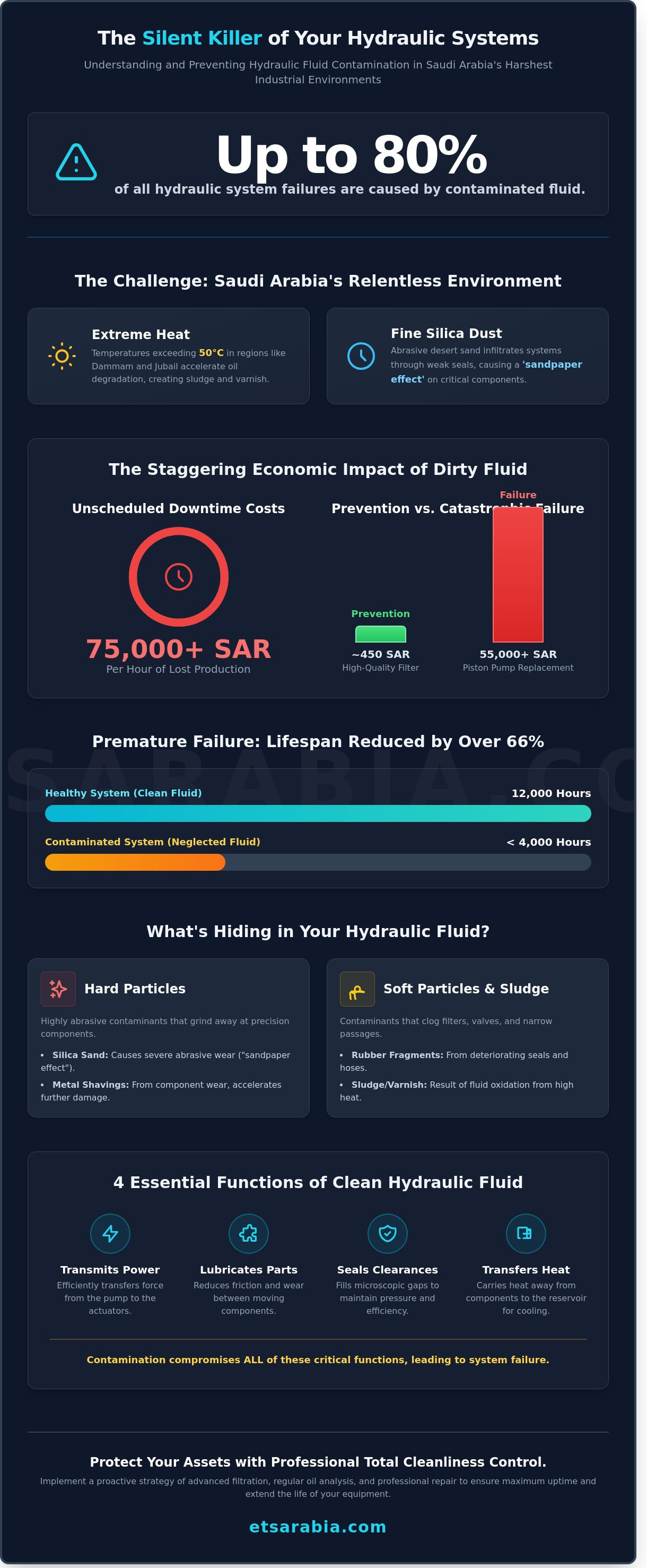
Did you know that 80% of all hydraulic system failures are caused by poor oil quality? In the industrial hubs of Dammam and Jubail, fine silica dust and extreme heat above 50°C create a relentless environment for your machinery. These harsh conditions often lead to unscheduled downtime that can cost a facility over 75,000 SAR for every hour the line stays silent. You understand that maintaining system pressure and protecting expensive seals is vital for your daily targets. It's frustrating to watch efficiency drop when you need peak performance most.
This article explains exactly what causes hydraulic fluid contamination so you can stop reacting to breakdowns and start preventing them. You'll learn to identify the specific sources of dirt, water, and heat-related sludge that threaten your equipment. We also provide a clear prevention strategy and introduce you to reliable local repair experts who ensure your operations stay in motion. By implementing these professional standards, you can maximize your productivity and extend the life of your critical assets.
Key Takeaways
- Understand why up to 80% of hydraulic system failures are linked to contamination and how this "silent killer" impacts your operational efficiency.
- Identify what causes hydraulic fluid contamination by categorizing the six primary types of hard and soft particulates that compromise industrial machinery.
- Learn to shield your systems from Saudi Arabia’s harsh environmental factors by pinpointing critical entry points and common human errors during fluid top-offs.
- Discover how to implement a multi-stage filtration strategy and regular oil analysis to establish a cleanliness baseline that ensures reliable performance.
- Explore the professional ETS approach to restoring damaged hardware, ensuring your components are fully recovered rather than just receiving a temporary fluid change.
What is Hydraulic Fluid Contamination and Why Does It Matter?
In industrial operations across Saudi Arabia, from the heavy fabrication shops in Dammam to the petrochemical complexes in Jubail, hydraulic systems drive productivity. What is Hydraulic Fluid? At its most basic level, it's the lifeblood of your machinery, responsible for transmitting power and protecting internal components. Contamination occurs when any foreign substance, whether solid, liquid, or gaseous, enters the fluid and impairs its ability to function as designed. Understanding what causes hydraulic fluid contamination is vital because even invisible particles can lead to catastrophic system failure. It's not just a maintenance issue; it's a direct threat to your operational continuity.
Technical experts often refer to contamination as the "silent killer" of hydraulic machinery. Data from the British Fluid Power Association suggests that 70% to 80% of all hydraulic system failures result directly from fluid contamination. These failures don't happen overnight. Instead, they manifest as a slow degradation of performance that eventually leads to a total halt. In the high-pressure environments typical of the Kingdom's oil and gas sector, even microscopic silt can bridge the gaps between moving parts, leading to abrasive wear. This process erodes the precision-engineered surfaces of your pumps and valves, making system health a top priority for any facility manager focused on reliability.
The impact on your Return on Investment (ROI) is substantial. When fluid is compromised, it acts like a grinding paste, accelerating wear on cylinders and motors. A pump that's designed to last 12,000 hours might fail in under 4,000 hours if the fluid is neglected. This premature aging forces companies into a cycle of reactive repairs rather than planned growth. Maintaining clean fluid is the most effective way to ensure reliable performance and minimize the risk of expensive, sudden breakdowns that compromise your project timelines.
The Economic Cost of Dirty Fluid
Unscheduled downtime in a Saudi industrial plant is expensive. For a mid-sized manufacturing facility, the cost of a halted production line can exceed 18,000 ﷼ per hour in lost output and idle labor. While a high-quality filter might cost 450 ﷼, replacing a damaged high-pressure piston pump can easily surpass 55,000 ﷼. There's also the hidden cost of energy efficiency. Particulate matter causes internal leakage in valves; a 5% drop in volumetric efficiency can increase annual electricity costs by over 2,500 ﷼ per machine due to the system working harder to maintain pressure.
The Role of Fluid in System Longevity
Fluid performs four essential tasks: it transmits power, lubricates moving parts, seals tight tolerances, and transfers heat to the reservoir. The ISO 4406 standard defines the cleanliness level of a fluid using a three-part code that represents the number of particles larger than 4, 6, and 14 microns found in a one-milliliter sample. To achieve maximum uptime, ETS recommends a strategy of "Total Cleanliness Control." This approach focuses on preventing contaminant entry and removing existing debris through rigorous filtration. By managing fluid health proactively, you protect your infrastructure and ensure your operations stay in motion without costly interruptions.
The 6 Primary Types of Hydraulic Fluid Contaminants
Understanding what causes hydraulic fluid contamination requires a precise look at the specific substances entering your system. In the industrial environments of Saudi Arabia, from the humid coastlines of Dammam to the arid heat of Riyadh, contaminants are rarely isolated. They interact, often accelerating the wear on pumps and valves. Identifying the exact nature of these pollutants is the first step toward maintaining a reliable system. Industry data suggests that nearly 80% of hydraulic component failures stem directly from fluid issues, making classification a critical skill for any maintenance team.
Particulate and Built-in Contamination
Solid matter is the most visible threat to system integrity. These contaminants are generally divided into three categories based on their hardness and origin. Hard particles, such as silica sand and metal shavings, are particularly destructive. In the local construction and mining sectors, fine desert sand often enters systems during filter changes or through damaged seals. These particles create a "sandpaper effect," grinding down internal surfaces and widening tolerances until the system loses pressure. Soft particles, including rubber fragments from deteriorating hoses or fibers from seals, might not scratch metal, but they are notorious for clogging fine orifices and sticking to valve spools.
Built-in contaminants are often overlooked because they exist before the machine even starts its first cycle. During the manufacturing or repair process, welding spatter, casting sand, and metal burrs can remain inside the reservoir or piping. If a system isn't properly flushed before commissioning, these "infant" contaminants can cause a catastrophic failure within the first 100 hours of operation. This is why a professional hydraulic system audit is essential for new installations to ensure all manufacturing debris is removed before it can circulate.
- Hard Particles: Metal wear debris, sand, and scale that cause abrasive wear.
- Soft Particles: Seal materials and hose polymers that lead to "stiction" in valves.
- Built-in Debris: Manufacturing leftovers that require high-velocity flushing to remove.
Liquid and Gaseous Contamination
Fluid-based contaminants often change the chemical properties of the oil itself. Water ingress is a frequent challenge in Saudi Arabia's coastal industrial zones. When moisture enters the reservoir, it leads to rust on precision-machined surfaces and promotes the formation of sludge. This moisture also depletes vital additives, reducing the oil's ability to protect against friction. Expert resources on Preventing Hydraulic Fluid Contamination suggest that keeping water levels below 100 ppm is vital for extending component life by up to 200%.
Air contamination is equally problematic, appearing as either entrained air or foam. This creates a "spongy" hydraulic response, where the system fails to move with precision. When air bubbles are compressed in a high-pressure pump, they implode, causing cavitation that pits metal surfaces and generates intense local heat. Chemical contamination occurs when the fluid is exposed to ambient temperatures exceeding 45°C, leading to oxidation. This thermal degradation turns the oil into a dark, acidic varnish that coats heat exchangers and reduces cooling efficiency. Identifying these chemical shifts early prevents a single 5,000 SAR pump repair from turning into a 50,000 SAR total system overhaul.
Effective contamination control isn't about general cleaning. It's about knowing exactly what causes hydraulic fluid contamination in your specific environment and deploying targeted filtration to stop it. Whether it's the silica of the desert or the humidity of the Gulf, your choice of defense must match the threat.
Common Sources: How Contaminants Enter Your System
Contaminants don't appear in a vacuum; they're introduced or generated through specific vulnerabilities in your industrial circuit. Understanding what causes hydraulic fluid contamination is the first step toward achieving the "Reliable Performance Guaranteed" promise that ETS delivers to its partners. In a typical Saudi Arabian industrial facility, the lifecycle of a contaminant begins at an entry point, accelerates through internal wear, and culminates in a system-wide failure if left unchecked. Research shows that 80% of hydraulic system failures stem directly from fluid issues, often costing local firms upwards of 45,000 SAR in unplanned downtime and component replacement.
Ingressed Contamination from the Environment
Environmental factors in the Eastern Province and Dammam region present unique challenges for hydraulic health. The fine silica sand prevalent in these areas often measures between 1 and 5 microns. These particles are small enough to pass through standard low-quality filters but large enough to bridge the critical clearances in high-pressure pumps. When cylinder seals wear down or harden due to the intense 45°C summer heat, they act like a vacuum, pulling this abrasive dust directly into the system with every stroke.
Humidity is another silent offender. In coastal industrial zones, humidity levels frequently exceed 85%. As temperatures drop during the night, the air inside the reservoir cools, causing moisture to condense on the tank walls. This water ingress reduces the fluid's lubricity and triggers a chemical breakdown of additives. Understanding the effects of contamination on hydraulic systems helps operators realize that even a small amount of water can lead to rust formation on precision-machined surfaces, creating a secondary source of hard particle debris.
Generated and Maintenance-Induced Contamination
Internal generation is a "chain reaction" of destruction. Once an initial particle enters the stream, it strikes metal surfaces, chipping off more microscopic fragments. These new particles then circulate to create even more wear. This cycle accelerates until a pump or valve suffers a catastrophic seizure. We've observed that a single unaddressed leak can lead to a 25% decrease in component lifespan within just six months of operation.
Human error during routine service is a primary driver of what causes hydraulic fluid contamination in many workshops. Many technicians mistakenly believe that "new" oil is clean oil. In reality, fresh hydraulic fluid delivered in a standard 208-liter drum typically has an ISO cleanliness code of 21/19/16. Most modern proportional valves require a much stricter 16/14/11 level. Adding unfiltered "new" oil directly to a reservoir is a guaranteed way to introduce thousands of harmful particles. Maintenance-induced issues also include:
- Using dirty funnels or galvanized buckets for fluid top-offs.
- Leaving hose ends unprotected during assembly or repair, allowing workshop grime to enter the bore.
- Using lint-producing rags to wipe down internal components during a rebuild.
- Failing to flush the system after a major component failure, leaving old debris to destroy the replacement part.
At ETS, we emphasize that a clean environment during repair is just as vital as the quality of the parts used. A single grain of sand can cause a 20,000 SAR pump to fail prematurely. By identifying these entry points and implementing strict handling protocols, your facility can significantly reduce the risk of costly interruptions and maximize the productivity of every machine in your fleet.
Prevention and Detection: Keeping Your Systems in Motion
Maintaining system integrity in the harsh Saudi Arabian climate requires more than standard maintenance. You must establish a baseline for fluid cleanliness using regular oil analysis to stop issues before they escalate. A single hour of unplanned downtime in a petrochemical facility or a construction site in Riyadh can cost upwards of 85,000 ﷼ in lost productivity. By implementing a multi-stage filtration strategy, you catch particles at every critical junction. This includes suction strainers to protect the pump, pressure filters for high-sensitivity valves, and return line filters to scrub fluid before it enters the reservoir again.
Identifying what causes hydraulic fluid contamination is only half the battle; the other half is rigorous exclusion. In regions like the Eastern Province, fine silica dust is a constant threat. You should upgrade to high-efficiency breathers and seals specifically designed for desert conditions. We also recommend a strict fluid transfer protocol using dedicated filter carts. Never pour oil directly from a drum into your machine. New oil often arrives with a cleanliness level of ISO 21/19/16, which is far too dirty for modern high-pressure systems. Finally, schedule a professional system flush after any major component failure. A pump blowout sends thousands of microscopic metal shards through your lines; if you don't remove them, your new pump will fail within 150 hours of operation.
Advanced Filtration and Sealing Solutions
Choosing the right micron rating is vital for component longevity. For systems with sensitive proportional valves, a 3-micron high-efficiency filter is the standard. In humid coastal areas like Jeddah, desiccant breathers are essential to prevent water ingress. These breathers use silica gel to strip moisture from the air before it reaches the reservoir. Using Parker or Rexroth high-performance seals ensures your system remains closed to external contaminants. These seals maintain their shape even when surface temperatures on heavy machinery exceed 70°C, providing a reliable barrier against fine sand and grit.
Oil Analysis and Monitoring
Reading a lab report correctly allows you to see the invisible threats inside your machines. Focus on the ISO 4406 particle count and water content measured in parts per million (ppm). If your water content exceeds 300 ppm, your oil's lubricity is compromised. On-site testing kits provide immediate results for daily checks, but quarterly laboratory testing offers a deeper look at wear metals like copper or iron. This data fuels predictive maintenance. By tracking trends, you can schedule a 12,000 ﷼ repair today instead of facing a 150,000 ﷼ total system overhaul next month. Understanding what causes hydraulic fluid contamination through these reports helps you adjust your filtration intervals based on actual data rather than guesswork.
Protect your equipment from costly failures by partnering with experts who understand the local industrial environment. Contact ETS for professional hydraulic maintenance solutions that keep your operations running at peak efficiency.
Professional Hydraulic Repair: When Contamination Causes Damage
Identifying what causes hydraulic fluid contamination is a critical first step, but it doesn't reverse the physical damage already inflicted on your hardware. When particulate matter enters a high-pressure system, it acts like an abrasive polishing compound. These microscopic contaminants score cylinder walls, pit valve seats, and erode pump vanes. Simply flushing the system and adding fresh oil won't fix these mechanical scars. If you ignore the underlying hardware damage, your new fluid will be contaminated by metal shavings from the damaged components within hours of operation. This creates a destructive cycle that leads to total system failure and expensive unscheduled downtime.
At Emdad Technical Services (ETS), we take a comprehensive approach to restoration. We recognize that 80 percent of hydraulic component failures are directly linked to fluid health. Our technicians don't just replace parts; they analyze the wear patterns to confirm what causes hydraulic fluid contamination in your specific application. This diagnostic depth allows us to provide solutions that prevent the same failure from happening twice. By restoring components to their original tolerances, we help Saudi Arabian industrial facilities avoid the massive capital expenditure of purchasing entirely new systems.
Cylinder and Pump Restoration
Precision is the core of our repair process. When a cylinder rod is scratched, it destroys the seal every time it cycles. Our Dammam facility utilizes advanced honing and industrial re-chroming to restore surface finishes to a precise 0.4 micron rating. This smooth finish is essential for maintaining a tight seal and preventing external leaks. After restoration, we perform seal replacements using high-performance fluorocarbon or nitrile materials suited for the intense heat of the Eastern Province. Every repaired component undergoes a static and dynamic pressure test at 110 percent of its rated capacity to guarantee performance before it leaves our shop.
For operations with unique requirements, we provide custom HPU (Hydraulic Power Unit) fabrication. These systems are designed with integrated contamination control, featuring high-efficiency beta-rated filters and desiccant breathers. A custom-built HPU from ETS can reduce your long-term maintenance costs by 30 percent compared to standard off-the-shelf units that aren't optimized for the dusty, humid conditions found in Dammam 2nd Industrial City.
Partnering with ETS for Industrial Support
Reliability is the foundation of our "Expertise You Can Trust" brand promise. We understand that in sectors like oil and gas or construction, a downed machine can cost upwards of 12,000 SAR per hour in lost productivity. Our rapid response team in Dammam 2nd Industrial City is positioned to provide immediate diagnostic support and fast-track repairs. We don't believe in temporary fixes. We focus on long-term reliability by using only genuine spare parts from global leaders like Rexroth, Eaton, and Parker. Using authentic components ensures that your system operates at its peak design efficiency and maintains its safety certifications.
Our relationship with our clients doesn't end when the repair is finished. We provide detailed reports and oil analysis data to help your team maintain the ISO 4406 cleanliness levels required for modern machinery. Choosing ETS means choosing a partner dedicated to keeping your operations moving forward with minimal interruptions. We combine local market knowledge with global technical standards to deliver the most reliable hydraulic services in the Kingdom.
Protect Your Operations From Silent System Killers
Understanding what causes hydraulic fluid contamination is the first step toward protecting your industrial investment. Research indicates that up to 80% of hydraulic failures stem directly from fluid impurities. You've seen how built-in debris, generated wear, and environmental ingression compromise your equipment's efficiency. Don't wait for a total system seizure to take action. Our specialized repair facility in Dammam provides expert diagnostic services and custom HPU fabrication designed for the harsh 50°C environments common across Saudi Arabia. As an authorized distributor for global leaders like Rexroth and Parker, we supply the precision components needed to maintain ultra-clean fluid standards. We help you maintain 100% operational readiness by addressing the root causes of component wear before they lead to expensive repairs. Trust our engineering team to keep your heavy machinery in motion with the reliability your business demands. Our local expertise ensures your systems stay productive and efficient year-round.
Minimize your downtime; schedule a professional hydraulic system check-up with ETS today
Frequently Asked Questions
How can I tell if my hydraulic fluid is contaminated without a lab test?
You can identify contamination through visual inspection and changes in system performance. Milky or cloudy fluid indicates water ingress, while a dark color and a burnt odor signify thermal degradation or aeration. If your pumps are 15% louder than usual or you notice jerky cylinder movements, particulate matter is likely present. These indicators serve as early warnings to prevent the 80% of system failures caused by fluid issues.
Is new hydraulic fluid clean enough to use straight from the drum?
No, new hydraulic fluid is rarely clean enough for immediate use in high-pressure systems. Typical fluid from a drum has an ISO 4406 cleanliness level of 21/19/16, which is significantly dirtier than the 16/14/11 level required by modern piston pumps. You must always filter new oil through a 10-micron kidney loop system before it enters your reservoir to ensure long-term component reliability and system health.
What is the most common cause of hydraulic pump failure?
Particle contamination is responsible for 75% of all hydraulic pump failures in industrial applications. Understanding what causes hydraulic fluid contamination is vital because even particles as small as 5 microns can erode internal valve clearances. These microscopic solids create a chain reaction of wear where one particle generates three more; eventually leading to catastrophic pump seizure and expensive operational downtime for your facility.
How often should I change my hydraulic filters in a high-dust environment?
In high-dust environments like Riyadh or the Eastern Province, you should replace filters every 500 operating hours or when the differential pressure indicator hits the 80% mark. Waiting for a scheduled annual maintenance is risky in Saudi Arabia's desert conditions. High ambient dust increases the ingression rate through breather caps, so monitoring your filter's bypass indicator daily is a mandatory practice for maintaining peak performance.
What does "cavitation" mean and is it caused by contamination?
Cavitation is the formation and subsequent collapse of vapor bubbles within the fluid, which creates micro-jets that pit metal surfaces. While it's often a mechanical issue, contamination is a frequent root cause. A clogged suction strainer, blocked by particulate matter, restricts flow and creates the vacuum necessary for cavitation. This process can destroy a 5,000 ﷼ pump in less than 48 hours of continuous operation.
Can I mix different brands of hydraulic fluid if they have the same viscosity?
You shouldn't mix different brands even if the ISO VG 46 or 68 viscosity grades match. While the base oils might be compatible, the additive packages often aren't. Mixing brands can lead to chemical reactions that cause 10% of the additives to drop out of the solution as silt. This sludge clogs fine filters and reduces the fluid's anti-wear properties, compromising your system's guaranteed performance and reliability.
What are the signs of water contamination in a hydraulic system?
The most obvious sign of water contamination is a milky or opaque appearance in the fluid. You'll also notice rust on internal components and a 20% increase in fluid compressibility, which makes the system feel spongy. Water reduces the lubricating film strength by 50%, leading to rapid bearing wear. If your fluid looks like a latte, it's time to use a vacuum dehydrator to remove the moisture immediately.
How does extreme heat in Saudi Arabia affect hydraulic fluid life?
Extreme temperatures in Saudi Arabia, often exceeding 45°C, accelerate the oxidation process of hydraulic fluid. According to the Arrhenius law, the service life of oil is halved for every 10°C increase in temperature above 60°C. In local operations, fluid running at 85°C will degrade 4 times faster than at 65°C. This thermal stress is a major factor in what causes hydraulic fluid contamination through the formation of varnish and sludge.