

In the high-stakes environment of industrial operations across Saudi Arabia, a flawless startup is non-negotiable. The pressure to commission a new hydraulic system quickly can lead to overlooked steps, resulting in premature component failure, costly downtime, and significant safety risks. Without a reliable, standardized procedure, your team is left navigating this critical phase with uncertainty. That is why having an expert-developed hydraulic system commissioning checklist 2026 is essential to protect your investment and ensure operational readiness from day one.
This definitive guide provides the solution. Engineered by the experts at Emdad Technical Services, this checklist offers a clear, step-by-step process to guarantee your commissioning is safe, efficient, and compliant with the latest industry standards. Follow our proven methodology to achieve maximum system reliability, extend the life of your equipment, and generate the complete documentation needed for compliance and handover. Move forward with the confidence that every critical check has been performed to perfection, minimizing risk and optimizing performance.
Key Takeaways
- Master the pre-commissioning and static check phases to identify and resolve potential issues before they lead to significant downtime and costly repairs.
- Understand why a meticulous system flushing and fluid conditioning process is the most critical step for guaranteeing long-term hydraulic system reliability and performance.
- Follow our comprehensive hydraulic system commissioning checklist 2026 to execute a structured, five-phase process that ensures safety and operational excellence from start to finish.
- Prepare your systems for the future by integrating 2026 best practices, including data-driven testing and readiness for predictive maintenance technologies.
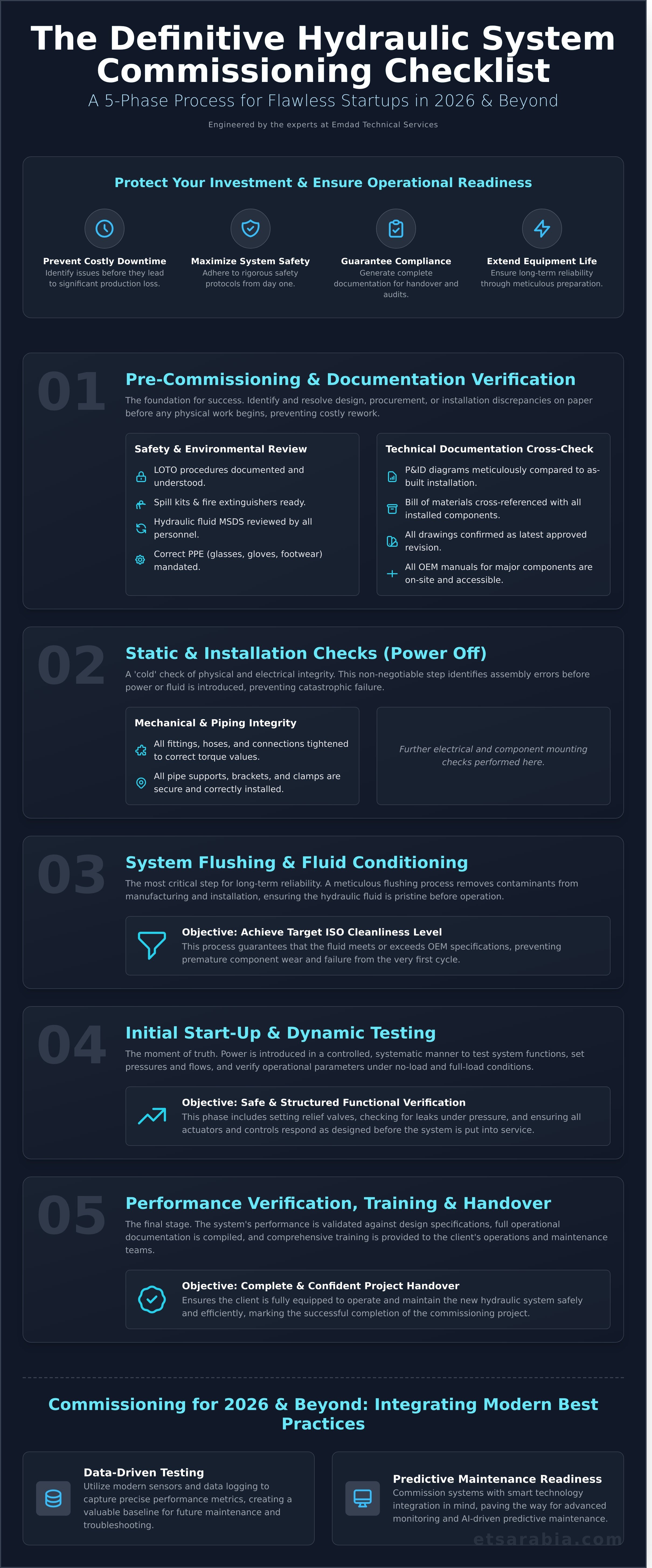
Phase 1: Pre-Commissioning and Documentation Verification
The foundation of a flawless hydraulic startup is built not with tools, but with meticulous verification. This initial phase is dedicated to ensuring everything is correct on paper before any physical work commences. The primary goal is to identify and resolve any design, procurement, or installation discrepancies early, thereby preventing costly rework and significant delays that can run into thousands of Saudi Riyals (SAR). Executing this stage with precision is the first critical step in our comprehensive hydraulic system commissioning checklist 2026.
At Emdad Technical Services, safety is the paramount priority from the very beginning. This phase establishes the documented safety and technical framework that guarantees a smooth, efficient, and traceable commissioning process, setting the standard for the entire project and minimizing operational downtime before the system is even energized.
Safety and Environmental Review
A safe work environment is non-negotiable. Before proceeding, our experts conduct a thorough review to confirm all safety and environmental protocols are rigorously established. This proactive step is essential for protecting personnel, equipment, and compliance with local Saudi Arabian regulations.
- LOTO Procedures: Confirm all Lock-Out/Tag-Out (LOTO) procedures are documented, clearly understood, and available for all relevant equipment.
- Emergency Equipment: Verify the strategic placement and full operational readiness of spill containment kits and appropriate fire extinguishers.
- Fluid Handling: Review the Material Safety Data Sheets (MSDS) for the specified hydraulic fluid to ensure all personnel are aware of handling requirements and potential hazards.
- Personal Protective Equipment (PPE): Mandate and verify that every individual on site is equipped with the necessary PPE, including safety glasses, reinforced gloves, and protective footwear.
Technical Documentation Cross-Check
Accuracy in documentation is critical to operational success. This step involves a detailed "paper-to-plant" comparison to ensure the engineered design has been perfectly translated to the physical installation. This detailed review requires a firm grasp of the project's design intent and the core principles of hydraulics to effectively identify potential issues.
- P&ID vs. As-Built: Meticulously compare Piping and Instrumentation Diagrams (P&IDs) with the physical installation, documenting any deviation for immediate rectification.
- Component Verification: Cross-reference the bill of materials and component lists against installed parts to ensure every pump, valve, and hose meets exact project specifications.
- Drawing Revisions: Confirm that all electrical, mechanical, and control system drawings are the latest approved revision to prevent errors based on outdated information.
- Vendor Manuals: Ensure all original equipment manufacturer (OEM) manuals for major components are collated, on-site, and accessible to the commissioning team.
Phase 2: Static and Installation Checks (Power Off)
Before introducing a single drop of fluid or an amp of power, this critical phase focuses on the physical and electrical integrity of the entire installation. These 'cold' checks are a non-negotiable part of our hydraulic system commissioning checklist 2026, designed to identify and rectify assembly errors before they can lead to catastrophic failure and extended operational downtime. While this guide provides a robust framework, industry best practices emphasize the importance of developing equipment-specific commissioning procedures to address the unique complexities of your machinery. The objective here is simple: confirm that what was designed has been built and installed correctly.
Mechanical and Piping Integrity Checks
A meticulous physical inspection guarantees the system's mechanical soundness from the reservoir to the final actuator. This step prevents leaks, vibration issues, and contamination from the outset.
- Fittings and Connections: Verify all welds, fittings, hoses, and connections are built to specification and tightened to the correct torque values. Check for any signs of stress or improper routing.
- Supports and Clamps: Ensure all pipe supports, brackets, and clamps are secure and correctly spaced to prevent vibration and mechanical stress during operation.
- Reservoir Cleanliness: Visually inspect the hydraulic reservoir internally to confirm it is completely clean and free from any manufacturing debris, rust, or contaminants.
- Instrumentation: Confirm that all pressure gauges, temperature sensors, flow meters, and other instruments are installed in the correct locations and orientations as per the hydraulic schematic.
Electrical and Control System Checks
Electrical safety and control system reliability are paramount. All checks must be performed with the main power locked out and tagged out (LOTO) to ensure personnel safety and prevent accidental startup.
- Wiring Verification: Meticulously check all electrical wiring against the design drawings. Ensure compliance with all relevant local electrical codes and standards in Saudi Arabia.
- Grounding and Bonding: Confirm that all electrical components, motors, and structural frames are properly grounded and bonded to prevent electrical hazards.
- Emergency Stops: Verify all emergency stop buttons and safety circuits are correctly wired, physically accessible, and clearly marked.
- Motor Insulation Test: Perform an insulation resistance (megohmmeter) test on all electric motor windings to detect any insulation breakdown before applying power.
Component Verification
Each major component must be verified for correct installation to prevent premature wear and ensure it functions as designed. An incorrectly installed component can cause immediate system failure upon startup.
- Pump/Motor Alignment: Check the alignment between the electric motor and the hydraulic pump. Misalignment is a primary cause of premature bearing failure and seal leaks.
- Valve Positions: Ensure all directional control valves, shut-off valves, and relief valves are set to their correct default or neutral positions for a safe initial startup.
- Filter Installation: Verify all hydraulic filters are installed with the correct filter element (correct micron rating) and in the proper flow orientation.
- Accumulator Safety: Confirm accumulators are installed correctly with functioning safety and bleed-down blocks, and that pre-charge pressure is verified against system specifications.
Phase 3: System Flushing and Fluid Conditioning
This phase is one of the most critical for guaranteeing long-term system reliability and is a non-negotiable component of any professional hydraulic system commissioning checklist 2026. The primary objective is to purge the system of all contaminants introduced during manufacturing, storage, and installation. These contaminants-including metal shavings, weld slag, dust, and sealant tape-can cause catastrophic failures in sensitive components, leading to unplanned downtime and costly repairs. A meticulous flushing process ensures the hydraulic fluid starts clean and stays clean, protecting your investment from day one.
Flushing Procedure Setup
Executing a successful system flush requires a methodical approach and specialized equipment to ensure efficiency and effectiveness. For optimal results, an external flushing rig is strongly recommended. This allows for high-velocity, turbulent flow that is powerful enough to dislodge stubborn contaminants from pipe walls and system reservoirs. The setup process is designed to protect your most valuable components while cleaning the rest of the circuit.
- Install Component Bypasses: Sensitive components such as servo valves, proportional valves, actuators, and motors must be bypassed using dedicated jumper hoses or blocks. This prevents high-velocity fluid and dislodged debris from causing irreversible damage.
- Employ External Filtration: Use high-capacity filter carts with high-efficiency (low micron rating) elements to capture contaminants. These external units are more effective than the system's own filters for this intensive cleaning task.
- Flush Systematically: Do not attempt to flush the entire system at once. Isolate and flush each circuit and sub-circuit independently to ensure targeted, high-velocity flow is achieved throughout the entire network of pipes and hoses.
Monitoring and Verification
Flushing is not a time-based procedure; it is a goal-oriented one. The process is complete only when the hydraulic fluid meets a pre-determined cleanliness standard. This is verified through precise measurement and documentation. Regular fluid samples must be taken from designated sample points and analyzed using a particle counter. The results are compared against the target cleanliness level specified by the component manufacturers, typically defined by an ISO 4406 cleanliness code. Flushing continues until this target is consistently achieved and maintained. All sample results, flushing durations, and procedural notes must be carefully documented as proof of a successful commissioning phase. Need expert flushing services or fluid analysis? Contact ETS.
Phase 4: Initial Start-Up and Dynamic Testing
This phase marks the critical transition from static checks to a live, powered system. All activities are performed under no-load or low-load conditions to minimize risk and ensure maximum control. The primary focus is on safety, methodical procedure, and establishing initial operating parameters without subjecting components to full operational stress. A disciplined approach here is essential to prevent pressure spikes, premature component wear, and costly damage. Following these steps is a cornerstone of any professional hydraulic system commissioning checklist 2026, guaranteeing a safe and efficient start-up.
First System Start (Jogging)
The very first introduction of power must be executed with extreme caution. This "jogging" process confirms fundamental settings and prepares the system for continuous operation. Our expert technicians ensure every step is meticulously followed to protect your investment.
- Set Relief Valves: Before start-up, ensure all pressure relief valves are backed off to their minimum pressure setting. This is a critical safety measure to prevent system over-pressurization.
- Confirm Motor Rotation: Briefly ‘jog’ the electric motor to verify its direction of rotation matches the arrow on the hydraulic pump. Incorrect rotation can cause immediate and severe pump damage.
- Fill and Vent System: Fill the reservoir with new, clean hydraulic fluid that has been filtered to the system’s required ISO cleanliness code. Systematically vent air from all high points, including cylinders and filter housings, to prevent cavitation and ensure smooth actuator movement.
Pressure and Flow Adjustments
With the system running, the next step is to gradually bring it to its designed operating parameters. This process is done incrementally while closely monitoring system feedback. The goal is to achieve stable pressure and flow without any leaks or temperature anomalies, a key part of a successful commissioning.
- Gradual Pressurization: Slowly increase the pressure relief valve settings, observing the pressure gauges to ensure a controlled rise to the specified no-load pressure.
- Valve Calibration: Set and verify the operational settings for all pressure control, flow control, and directional valves as per the hydraulic schematic.
- Leak Detection: Conduct a thorough inspection of all fittings, hoses, and component seals for any external fluid leaks. Simultaneously, check for internal leaks by observing for cylinder drift or unintended motor creep.
- Temperature Monitoring: Keep a close watch on the hydraulic fluid temperature. Ensure it stabilizes within the optimal design range and confirm that cooling systems are functioning correctly.
No-Load Function Testing
Once initial pressures are set, every function of the system must be tested without any external load. This step validates the control logic, safety circuits, and mechanical operation of all actuators, ensuring the system behaves predictably before it is asked to perform work.
- Cycle All Actuators: Operate all cylinders, motors, and other actuators through their full range of motion several times. Listen for unusual noises and watch for any signs of erratic movement or binding.
- Test Control Sequences: Verify that all automated sequences and control interlocks function correctly. Test both manual and automatic modes to confirm the system logic is flawless.
- Verify Safety Features: Manually trigger all safety devices, including emergency stops and pressure-activated switches, to guarantee they operate as designed and bring the system to a safe state.
- Check for Noise and Vibration: Listen carefully for abnormal sounds like pump whining or valve chatter. Check for excessive vibration in pumps, motors, and tubing, which can indicate alignment issues or cavitation.
Phase 5: Performance Verification, Training, and Handover
The final phase of commissioning is where theoretical design meets operational reality. This is the critical stage where the system is proven to perform under real-world conditions, ensuring it meets all design specifications and is ready for productive use. This phase is the culmination of the hydraulic system commissioning checklist 2026, transforming a newly installed system into a fully operational, reliable asset. The goal is a seamless transition, empowering your team with the knowledge and documentation needed for long-term success and minimizing future downtime.
Load Testing and Performance Tuning
Once the system is verified as safe and leak-free, we begin performance validation. This involves methodically applying working loads, gradually increasing to the system's maximum design capacity. Throughout this process, our expert technicians record key performance indicators such as cycle times, operating pressures, and fluid temperatures. This data allows us to fine-tune valve settings and system parameters, optimizing for both efficiency and performance. The system is then run for a sustained period to verify thermal stability, ensuring it can handle continuous operation without overheating or performance degradation.
Operator and Maintenance Training
A high-performance hydraulic system is only effective if your team can operate and maintain it correctly. We provide comprehensive, on-site training for both operators and maintenance personnel. This knowledge transfer covers correct startup, shutdown, and emergency procedures, as well as the function of all key components. We equip your maintenance team with detailed lubrication schedules, service point locations, and troubleshooting guides. This proactive approach ensures safe operation and empowers your staff to maintain peak system reliability.
Final Documentation and Handover
The formal handover completes the commissioning process. Emdad Technical Services provides a complete documentation package that serves as the official record of the system's health and performance. This comprehensive dossier is a key deliverable that guarantees transparency and provides a vital resource for the life of the equipment. The package includes:
- All load test records, pressure/temperature logs, and calibration certificates.
- Finalized as-built P&ID (Piping and Instrumentation Diagram) and electrical schematics.
- A complete maintenance manual and recommended spare parts list.
- Fluid cleanliness and flushing data certificates.
Upon delivery and review of this package, we obtain a formal sign-off from you, the client. This signature confirms that the system has met all performance criteria and marks the successful completion of the project. For expert support through every phase of hydraulic commissioning, contact the specialists at ETS.
Commissioning for 2026 and Beyond: Integrating Modern Best Practices
The landscape of industrial hydraulics is rapidly evolving, driven by digital technology and higher operational standards. A successful startup in 2026 is no longer just about mechanical integrity; it demands a forward-thinking approach focused on data, long-term efficiency, and predictive intelligence. By integrating modern best practices, you future-proof your investment, significantly reduce the total cost of ownership, and position your operations for unparalleled safety and performance. This final stage transforms a standard procedure into a strategic advantage.
Digital Integration and IIoT
In the era of Industry 4.0, your hydraulic system must function as an intelligent, connected asset. Verification of its digital nervous system is critical for optimizing performance and minimizing downtime. Our expert process ensures:
- Sensor Verification: All Industrial Internet of Things (IIoT) devices, including pressure, temperature, and flow sensors, are correctly installed, calibrated, and communicating.
- Data and Monitoring Tests: We test and confirm the reliability of data logging systems and remote monitoring capabilities, ensuring you have real-time visibility into system health.
- Control System Integration: Seamless integration with your plant's central SCADA or DCS is verified, allowing for unified operational control.
- Predictive Alerts: Initial alert thresholds for key predictive maintenance indicators (e.g., fluid contamination, filter pressure drop) are established to pre-empt failures.
Enhanced Safety and Compliance
Operational safety and regulatory adherence are non-negotiable pillars of modern industry in Saudi Arabia. A comprehensive hydraulic system commissioning checklist 2026 must prioritize the verification of advanced safety protocols and documentation. This step provides peace of mind and safeguards your personnel and assets.
- Standards Adherence: We ensure full compliance with the latest versions of critical international standards, such as ISO 4413 (Safety requirements for hydraulic systems).
- Formal Risk Assessment: A documented risk assessment of the newly commissioned system is conducted to identify and mitigate potential hazards.
- Component Verification: The correct performance of modern safety components, like safety-rated proportional valves and emergency stop circuits, is rigorously tested.
- Compliance Documentation: All compliance activities are meticulously documented to satisfy regulatory bodies and insurance providers.
By adopting these advanced commissioning principles, you are not merely starting up a machine; you are launching a highly efficient, safe, and intelligent asset built for the demands of tomorrow. To ensure your hydraulic systems deliver reliable performance from day one, partner with the experts. Contact Emdad Technical Services to guarantee your operations are moving forward with confidence.
Your Partner in Flawless Hydraulic Commissioning
A successful hydraulic system launch is the bedrock of long-term operational excellence. It guarantees peak performance, enhances safety, and prevents the costly downtime that can impact your bottom line. As this guide has shown, achieving this requires a meticulous, phase-by-phase approach, from initial documentation checks to final performance verification. Using a detailed hydraulic system commissioning checklist 2026 is not just best practice-it is a strategic investment in the future reliability and efficiency of your critical assets.
Executing this complex process requires more than a checklist; it demands hands-on expertise. For businesses across Saudi Arabia, particularly in the demanding oil & gas and manufacturing sectors, Emdad Technical Services (ETS) is the trusted partner for flawless commissioning. Our specialists provide comprehensive support, from component supply to full system handover, with expert technicians ready for on-site deployment. We ensure your system is not just running, but optimized for peak performance from day one. Need expert support for your next commissioning project? Contact ETS today.
Frequently Asked Questions
What is the most common mistake made during hydraulic system commissioning?
The most common and costly mistake is inadequate system flushing. Many teams, under pressure to meet deadlines, fail to properly remove contamination from new pipes, hoses, and components. This initial debris can cause immediate damage to sensitive parts like servo valves and pumps, leading to premature failure and significant operational downtime. A meticulous approach to fluid cleanliness from day one is non-negotiable for ensuring long-term system reliability and performance in demanding industrial environments across Saudi Arabia.
How long does a typical hydraulic commissioning process take?
The duration of hydraulic commissioning varies significantly based on system complexity and scale. A small, straightforward system might take only a few days. However, for large-scale industrial systems common in Saudi Arabia's petrochemical or manufacturing sectors, the process can extend from one to several weeks. Factors like the length of pipework requiring flushing, the number of actuators to be tested, and the stringency of performance verification all influence the final timeline. Proper planning is key to optimizing this schedule.
What is the required ISO 4406 fluid cleanliness code for a new hydraulic system?
The required ISO 4406 code is determined by the most sensitive component in your system. For systems with standard gear pumps and motors, a code of 20/18/15 might be acceptable. However, for high-performance systems with servo or proportional valves, a much stricter code, such as 16/14/11, is often required. Always consult the OEM specifications for each component. Our hydraulic system commissioning checklist 2026 emphasizes verifying these targets before introducing fluid to critical components.
What are the biggest safety risks during hydraulic system startup?
The primary safety risks involve the uncontrolled release of high-pressure energy. This includes high-velocity fluid injection injuries from pinhole leaks, which can be severe, and the violent failure of improperly installed hoses or fittings. Another major risk is unexpected or rapid movement of actuators and machinery if controls are not properly isolated and tested. Adhering to strict Lockout/Tagout (LOTO) procedures and wearing appropriate Personal Protective Equipment (PPE) is absolutely critical for all personnel involved.
Can I perform commissioning without specialized equipment like a flushing rig?
While basic commissioning is technically possible, attempting it without specialized equipment like a high-velocity flushing rig and a particle counter is strongly discouraged. Using the system's own pumps for flushing is inefficient and risks circulating contaminants through new, expensive components. Investing in or hiring proper equipment ensures the system is cleaned to the correct ISO standard, preventing premature wear and future repair costs that could easily exceed thousands of Saudi Riyal (SAR) in parts and lost production.
What key documentation should be included in the final handover package?
A comprehensive handover package is crucial for long-term operational success. It must include the final signed-off hydraulic system commissioning checklist 2026, "as-built" P&ID schematics, and all equipment datasheets. Also essential are the final fluid cleanliness analysis reports (ISO 4406), a log of all final pressure and flow settings, and a recommended preventative maintenance schedule. This complete documentation ensures your maintenance team has the reliable information needed to optimize system performance.