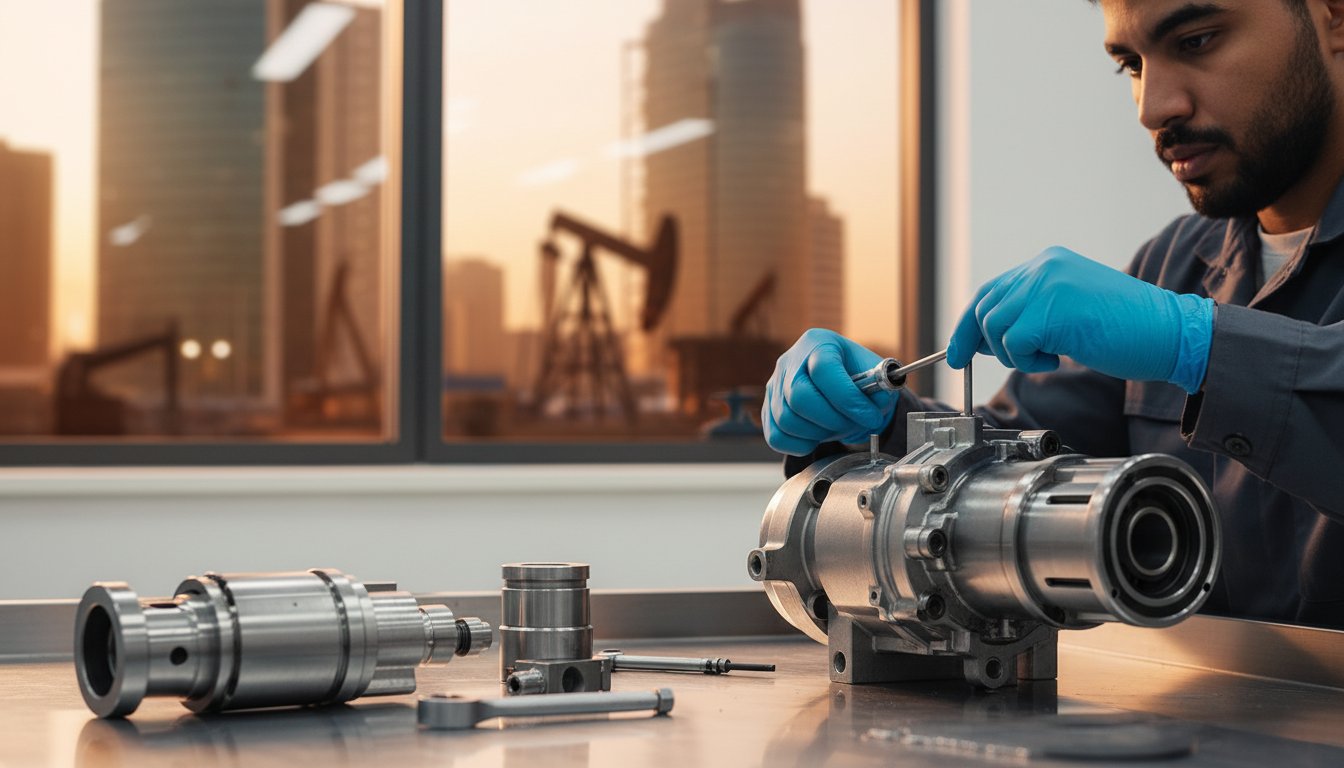
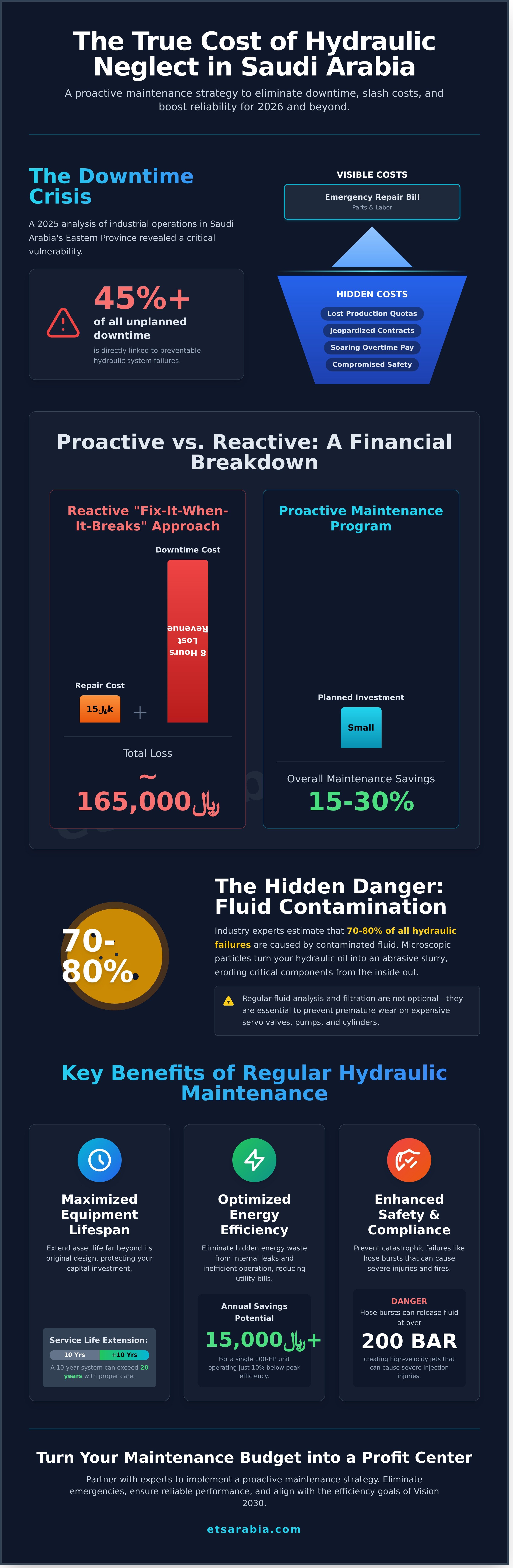
A 2025 analysis of industrial operations in Saudi Arabia's Eastern Province revealed a startling fact: over 45% of all unplanned downtime is directly linked to hydraulic system failures that could have been prevented. You've likely felt the impact firsthand. An unexpected breakdown leads to frantic calls for emergency parts, soaring costs in Saudi Riyal, and production schedules that spiral out of control, jeopardizing critical client contracts.
This article will shift your perspective from reactive repair to proactive control. We will detail the strategic benefits of regular hydraulic maintenance, showing you exactly how to eliminate these emergency shutdowns, slash repair costs, and significantly extend the lifespan of your critical machinery, even in the Kingdom's demanding climate. We'll break down the financial, operational, and safety advantages that a scheduled maintenance program delivers, providing a clear roadmap to achieving maximum ROI and predictable performance in 2026.
Key Takeaways
- Understand why the visible repair bill is only the tip of the iceberg, and learn to calculate the hidden costs of unplanned downtime in Saudi Riyal (SAR).
- Discover the primary benefits of regular hydraulic maintenance, from extending equipment lifespan beyond its design to optimizing energy efficiency for significant cost savings.
- Implement specific strategies to protect your hydraulic systems from the harsh Saudi climate, combating the damaging effects of extreme heat and dust common in Dammam.
- Learn how a proactive maintenance partnership turns your budget into a profit center, eliminating costly emergency repairs and ensuring reliable operational performance.
Understanding the True Cost of Hydraulic Neglect
In the high-stakes industrial environments of Saudi Arabia, from Dammam's manufacturing hubs to Jubail's petrochemical plants, hydraulic systems are the lifeblood of production. Ignoring their upkeep is not a cost-saving measure; it’s a high-interest liability. The true cost of hydraulic neglect is an iceberg. The visible tip is the emergency repair bill, but beneath the surface lies the massive, unseen cost of unplanned downtime, lost production quotas, and compromised safety. One of the primary benefits of regular hydraulic maintenance is transforming this unpredictable liability into a manageable, predictable operational expense.
Consider a minor hose leak, seemingly insignificant. Left unchecked, this small drip can escalate into a catastrophic system-wide pressure loss. This isn't just a component failure; it’s a direct violation of fundamental Hydraulic engineering principles that govern your machinery's power and precision. As Saudi Arabia's industrial sector advances towards the efficiency and safety goals of Vision 2030, meeting stringent 2026 standards will demand a proactive, not reactive, approach to asset management.
Proactive vs. Reactive: A Shift in Mindset
Waiting for a critical pump to fail during a peak production run is the most expensive way to manage a plant. A reactive repair might cost ﷼15,000 for the part and labor, but the resulting 8 hours of downtime could represent over ﷼150,000 in lost revenue. The shift from "fixing" to "preserving" assets is crucial. It’s about investing a small, planned amount now to prevent a large, unplanned catastrophe later. Industry data consistently shows that a well-implemented preventive maintenance program can reduce overall maintenance costs by 15-30% compared to a reactive strategy.
The Hidden Dangers of Fluid Contamination
It’s a startling fact: industry experts estimate that 70-80% of all hydraulic system failures are a direct result of fluid contamination. Your hydraulic fluid isn't just a liquid; it’s a power transmission medium. When contaminated with microscopic particles-often smaller than a red blood cell-it becomes an abrasive slurry. These particles can score the inside of a high-precision servo valve, leading to internal leakage, reduced efficiency, and eventual failure. Regular fluid analysis and filtration prevent this internal component "erosion," safeguarding your most critical and expensive parts from premature wear.
The 5 Primary Benefits of Regular Hydraulic Maintenance
Proactive hydraulic care is not an expense; it’s a strategic investment that delivers quantifiable returns. Shifting from a reactive "fix-it-when-it-breaks" model to a scheduled maintenance program generates significant operational advantages. The core benefits of regular hydraulic maintenance extend far beyond simply preventing failures. They directly impact your bottom line, enhance workplace safety, and secure the long-term value of your capital assets. Let’s explore the five primary advantages that facilities in Saudi Arabia gain from a disciplined approach.
1. Maximized Equipment Lifespan
Hydraulic systems are built to last, but their operational life is determined by maintenance quality. A system designed for a 10-year service life can reliably perform for over 20 years with a proper preventive care plan. This isn't just about avoiding catastrophic failure. It’s about protecting core components from accelerated degradation. Contaminated fluid, for example, acts like liquid sandpaper on expensive chrome-plated rods and precision-honed cylinder tubes, causing scoring that leads to seal failure and costly downtime. A simple, consistent lubrication schedule has been shown to double the functional life of critical pivot points on heavy machinery, preventing seizure and wear that would otherwise require complete replacement costing thousands of riyals.
2. Optimized Energy Efficiency
Your hydraulic system can be a hidden source of energy waste. Internal leaks, incorrect pressure settings, or fluid that has lost its viscosity forces the system's pump to work harder, consuming excess electricity. This inefficiency is rarely obvious until it shows up on your utility bill. A system operating just 10% below its optimal efficiency can waste over 15,000 SAR in electricity annually for a single 100-horsepower unit. Regular maintenance ensures your system operates at peak pressure and flow, minimizing power consumption and reducing operational costs month after month.
3. Enhanced Safety and Environmental Compliance
The most critical benefit is protecting your team. A sudden hydraulic hose burst can release fluid at over 200 bar, creating a high-velocity spray that can cause severe injuries or fires. Even a pinhole leak, nearly invisible to the naked eye, can inject fluid through skin, a severe medical emergency detailed in expert resources on Hydraulic System Safety and Maintenance.
In demanding environments like Dammam's industrial zones, this focus on safety is paramount. Proactive maintenance prevents these accidents and ensures environmental compliance. An uncontained fluid spill can result in fines from the National Center for Environmental Compliance (NCEC) exceeding 50,000 SAR, not including cleanup costs. Adherence to international standards like ISO 4413 for hydraulic system reliability is essential for both safety and securing high-value contracts.
4. Predictable and Controlled Budgeting
Emergency repairs create financial chaos. An unexpected cylinder failure can generate an invoice for 10,000 SAR or more, completely disrupting your quarterly budget. Regular maintenance transforms these unpredictable emergency spikes into manageable, planned expenditures. You move from chaotic, high-cost repairs to a fixed, predictable maintenance line item. For example, an emergency hose replacement might cost 3,000 SAR including lost production time, while a planned replacement during a scheduled service costs less than 800 SAR. This financial stability allows for more accurate forecasting and resource allocation.
5. Preservation of High Resale Value
When it's time to upgrade or sell heavy equipment, a detailed service history is your most valuable asset. A complete logbook demonstrating consistent, professional maintenance is proof of the equipment's condition and reliability. In the competitive Saudi market, heavy equipment with meticulous service records, like those provided by our comprehensive maintenance programs, can command a 15-20% higher resale price than a comparable unit with no documented history. This preserved value directly translates to a higher return on your initial investment.
Calculating ROI: Why Maintenance is a Profit Center
Shifting your perspective on hydraulic system care is critical. Don't view it as an operational expense; see it as a high-return investment. The most significant benefits of regular hydraulic maintenance are not just about preventing failures, they are about actively generating profit by eliminating quantifiable losses. Every Riyal spent on a proactive maintenance program with ETS returns multiples in saved downtime, energy, and component costs.
Consider the simple "Cost of Downtime" formula. If your production line in Dammam's 2nd Industrial City generates ﷼20,000 per hour, a catastrophic pump failure causing a 10-hour standstill results in a ﷼200,000 revenue loss. This doesn't even account for labor costs for the idle team or potential penalties for late orders. Compare that to a scheduled 3-hour maintenance session costing ﷼4,500. The return on that small investment is over 4,300%. The numbers speak for themselves.
Downtime Optimization Strategy
There's a fundamental difference between planned downtime and a catastrophic failure. Planned downtime is a strategic tool. We schedule service during natural production lulls, shift changes, or holidays to ensure zero impact on your output. Catastrophic failure, however, is chaos. It brings operations to an immediate, uncontrolled halt. Our expert ETS teams can synchronize maintenance across multiple units, consolidating all service into a single, efficient window that minimizes disruption and optimizes your operational calendar.
Beyond downtime, proactive maintenance directly impacts your procurement budget. A critical servo valve might have a standard cost of ﷼3,000. When that valve fails unexpectedly, sourcing a replacement on an emergency basis from Germany or the USA can inflate the cost to over ﷼8,000 with rush shipping and priority customs clearance. That’s a 166% cost increase that our routine inspections and fluid analysis can help you avoid entirely by identifying component wear months in advance.
Maintenance records also serve as a critical insurance policy. In the event of a workplace accident involving hydraulic machinery, detailed service logs from a certified provider like ETS demonstrate due diligence and a commitment to safety. High-pressure fluid injection from a pinhole leak in a hose can cause severe, life-altering injuries. As detailed in Ohio State University's guide to Safe Hydraulic System Use, proper inspection is a cornerstone of operational safety. Your maintenance records are your first line of defense against major liability claims, proving you took every reasonable step to ensure equipment integrity.
Lowering Total Cost of Ownership (TCO)
Total Cost of Ownership (TCO) for a hydraulic power unit is the complete financial cost of the asset over its lifespan, including initial purchase price, energy consumption, spare parts, maintenance, and disposal. A well-maintained system dramatically lowers this figure. For example, a 100 kW HPU operating with a 15% loss in volumetric efficiency can waste over ﷼25,000 in electricity costs annually. Regular maintenance plugs these internal leaks and restores efficiency, delivering direct energy savings. Over five years, the TCO for an unmaintained pump, including emergency repairs and inflated energy use, can easily exceed ﷼150,000, more than double the TCO of an identical pump under a proactive ETS maintenance plan.
Regional Focus: Maintaining Hydraulics in the Saudi Climate
Operating heavy machinery in the Kingdom of Saudi Arabia presents a unique set of challenges that standard maintenance manuals often overlook. The combination of extreme heat, abrasive dust, and coastal humidity creates an environment where only the most robust and well-maintained hydraulic systems can perform reliably. Understanding these local factors isn't just good practice; it's essential for protecting multi-million Riyal investments and ensuring operational continuity. One of the greatest benefits of regular hydraulic maintenance is the ability to proactively counter these aggressive environmental threats before they lead to catastrophic failure and costly downtime.
Managing Heat and Viscosity
In the Eastern Province, where summer ambient temperatures frequently exceed 45°C, standard hydraulic fluids can break down rapidly. Oil viscosity thins dramatically under this thermal stress, reducing its lubricating properties and increasing metal-on-metal wear inside pumps and motors. A fluid's resistance to this thinning is measured by its Viscosity Index (VI). While a standard hydraulic oil might have a VI of 100, systems operating in Saudi Arabia demand a high-VI fluid (150 or greater) to maintain stable performance. Furthermore, the system's cooling circuit, including heat exchangers and fans, must be kept impeccably clean to function at peak efficiency. A clogged cooler can be as damaging as using the wrong fluid.
Contamination Control in Desert Environments
The fine sand and dust characteristic of desert industrial zones like Dammam and Jubail are silent killers of hydraulic systems. These highly abrasive silica particles act like liquid sandpaper, accelerating wear on critical components.
- Advanced Filtration: Standard 25-micron filters are insufficient. To capture the fine particles that cause the most damage, systems here require multi-stage filtration down to 5-10 microns.
- Seal & Breather Integrity: Low-quality rod seals can be compromised in weeks. Upgrading to high-specification polyurethane seals and installing desiccant breathers on reservoirs are critical steps to prevent the ingress of both dust and moisture.
Even with the best preventative measures, the harsh environment inevitably causes wear. When components fail, immediate access to expert hydraulic repair services near me becomes critical to restoring operations and minimizing financial losses.
Finally, relying on international supply chains for critical components is a significant risk. Waiting 4-6 weeks for a replacement pump or valve from Europe or the USA is unacceptable when every hour of downtime costs thousands of Riyals. Sourcing high-quality, climate-appropriate parts from a local partner with extensive inventory eliminates these delays. This localized approach is one of the most practical benefits of regular hydraulic maintenance, ensuring that the right parts are available when you need them most, not weeks later. Protect your equipment from the Kingdom's demanding climate. Contact an ETS expert today to design a localized maintenance plan.
The ETS Advantage: Partnering for Reliable Performance
A reactive approach to hydraulics, relying on in-house "patch jobs," often creates more problems than it solves. A quick fix on a leaking hose might seem efficient, but it ignores the root cause, like excessive system pressure or contamination. These temporary solutions frequently lead to catastrophic failures, resulting in unplanned downtime that can cost a plant upwards of 100,000 SAR per hour. Partnering with a dedicated technical service provider like ETS transforms maintenance from an expense into a strategic investment in operational continuity.
Our expertise extends beyond simple repairs. As a premier Dammam supplier, we provide direct access to genuine components from global leaders like Bosch Rexroth and Parker. This means you aren't waiting weeks for a critical valve or pump to arrive; you are getting OEM-quality parts installed by certified technicians, often within 24-48 hours. This access is a cornerstone of effective maintenance, ensuring your equipment performs to its original specifications.
We also specialize in custom HPU fabrication. Designing a new Hydraulic Power Unit with maintenance in mind from day one is a game-changer. We engineer systems with accessible filter ports, logical valve layouts, and integrated diagnostic points. This proactive design philosophy drastically reduces service time and makes routine checks simpler and faster, embodying the long-term benefits of regular hydraulic maintenance from the moment of installation.
The ETS promise is simple: We deliver the expertise, reliability, and solutions that keep your operations moving forward. We don't just fix problems; we prevent them.
Comprehensive Repair and Support Services
We understand that industrial operations face both sudden emergencies and the need for planned upkeep. Our team is structured to handle both with precision. We offer urgent, on-site repair services to address critical breakdowns and minimize immediate losses. Simultaneously, we work with you to implement a scheduled maintenance program. As a leading industrial support services company, our capabilities cover hydraulics, pneumatics, and power transmission, providing a single, reliable partner for all your system needs, backed by technical support that continues long after the initial job is complete.
Your Next Steps for System Reliability
Securing your operations against hydraulic failure starts with a clear understanding of your current system's health. We invite you to request a comprehensive system audit from our expert technicians. This process involves a detailed inspection of your critical equipment to identify potential failure points and inefficiencies. Based on this audit, we will collaborate with you to develop a custom maintenance schedule tailored to your specific plant or fleet, ensuring you realize all the benefits of regular hydraulic maintenance. Don't wait for a breakdown to force your hand.
Take proactive control of your equipment's performance and budget. Contact ETS today for a professional hydraulic assessment and discover how a strategic partnership can safeguard your productivity and profitability.
Turn Hydraulic Maintenance Into Your Competitive Advantage
The path to operational excellence in 2026 isn't about reacting to failures; it's about preventing them. Neglecting hydraulic systems in Saudi Arabia's demanding climate can result in unplanned downtime costing upwards of 150,000 SAR per incident. Proactive care, however, transforms this liability into a strategic asset. The proven benefits of regular hydraulic maintenance directly translate to enhanced equipment lifespan, improved safety compliance, and a significant boost to your bottom line. It’s a shift from an expense to a profit center.
You don't have to manage this complex task alone. As an authorized distributor for global leaders like Rexroth and Parker, ETS provides unparalleled expertise. Our strategic location in Dammam's 2nd Industrial City guarantees a rapid response to minimize any interruptions, and our custom HPU fabrication expertise means we can deliver solutions tailored precisely to your needs.
Ready to stop reacting and start optimizing? Maximize your uptime with ETS professional maintenance services. Let's work together to ensure your systems deliver peak performance through 2026 and beyond.
Frequently Asked Questions
How often should a hydraulic system be serviced?
A hydraulic system's service schedule depends on manufacturer guidelines and its specific operating environment. As a professional standard, we recommend a comprehensive service every 2,000 operating hours for equipment under heavy, continuous use. For systems in less demanding conditions, an interval of 3,000 to 4,000 hours, or at least annually, is a reliable benchmark. This proactive approach is essential to prevent unexpected downtime and costly emergency repairs.
What are the most common signs that my hydraulic system needs urgent maintenance?
You should seek urgent maintenance if you notice unusual noises like whining or knocking, slower than normal operation, or elevated fluid temperatures consistently above 82°C. Visible fluid leaks, especially around hoses and fittings, or a milky appearance in the hydraulic fluid indicating water contamination are also critical indicators. Acting on these signs immediately is key to preventing catastrophic failure and minimizing operational downtime for your business.
Can I perform hydraulic maintenance myself or do I need a professional?
While your team can perform daily visual checks for leaks and monitor fluid levels, comprehensive maintenance demands a certified technician. Professional service involves specialized tasks like pressure testing, internal component inspection, and detailed fluid analysis which require specific tools and expertise. Attempting complex repairs without proper training poses significant safety risks and can cause more expensive damage, making professional service the most reliable solution.
How does heat affect the lifespan of hydraulic hoses and seals?
Excessive heat is the primary enemy of hydraulic hoses and seals, causing their rubber compounds to harden and crack. As a rule, for every 10°C increase above the maximum recommended operating temperature (typically 82°C), the service life of these components can be reduced by as much as 50%. This accelerated degradation leads directly to leaks, system contamination, and unexpected equipment failure, underscoring the need for proper cooling and system monitoring.
What is the most common cause of hydraulic pump failure in Saudi Arabia?
Fluid contamination is the leading cause of hydraulic pump failure in Saudi Arabia, accounting for over 75% of cases. The region's high ambient temperatures and airborne dust and sand create a challenging environment. These abrasive particles enter systems through worn seals or during maintenance, causing premature wear on the pump's precision components. This leads to efficiency loss and eventual catastrophic failure, making vigilant filtration and fluid management absolutely critical.
Does regular maintenance really lower my electricity or fuel consumption?
Yes, it absolutely does. A key one of the benefits of regular hydraulic maintenance is improved energy efficiency. When a system has clogged filters, internal leaks, or worn components, the pump must work harder to generate the required pressure, consuming more fuel or electricity. A properly maintained system can operate up to 20% more efficiently, translating into significant annual savings on your operational costs, often amounting to thousands of Saudi Riyals.
How do I know if my hydraulic fluid needs to be changed or just filtered?
A professional fluid analysis is the only certain method to determine the correct course of action. While visual signs like a milky color (water) or dark, burnt-smelling fluid indicate a problem, an analysis provides precise data on particle count and additive depletion. Filtration can remove solid contaminants, but it cannot restore the fluid's essential chemical properties. An expert analysis prevents unnecessary fluid changes, saving you considerable cost and ensuring optimal performance.
What information should I have ready when calling for hydraulic repair services?
To ensure the fastest and most efficient response, please have the following information available: the equipment's make, model, and serial number; a detailed description of the issue, including any error codes or performance changes; and the machine’s location. Knowing the system’s recent service history is also extremely helpful. This preparation allows our technicians to arrive with the right tools and potential parts, significantly reducing your equipment's downtime.