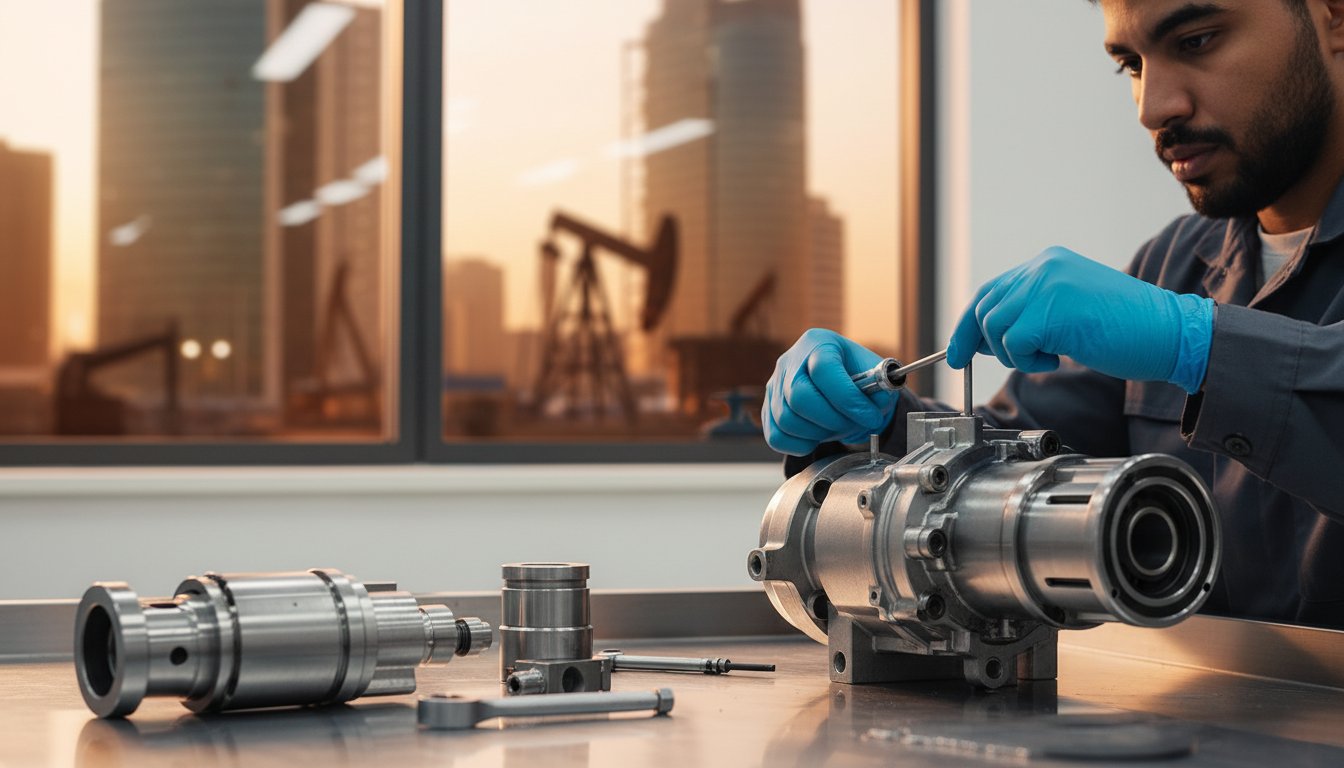
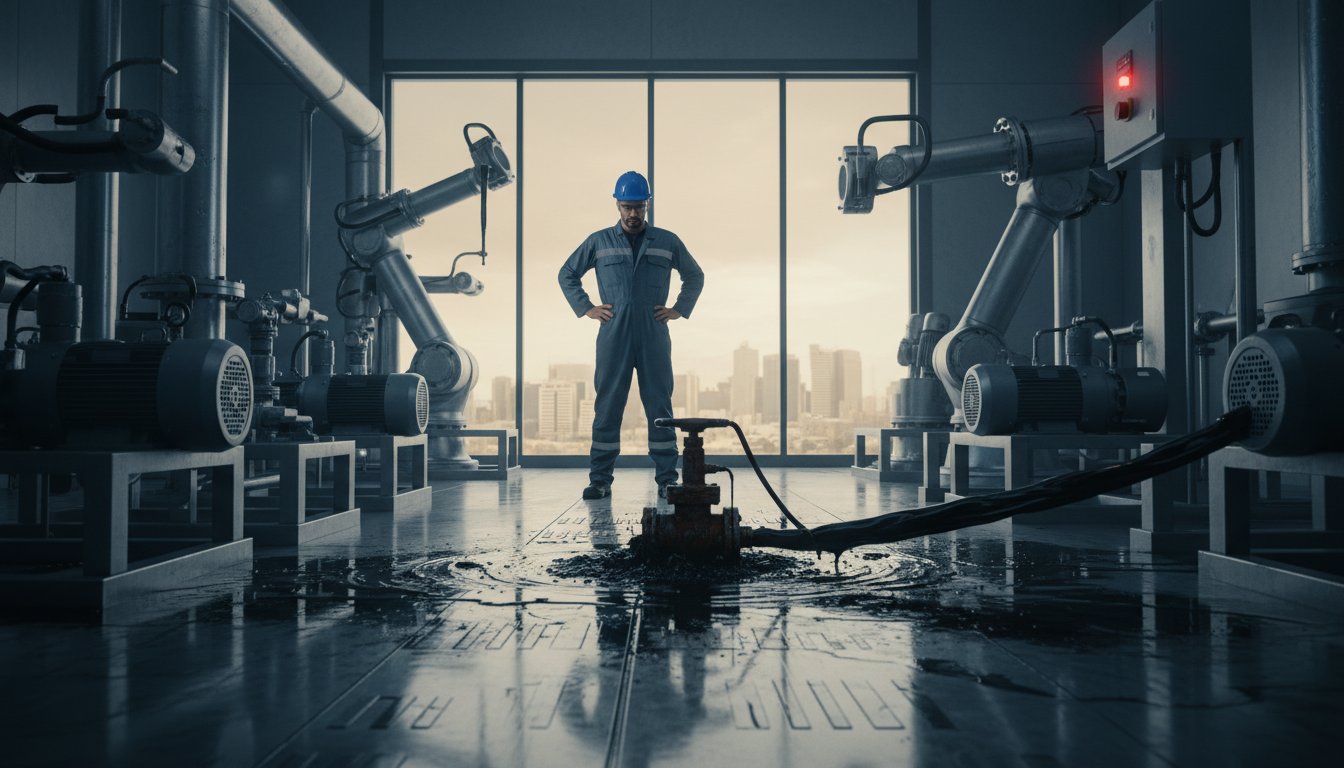
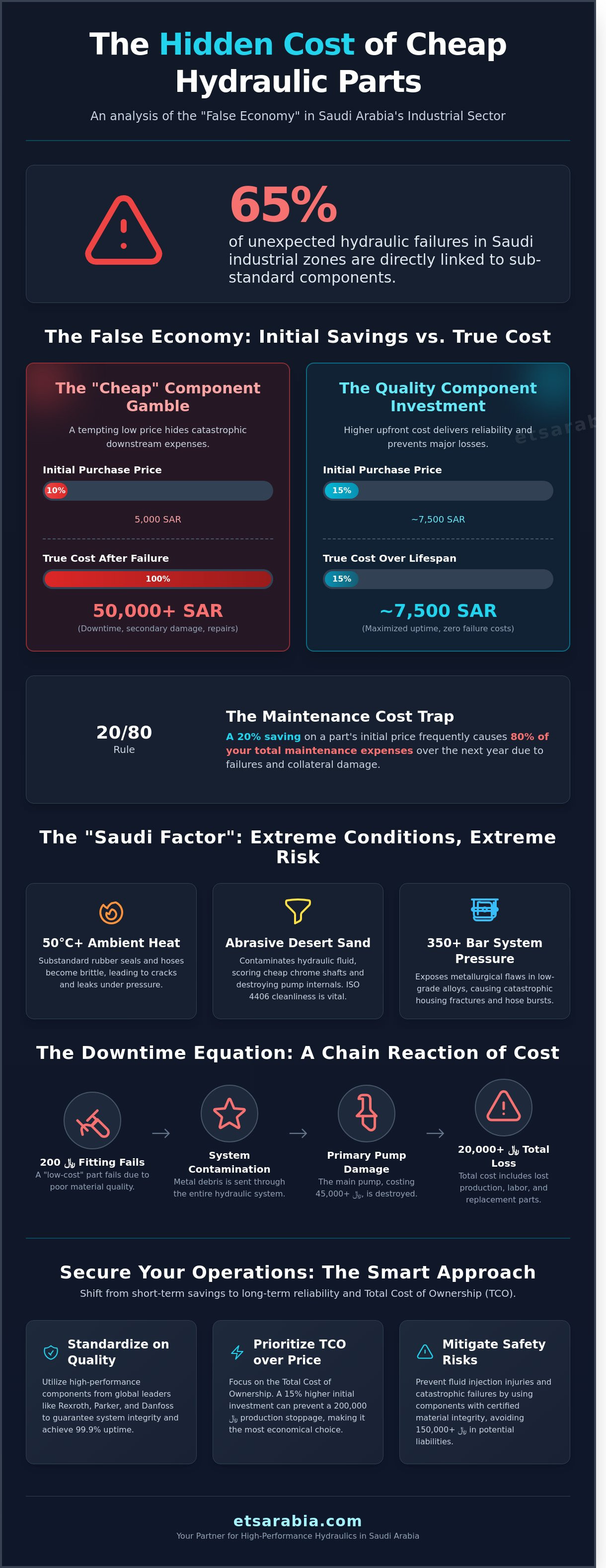
Did you know that 65% of unexpected hydraulic failures in Saudi industrial zones are directly linked to sub-standard components? You're likely under constant pressure to hit strict KPIs while managing a tight maintenance budget. It's tempting to save 5,000 SAR on a generic pump or valve today to keep your procurement targets on track. However, the risk of using cheap hydraulic parts often manifests as a 50,000 SAR loss in a single afternoon when a low-grade seal fails under the intense 50°C heat of the Eastern Province.
At Emdad Technical Services (ETS), we've seen how these budget choices lead to catastrophic system failures and compromised on-site safety. You don't have to sacrifice your operations for a lower upfront price. This article explains why cheap components are actually the most expensive items in your inventory and provides a roadmap to protect your systems from costly downtime. We'll show you how to reduce your total cost of ownership and standardize on reliable parts that ensure 99.9% uptime, even in the harshest Saudi Arabian environments.
Key Takeaways
- Understand the "False Economy" of industrial procurement and why saving 20% on initial part costs often results in 80% of your total repair expenses.
- Identify the critical risk of using cheap hydraulic parts, specifically how metallurgical flaws and inferior rubber compounds trigger catastrophic system failures under high pressure.
- Learn how the extreme Saudi climate, including 50°C+ ambient heat and abrasive desert sand, accelerates the degradation of substandard seals and chrome shafts.
- Quantify the real financial impact of failure by calculating the "Downtime Equation," where a 200 ﷼ fitting can cause over 20,000 ﷼ in secondary pump damage and lost production.
- Discover the ETS strategy for securing your operations by utilizing high-performance components from global leaders like Rexroth, Parker, and Danfoss.
The Hidden Cost of "Cheap": Why Initial Savings Are Deceptive
Industrial procurement in Saudi Arabia often involves a high-stakes tug-of-war between immediate budget constraints and long-term operational health. When a procurement team chooses a hydraulic component based solely on the lowest bid, they often fall into the trap of a "false economy." This occurs when the money saved during the initial purchase is eclipsed by the astronomical costs of subsequent repairs and lost production time. In the high-pressure environments of Jubail or Yanbu, the risk of using cheap hydraulic parts isn't just a line item; it's a gamble with your facility's entire output.
The 20/80 rule applies strictly here. A 20% saving on the purchase price of a seal or valve can trigger 80% of your total maintenance expenses over the following 12 months. Hydraulic physics don't respect a tight budget. These systems rely on incredibly tight tolerances and specific material compositions to handle pressures that often exceed 350 bar. When you deviate from established hydraulic principles and components to save a few hundred Saudi Riyals, you're inviting catastrophic failure.
There's a critical distinction between cost-effective parts and substandard ones. A cost-effective component offers the best value over its entire lifespan. A substandard part is simply cheap. For example, a 1,200 ﷼ high-quality hose might last 8,000 hours, while a 700 ﷼ budget alternative could fail after just 1,500 hours. The "cheap" option actually costs significantly more per hour of operation.
The Lifecycle of a Substandard Part
The deceptive allure of a low-bid winner starts at the procurement desk. For the first few weeks, the part might seem like a success because it's "working fine for now." However, this early-stage performance is a warning sign. Substandard materials often lack the thermal stability required for the Saudi climate, where ambient temperatures hit 48°C. Internal erosion begins almost immediately. Eventually, the part fails without warning, often sending metal debris through the entire system and destroying the primary pump, which can cost upwards of 45,000 ﷼ to replace.
Procurement vs. Engineering: Bridging the Gap
Closing the gap between finance and engineering requires a shift toward Total Cost of Ownership (TCO). You must communicate that the risk of using cheap hydraulic parts includes labor costs, which in specialized Saudi sectors can exceed 500 ﷼ per hour. We recommend setting strict quality standards based on ISO 4406 cleanliness levels and SAE durability ratings. When stakeholders see that a 15% higher initial investment prevents a 200,000 ﷼ production stoppage, the "expensive" part suddenly becomes the most economical choice for the business.
Critical Risks: How Low-Quality Components Compromise Your System
The risk of using cheap hydraulic parts isn't just a financial gamble; it's a direct threat to your operational safety and equipment longevity. In Saudi Arabia's demanding industrial environments, where ambient temperatures often exceed 45°C, unbranded valves and fittings frequently suffer from metallurgical flaws. These components lack the structural integrity required to withstand cyclical loading. A single hairline fracture in a low-cost alloy pump housing can lead to catastrophic failure under a standard 350-bar load. Research into the importance of component reliability confirms that material integrity is the foundation of any high-pressure system.
Safety hazards represent the most severe consequence of budget sourcing. Cheap high-pressure hoses often feature inconsistent wire braiding. This leads to sudden bursts that cause fluid injection injuries. These injuries occur when hydraulic oil penetrates human skin at velocities exceeding 180 meters per second. Such incidents require immediate surgical intervention. They can cost companies over SAR 150,000 in medical liabilities and lost productivity. Don't let a small saving on a hose assembly lead to a life-altering accident on your site.
The Science of Material Failure
Precision machining is non-negotiable for directional control valves. While premium brands use high-grade hardened steel, cheap alternatives often rely on softer alloys that deform under extreme heat. Inaccurate tolerances as small as 0.01mm cause internal leakage. This results in a 15% to 20% loss in volumetric efficiency. Proper heat treatment ensures parts maintain their shape over thousands of cycles. Without it, your system works harder, consumes more energy, and generates excessive heat that prematurely kills your seals.
Systemic Contamination: The Silent Killer
Contamination causes approximately 80% of all hydraulic system failures. Low-quality hoses are a primary culprit; they often shed internal rubber particles directly into the fluid stream during operation. These particulates act like sandpaper on the precision-ground surfaces of expensive Rexroth or Parker piston pumps. A single SAR 250 fitting can introduce enough debris to destroy a custom Hydraulic Power Unit (HPU) worth SAR 80,000. If you notice unexpected pressure drops or erratic actuator movement, it is vital to partner with a technical specialist who understands the necessity of clean, certified components. One inferior part can compromise the entire fluid circuit, leading to hours of unplanned downtime and expensive flushing procedures.
The "Saudi Factor": Harsh Environments vs. Substandard Materials
The Eastern Province presents one of the world's most unforgiving environments for industrial machinery. In Dammam and Al Khobar, ambient temperatures regularly exceed 50°C during the summer months. This environmental stress amplifies the risk of using cheap hydraulic parts, as components designed for temperate climates often fail under these extreme conditions. Substandard materials lack the thermal stability and chemical resistance required to survive the combination of intense heat, fine silica sand, and high humidity found in the Kingdom.
Heat and Fluid Viscosity
When ambient temperatures hit 52°C, internal hydraulic fluid temperatures can quickly climb above 85°C. Cheap hydraulic components often lose structural integrity at these levels. Low-budget seals manufactured from generic nitriles often become brittle and crack within 90 days of operation in the Saudi summer. This leads to internal leakage and a significant drop in system pressure. The risk of using cheap hydraulic parts becomes a massive financial liability when a single failed fitting halts a 250,000 ﷼ per day operation.
Budget cooling units often fail to maintain the required 15°C to 20°C temperature differential needed for heavy duty cycles. When fluid viscosity drops due to excessive heat, the lubricating film between moving parts thins out. This results in metal on metal contact. We've seen local operators face repair bills exceeding 45,000 ﷼ because a 600 ﷼ "standard" valve couldn't handle the thermal expansion. Standard parts aren't enough for Middle Eastern operations; you need components engineered for the desert.
Corrosion and Salt Air Challenges
Coastal industrial zones in DMM face constant salt-laden air that accelerates chemical degradation. Low-quality chrome shafts with thin plating, often less than 20 microns, show signs of pitting and oxidation in as little as 30 days. These micro-pits act as abrasive teeth. They shred seals every time the cylinder cycles, leading to catastrophic fluid loss.
Fine desert sand adds another layer of complexity. It acts as an abrasive that destroys substandard wipers and enters the fluid stream. ETS prioritizes precision-engineered hoses and fittings that meet the rigorous demands of the petrochemical and mining sectors. To maintain operational uptime, consider these local requirements:
- Petrochemical Standards: Systems must maintain zero-leakage to prevent fire hazards in high-heat zones.
- Mining Durability: Equipment in the interior needs seals that can withstand 90% humidity and abrasive dust simultaneously.
- Corrosion Resistance: Fittings must exceed 500-hour salt spray tests to survive coastal DMM environments.
Choosing high-grade components isn't just about quality; it's about survival in the Saudi climate. Reliable performance is guaranteed when you match the hardware to the environment. Our team ensures your systems are always in motion by providing parts that exceed local industry standards.
Calculating the Real Price: Downtime, Repairs, and Liability
Procurement teams often focus on the immediate invoice price. This is a dangerous oversight. The purchase price of a component represents less than 15% of its total lifecycle cost. When you analyze the risk of using cheap hydraulic parts, the financial equation shifts from a perceived saving to a massive operational debt. In the high-pressure environments of Saudi Arabia's industrial sectors, a single component failure triggers a chain reaction of expenses that far outweigh any initial discount.
- The Downtime Equation: Every hour a machine sits idle, you lose the profit from unproduced goods while still paying for fixed overheads and labor.
- Secondary Damage: Substandard parts rarely fail in isolation. A SAR 200 fitting that shears under pressure can send metal contaminants through the system, destroying a SAR 20,000 hydraulic pump in seconds.
- Labor Inflation: Emergency repairs in the Eastern Province often command a 250% premium over scheduled maintenance rates due to urgent mobilization and after-hours service requirements.
- Legal Exposure: Part failures that lead to site accidents result in heavy fines from the General Organization for Social Insurance (GOSI) and potential project suspension.
Quantifying Operational Downtime
Downtime is the silent killer of profitability. For a typical manufacturing plant in Dammam's Second Industrial City, downtime cost is defined as the total sum of idle labor wages, wasted energy, and missed production quotas for every sixty minutes the assembly line remains stationary. In an oil and gas setting, the stakes are even higher. A 2023 case study of a mid-sized drilling operation in the Empty Quarter showed that a failed hydraulic seal on a top drive led to 12 hours of non-productive time, costing the operator SAR 2.2 million in lost revenue and rig lease fees. While the prompt repair services from ETS can significantly reduce the duration of these outages, they cannot recover the capital already lost to the initial failure.
The Ripple Effect of Failure
The risk of using cheap hydraulic parts extends beyond the machine itself. When a hydraulic hose bursts on a construction site in Riyadh, the immediate mess is only the beginning. Environmental cleanup costs for hydraulic fluid spills can exceed SAR 45,000 depending on the soil contamination levels and municipality regulations. Furthermore, missed project deadlines lead to liquidated damages and a rapid erosion of client trust. If you fail to deliver on a contract for a major entity like Aramco or NEOM because of a bargain-bin valve, the long-term cost to your brand reputation is impossible to calculate on a spreadsheet. Reliable systems require precision-engineered components that handle the extreme heat and dust of the Saudi climate without flinching.
Don't let a cheap component compromise your entire operation. Contact Emdad Technical Services today for high-quality hydraulic solutions that guarantee long-term performance.
Securing Your Operations: The ETS Approach to High-Performance Hydraulics
Choosing the wrong component can cost a Saudi industrial facility upwards of 75,000 SAR in a single day of lost production. At Emdad Technical Services (ETS), we eliminate the risk of using cheap hydraulic parts by prioritizing engineering integrity over low initial price points. We partner with global leaders like Rexroth, Parker, and Danfoss to ensure every valve, pump, and motor meets rigorous international standards. These brands aren't just labels; they represent a guarantee of precision that budget alternatives can't replicate.
When we design and fabricate custom Hydraulic Power Units (HPUs), we treat quality components as the non-negotiable foundation of the build. Using a sub-par fitting in a high-pressure system isn't a cost-saving measure; it's a liability. Our technical team provides expert support to ensure every part selection matches your specific flow rates and pressure requirements. We focus on optimizing downtime through a reliable parts supply and expert repair services that keep your machinery running at peak efficiency.
Why Quality Selection is a Strategic Investment
Precision matters in the intense heat of the Saudi Arabian climate. ETS sources precision-engineered parts specifically designed to withstand the harsh environments of the Eastern Province. We focus on the long-term benefits of using genuine seals, hoses, and valves:
- Extended Service Life: Genuine parts often last 3 to 4 times longer than generic counterparts.
- System Integrity: Proper fitment reduces the risk of using cheap hydraulic parts that cause catastrophic fluid leaks.
- Safety Compliance: High-quality components meet Saudi industrial safety regulations, protecting your workforce.
Our relationship doesn't end at the sale. We provide ongoing technical support to help your team understand the maintenance needs of high-performance systems. It's about building a partnership that values operational longevity.
Your Local Partner in Dammam
Located strategically in the 2nd Industrial City, ETS provides a rapid response that off-shore suppliers simply cannot match. We understand that every hour of halted production impacts your bottom line. Our local presence allows us to deliver hydraulic repair services and parts faster than international competitors, often saving clients thousands of SAR in potential losses.
We've helped over 150 local firms transition from a cycle of "cheap" replacements to a strategy of "reliable" performance. This shift typically reduces annual maintenance expenditures by 25% within the first 12 months. We don't just provide parts; we provide the expertise to ensure those parts keep your business moving.
Secure Your Infrastructure with High-Performance Engineering
Opting for the lowest initial price often results in a catastrophic risk of using cheap hydraulic parts that fail under the intense 50°C heat of the Saudi desert. A component that saves you 3,500 SAR today can easily lead to 200,000 SAR in lost revenue when a critical system grinds to a halt. True efficiency comes from components engineered to handle high-pressure environments without compromise. Investing in quality isn't just about safety; it's about protecting your bottom line from the compounding costs of frequent replacements.
Emdad Technical Services (ETS) provides the technical certainty your operations require. As an authorized distributor for premium global brands, we specialize in HPU fabrication built strictly to Saudi Aramco standards. For immediate needs, our Dammam facility offers emergency hydraulic repair services to get your machinery back online fast. We don't just supply hardware; we deliver the expertise needed to optimize your system's lifespan and minimize expensive downtime.
Consult with our hydraulic experts for a reliability audit of your system and protect your facility from avoidable failures. Your operations deserve a partner that prioritizes long-term stability and professional excellence.
Frequently Asked Questions
What are the most common signs that a cheap hydraulic part is about to fail?
The most immediate indicators include excessive heat generation and unusual knocking sounds known as cavitation. Low-grade seals often begin "sweating" or leaking fluid within the first 500 operating hours. You'll likely notice a 15% drop in system pressure or slower cycle times, which signal that the internal components are wearing down prematurely. Monitoring these specific performance metrics helps prevent a total system seizure.
How does the Saudi Arabian climate specifically affect low-quality hydraulic hoses?
Extreme temperatures reaching 50°C in regions like the Eastern Province cause budget rubber compounds to lose elasticity and crack. Low-quality hoses often lack necessary UV-stabilizers, leading to outer cover degradation within just 90 days of sun exposure. While a premium SAE-rated hose lasts years, a sub-standard alternative frequently bursts under the combined stress of high ambient heat and internal 3,000 PSI operating pressures.
Can using unbranded hydraulic parts void my equipment warranty?
Yes, installing unbranded or non-OEM components typically voids the standard 2-year manufacturer warranty provided by brands like Caterpillar or Komatsu. Manufacturers require parts that meet exact engineering specifications to maintain coverage. The risk of using cheap hydraulic parts involves more than just the component cost; it exposes your business to the full financial burden of major engine or transmission repairs that would have been covered.
Is there ever a situation where using a cheaper hydraulic part is acceptable?
Budget-friendly parts are only appropriate for low-pressure, non-critical applications such as basic fluid transfer or static drainage. You should never use these components in high-pressure systems exceeding 200 bar or in safety-critical steering and braking circuits. Statistics show that 80% of catastrophic hydraulic failures in industrial settings stem from using mismatched, low-cost components in high-demand machinery where precision is vital.
How much more does a premium hydraulic pump cost compared to a budget version?
A premium hydraulic pump in the Saudi market typically ranges from 7,500 SAR to 12,000 SAR depending on the flow rate. Budget versions often retail for 3,000 SAR to 4,500 SAR, offering an initial saving of roughly 50%. However, when you factor in the 10,000 SAR average cost of emergency downtime and the shorter 6-month lifespan of budget pumps, the premium option becomes the more economical choice.
How can I verify the quality of a hydraulic component before purchasing?
Always check the component casing for ISO 9001 certification marks and specific SAE or DIN standards. High-quality parts feature a unique serial number for traceability and a smooth finish free of casting defects or burrs. You should request a 12-month manufacturer performance guarantee and a technical data sheet. Reliable suppliers in Saudi Arabia will always provide these documents to prove the part's industrial grade.
What is the risk of using "rebuilt" hydraulic pumps from uncertified shops?
Uncertified shops often use "will-fit" internal parts that lack the 0.001-inch precision required for high-pressure loads. These shops don't have the calibrated test benches needed to simulate 3,000 PSI operating conditions before the pump leaves the facility. Data indicates that 40% of uncertified rebuilds fail within the first 100 hours of operation, often sending metal debris throughout your entire hydraulic circuit and causing secondary damage.
How does ETS ensure the quality of the hydraulic parts they supply in Dammam?
ETS subjects every component to rigorous pressure and flow testing at our Dammam facility to ensure it meets global performance benchmarks. We source our inventory directly from industry leaders like Parker and Danfoss to guarantee authenticity and reliability. Our engineering team provides 24/7 technical support, ensuring your systems maintain 99.9% uptime. We don't just sell parts; we deliver certified solutions that keep your heavy operations moving forward.