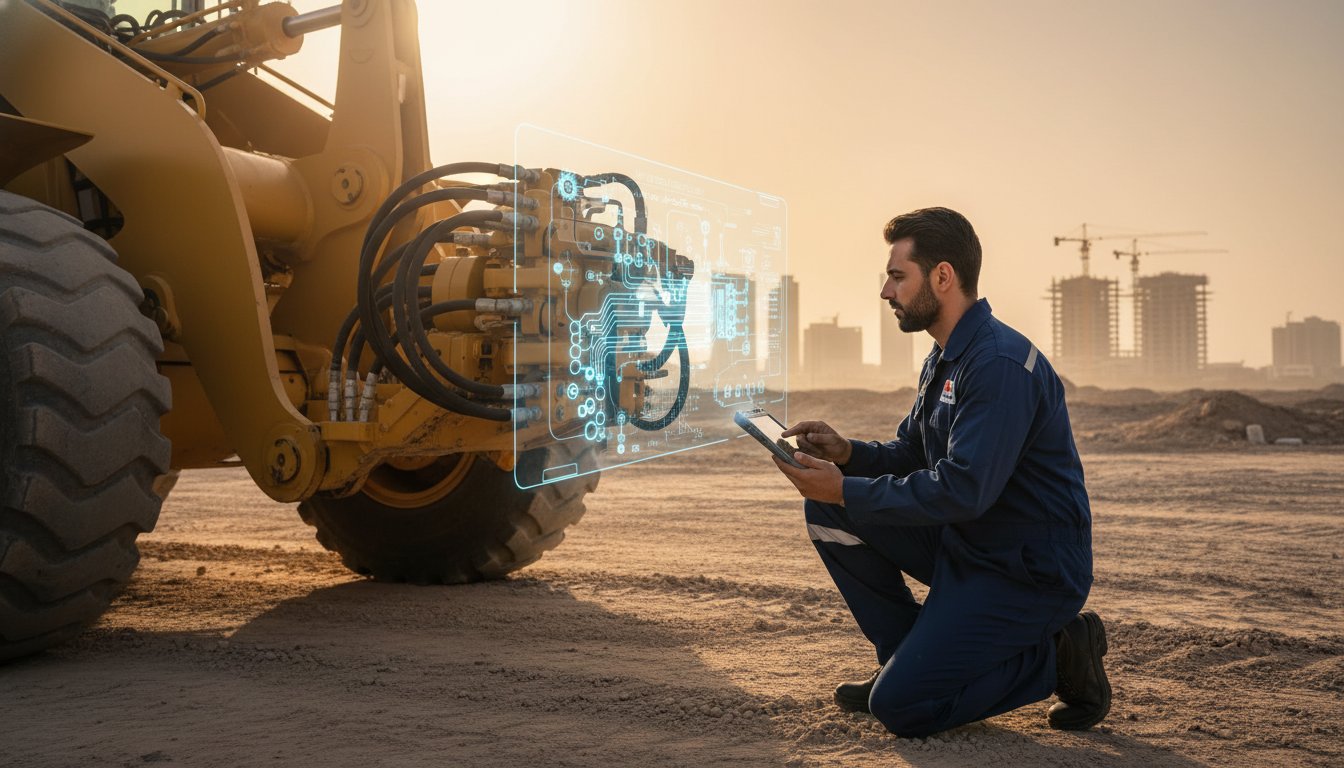
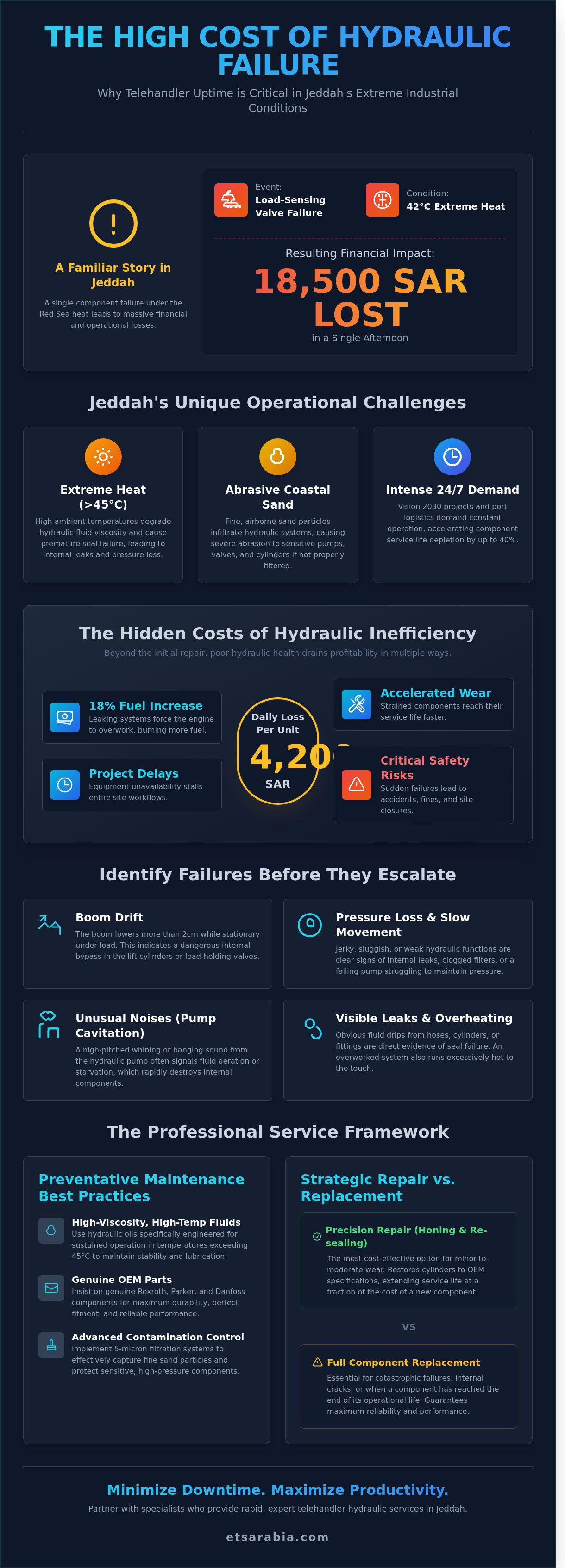
On July 14th, a project manager at the Jeddah Islamic Port watched 18,500 SAR vanish in a single afternoon because a telehandler’s load-sensing valve failed under the 42°C heat. It’s a familiar story for many operators across the Kingdom. You already recognize that the combination of fine coastal sand and extreme temperatures creates a brutal environment for your machinery. You need more than a quick fix; you need a technician who understands the specific pressure requirements of high-reach equipment.
This guide to professional telehandler hydraulic service jeddah shows you how to eliminate these costly interruptions. We’ll teach you to identify early warning signs of seal degradation and ensure your fleet uses only genuine Rexroth or Parker components for maximum durability. We're going to break down the exact maintenance protocols required to keep your systems moving without a single minute of unnecessary downtime. By following these industry-tested steps, you can guarantee reliable performance even in the harshest Western Province conditions.
Key Takeaways
- Understand why hydraulic integrity is the backbone of Jeddah’s infrastructure projects and how it powers critical functions like lifting and reaching.
- Learn to identify early warning signs of hydraulic failure, such as boom drift and pump cavitation, to prevent sudden equipment breakdowns.
- Master best practices for a professional telehandler hydraulic service jeddah, including selecting high-viscosity oils specifically engineered for temperatures exceeding 45°C.
- Implement a strategic framework to determine when to choose precision cylinder honing and re-sealing over expensive component replacements.
- Discover how expert technical partnerships help industrial leaders optimize downtime by providing rapid repairs and access to genuine Rexroth and Danfoss parts.
Why Telehandler Hydraulic Performance is Critical for Jeddah’s Construction Sector
Jeddah's skyline is transforming at an unprecedented rate. From the expansion of the Jeddah Central Project to the massive infrastructure upgrades in the south, the Telescopic handler has emerged as the indispensable workhorse of the local construction sector. These machines are prized for their versatility, but that versatility depends entirely on a complex hydraulic system. Unlike standard forklifts, a telehandler relies on high-pressure hydraulic circuits to manage three distinct functions simultaneously: lifting, extending the reach, and providing multi-mode steering. When these systems operate at peak efficiency, they allow contractors to meet aggressive deadlines. When they falter, the entire site's workflow grinds to a halt.
The technical demands on these machines are extreme. A typical telehandler in a Jeddah warehouse or construction site operates under high heat and heavy dust, conditions that degrade hydraulic fluid and stress seals. Precision is the most critical factor. The hydraulic system must maintain constant pressure to hold heavy loads at full extension without "drifting." This is where generic hydraulic shops often fail. Calibrating load-holding valves and counterbalance valves requires specific manufacturer data and precision flow meters. A shop that treats a telehandler like a simple tractor often leaves the machine with jerky movements or, worse, a boom that creeps downward under load. Professional telehandler hydraulic service jeddah ensures these valves are set to exact specifications, preventing catastrophic failures during high-stakes lifts.
The High Cost of Hydraulic Failure in Saudi Arabia
Downtime in the Saudi construction market is exceptionally expensive. On a Tier 1 project site in the Jeddah 2nd Industrial City, the daily loss of a stalled 4-ton telehandler is estimated at 4,200 SAR when factoring in operator wages, project delays, and equipment rental extensions. Beyond the immediate stoppage, hydraulic inefficiency quietly drains a company's budget. A system with internal leaks or clogged filters forces the engine to work harder to maintain pressure, which typically increases fuel consumption by 18% and accelerates engine wear. Safety remains the highest priority. A hydraulic failure during high-altitude material handling isn't just a mechanical issue; it's a critical safety risk that can lead to site closures and heavy fines from regulatory bodies.
Jeddah’s Industrial Landscape and Equipment Demands
The growth of the logistics sector near the Port of Jeddah has created a massive demand for reliable reach equipment. Warehousing operations here now run 24/7 to keep up with global supply chains. Similarly, residential and commercial projects in Obhur and South Jeddah are shifting toward around-the-clock shifts to meet Vision 2030 milestones. This constant operation means hydraulic components reach their service life 40% faster than they would in standard applications. Having a specialized service hub nearby provides a significant competitive advantage. It allows fleet managers to schedule preventative maintenance during low-activity windows, ensuring that every machine in the fleet is ready for the next heavy-duty cycle without the risk of unexpected failure.
- Precision Calibration: Ensuring load-holding valves prevent boom drift during high-altitude tasks.
- Contamination Control: Implementing 5-micron filtration to protect sensitive piston pumps from Jeddah's fine sand.
- Urgent Response: Minimizing the 4,200 SAR daily loss associated with equipment downtime on Tier 1 sites.
- Local Expertise: Providing telehandler hydraulic service jeddah that understands the specific heat-load profiles of the Red Sea coast.
Identifying Common Telehandler Hydraulic Failures: From Leaks to Pressure Loss
Telehandlers operating across Jeddah's construction sites face some of the harshest conditions in the Kingdom. High ambient temperatures combined with abrasive coastal air create a perfect storm for hydraulic degradation. Boom drift is a common but dangerous symptom we see frequently in older fleets. If your boom lowers by more than 2 centimeters while stationary under a rated load, it's a clear sign of an internal bypass in the lift cylinders. This failure doesn't just slow down work; it creates significant risk for ground crews. Adhering to hydraulic safety best practices remains the most effective way to identify these drifts during pre-shift checks before they escalate into a total system collapse.
Slow hydraulic response is another frequent complaint from operators in the Western Province. When a machine feels sluggish, it's often due to pump cavitation or a restricted suction line. A clogged 10-micron filter can starve the pump of oil, leading to a high-pitched whining sound that signals imminent failure. Statistics show that roughly 35% of hydraulic performance issues in Jeddah are resolved by simply replacing contaminated filters and cleaning the suction strainers. Steering misalignment also plagues local fleets; if the rear wheels fail to sync with the front or if the steering feels "soft," the priority valve or the steering orbitrol is likely bypassing internally.
Overheating stands as the absolute enemy of hydraulic systems in the Western Province. During peak summer months, ambient temperatures often exceed 45°C, pushing hydraulic oil toward its thermal breakdown point of 82°C. Once the oil thins, it fails to lubricate critical tolerances in the pump. This leads to a vicious cycle of heat and wear that can destroy a SAR 18,000 pump in a single afternoon. Maintaining a professional telehandler hydraulic service jeddah schedule is the only way to ensure your cooling systems are optimized for this specific climate.
Symptoms of Cylinder and Seal Degradation
Visual cues are your first line of defense against downtime. Scored chrome shafts are a major red flag; these tiny scratches act like files, shredding seals with every stroke. You might also notice "weeping" or oil dampness at the gland nut. In the Jeddah region, the fine, silica-rich sand is particularly destructive. It settles on the boom sections and gets pulled into the seals during retraction. This results in jerky, inconsistent movements during boom extension, which indicates that internal friction has reached a critical level. If your machine shudders under load, the seals have likely lost their structural integrity.
Pump and Valve Diagnostics
Diagnosing a pump requires a keen ear and the right tools. Unusual knocking or "marbles in a tin can" sounds usually point to air aeration or mechanical piston damage. Technicians must use flow meters to check if pressure relief valves maintain their factory set-points, typically ranging between 210 and 280 bar depending on the model. Load-sensing hydraulics serve as the brain of modern telehandlers by precisely modulating oil flow based on operator demand. For reliable results, a routine telehandler hydraulic service jeddah should include a full pressure test of the sensing lines to prevent erratic behavior and maximize fuel efficiency across your entire project site.
Expert Hydraulic Repair vs. Component Replacement: A Strategic Framework
Choosing between a full component replacement and a precision repair is a critical financial decision for fleet managers in Saudi Arabia. When you require a telehandler hydraulic service jeddah, the goal is to balance upfront costs with the long-term total cost of ownership. A new hydraulic pump for a standard 10-meter telehandler can easily exceed 22,000 SAR. In contrast, a comprehensive ETS rebuild typically costs between 9,000 SAR and 12,000 SAR. This professional rebuild restores approximately 95% of the original service life, providing a much higher return on investment than a "quick fix" patch that might fail within 150 operating hours.
Our framework prioritizes structural integrity. If a valve block or cylinder barrel shows signs of heat-induced warping or deep internal cracking, we recommend immediate replacement to prevent catastrophic system failure. However, for 85% of wear-related issues, precision engineering offers a permanent solution. Maintaining these tight tolerances isn't just about performance; it's a safety requirement. Adhering to OSHA safety standards for heavy equipment ensures that repaired components don't fail under load, protecting both your operators and your valuable site assets. At ETS, we use precision-engineered hoses and fittings to ensure every connection meets or exceeds the original manufacturer's burst pressure ratings.
Cylinder Rebuilding: Honing and Chroming
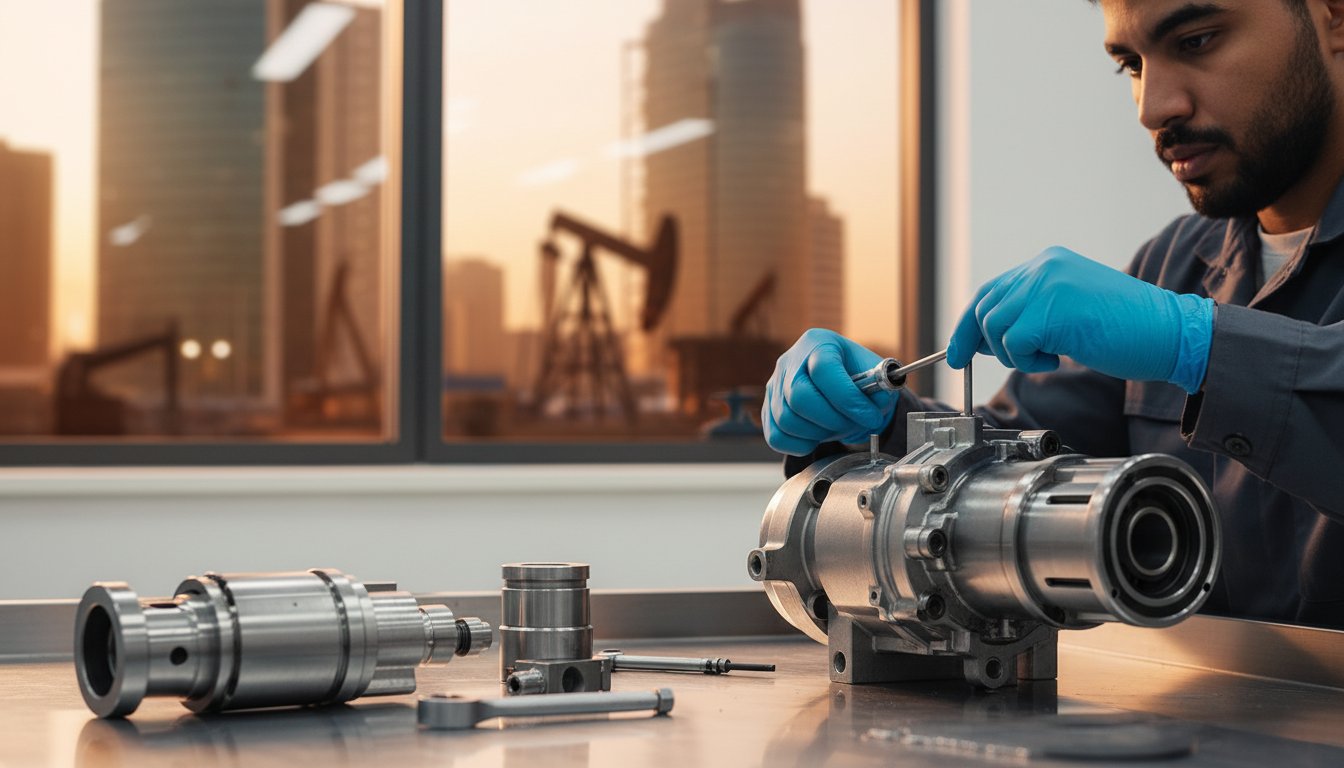
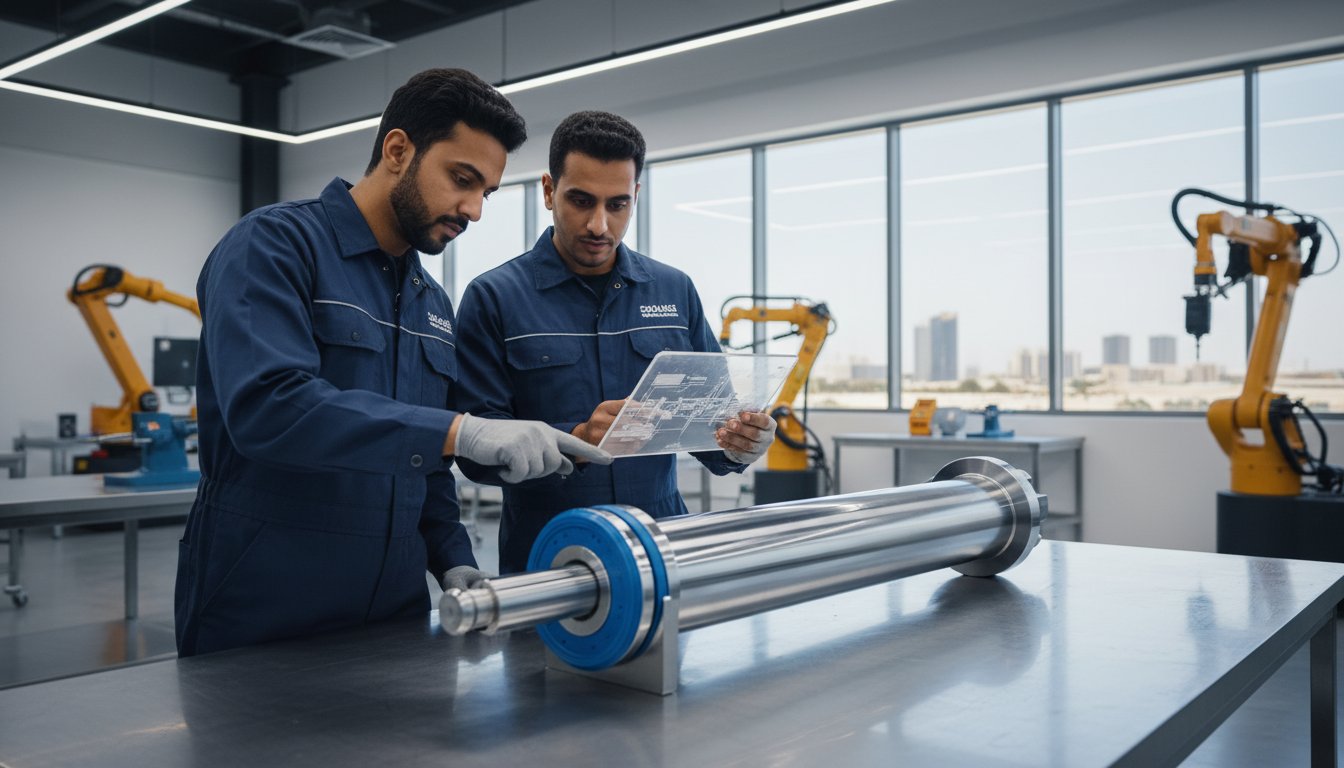
Jeddah's coastal environment is notoriously aggressive toward hydraulic machinery. The high salinity and humidity lead to rapid rod pitting. Our technical process involves honing the cylinder tube to restore a perfect micro-finish, which is essential for oil film retention. We apply hard chrome plating to rods to achieve a surface hardness of 65-70 HRC. This level of protection is vital for telehandlers operating near the Jeddah Islamic Port or along the Red Sea coast. ETS facilities are equipped to handle large-bore cylinders with precision, ensuring that tolerances remain within 0.02mm of factory specifications.
Sourcing Quality Hydraulic Parts in Saudi Arabia
The local market is often flooded with "grey market" seals that lack the thermal resistance needed for the 50°C temperatures common in Saudi summers. Using these sub-par parts in a high-pressure 350-bar system is a recipe for immediate downtime. We eliminate this risk by partnering directly with global brands like Parker, Rexroth, and Danfoss. By maintaining a robust local inventory of genuine heavy equipment spare parts, we reduce wait times from weeks to hours. This strategic stocking allows us to provide a telehandler hydraulic service jeddah that keeps your projects moving without the delays associated with international shipping. Our clients benefit from components that are 100% compatible with their specific machinery models, ensuring reliable performance under the most demanding conditions.
- Cost Efficiency: Rebuilds save up to 60% compared to buying new OEM components.
- Rapid Turnaround: Local stock of Rexroth and Danfoss parts prevents long lead times.
- Durability: Hard chrome plating specifically designed for Saudi Arabia's coastal humidity.
- Expertise: Precision honing that restores factory-level micro-finishes to cylinder bores.
We don't believe in temporary fixes. Every repair at ETS is treated as a long-term engineering solution. By focusing on the root cause of hydraulic degradation, we help you optimize downtime and maximize the productivity of your telehandler fleet. Our relationship doesn't end when the machine leaves our shop; we provide the ongoing technical support needed to ensure your systems remain in motion.
Best Practices for Telehandler Maintenance in the Jeddah Climate
Operating heavy machinery in Western Saudi Arabia presents unique challenges that standard maintenance manuals often overlook. When ambient temperatures regularly exceed 45°C, hydraulic systems face extreme thermal stress. This heat thins the oil, reduces lubrication, and accelerates seal degradation. Professional telehandler hydraulic service jeddah requires a localized approach to ensure your equipment doesn't succumb to the harsh environment. We've found that 85% of hydraulic failures in the region are preventable through climate-specific adjustments and rigorous inspection routines.
Selecting the correct oil viscosity is your first line of defense. Standard ISO VG 46 oils often fail when internal system temperatures climb during heavy lifting cycles. For Jeddah's peak summer months, upgrading to an ISO VG 68 or a high-viscosity index (VI) fluid is essential. These fluids maintain their "body" at higher temperatures, preventing internal pump slippage and ensuring the boom remains responsive. Without this adjustment, you'll notice a 15% to 20% drop in lifting efficiency as the oil loses its ability to transmit power effectively.
The Daily Walk-Around: A Preventive Checklist
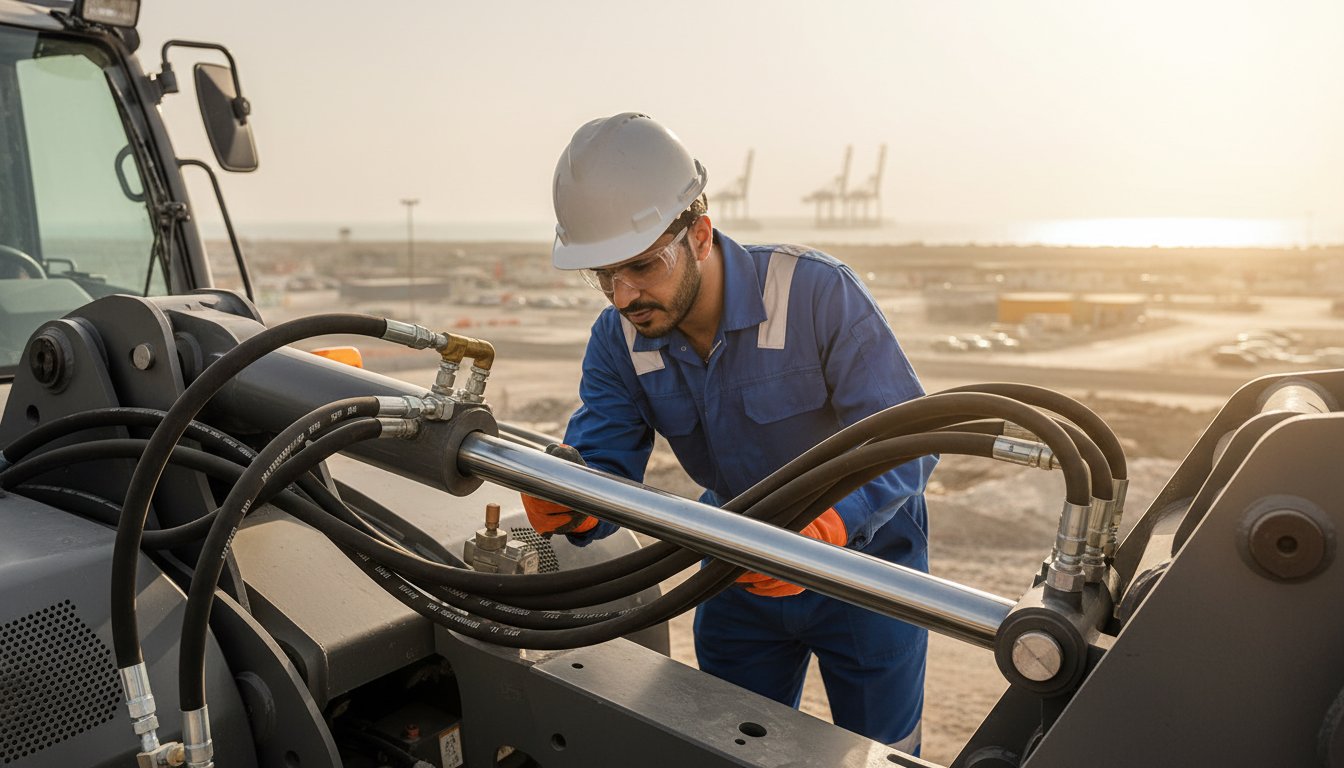
Operators must perform a focused inspection every morning before the heat peaks. Check hydraulic hose routing specifically for signs of rubbing; heat makes rubber more pliable and prone to friction damage during boom extension. Clear the hydraulic oil cooler of any dust or sand blockages immediately. A 2mm layer of Jeddah dust can reduce cooling efficiency by 30%, leading to rapid oil oxidation. Finally, ensure all grease points are saturated to purge out abrasive sand that destroys rod seals.
Managing Oil Quality and Filtration
The standard 250-hour service interval is often too long for the Saudi market. High humidity near the Red Sea combined with fine airborne particulates means filters reach capacity much faster than in temperate climates. We recommend sampling oil every 150 hours to check for "burnt" characteristics. If your oil smells acrid or looks like dark tea, it has oxidized. This chemical breakdown creates varnish that clogs sensitive proportional valves, leading to jerky movements and potential safety hazards on the job site.
High-efficiency filtration is non-negotiable for modern telehandlers. Using 3-micron or 5-micron absolute-rated filters protects the tight tolerances of your hydraulic pump. We also emphasize the importance of scheduled oil analysis. By measuring parts-per-million of copper and iron, we can detect "silent" pump wear long before a catastrophic failure occurs. This proactive data can save a fleet owner upwards of SAR 25,000 in emergency replacement costs and unplanned downtime.
External components also require protection from salt-air corrosion. Exposed cylinder rods should be retracted when the machine is parked overnight to prevent pitting from the humid, saline atmosphere. If a machine must sit idle for more than 48 hours, applying a thin film of specialized protective spray to the chrome surfaces is a cost-effective way to prevent seal leaks caused by surface roughness. For comprehensive support and technical inspections, schedule your telehandler hydraulic service jeddah with our expert team today to keep your fleet operational in any weather.
Rapid Response Telehandler Hydraulic Services in Jeddah with ETS
Every minute a telehandler sits idle at a Jeddah port or construction site, your operational costs climb. Industry data suggests that unplanned equipment failure can cost Saudi firms between 12,000 SAR and 25,000 SAR per day in lost productivity and project delays. Emdad Technical Services (ETS) specializes in optimizing downtime for Jeddah’s industrial leaders by providing rapid, technical interventions that solve the root cause of hydraulic failure. We don't just patch leaks; we restore the structural integrity of your machine's most vital systems.
Our repair capabilities are comprehensive and precision-focused. We manage everything from the calibration of complex Hydraulic Power Units (HPUs) to the precision fabrication of custom components that are no longer available from original manufacturers. If your telehandler suffers from slow boom extension, jerky steering, or pressure drops, our engineers utilize advanced diagnostic tools to pinpoint the exact component at fault. This surgical approach prevents the unnecessary replacement of expensive parts, saving your budget for where it matters most.
At ETS, our relationship doesn't end at the sale or the completion of a single repair. We provide ongoing technical support and preventative maintenance schedules designed to catch 95% of hydraulic issues before they cause a total system shutdown. Our team remains available for consultations, ensuring your operators understand the early warning signs of hydraulic fatigue. This commitment to long term partnership is why we remain the preferred choice for telehandler hydraulic service jeddah among major logistics and construction firms.
The ETS Advantage: Reliability Guaranteed
Our "Expertise You Can Trust" philosophy is backed by robust infrastructure and capabilities. We can manufacture custom hydraulic hoses in less than 45 minutes, significantly outperforming standard lead times. By combining localized support with global part partnerships, we ensure that 98% of common hydraulic fittings are always in stock. We bridge the gap between international quality standards and the specific environmental challenges of the Saudi Arabian climate, such as extreme heat and fine sand infiltration, which often compromise hydraulic seals.
Get Your Equipment Back in Motion
Securing a professional telehandler hydraulic service jeddah is a straightforward process designed for busy project managers. ETS is committed to rapid mobilization, deploying our specialized mobile diagnostic units directly to your site across Jeddah's industrial areas. To request a quote or an urgent site visit, you simply need to provide your equipment model and a brief description of the fault. Our technicians will arrive with the necessary pressure testing kits and tools to begin work immediately.
- Direct access to certified hydraulic engineers for immediate troubleshooting.
- Optimized logistics for timely service at your Jeddah site.
- Comprehensive 12-month warranty on all fabrication and major component overhauls.
- Transparent pricing in SAR with no hidden emergency call-out fees.
Ensure your telehandler stays in motion-contact ETS for hydraulic service today. We are ready to dispatch a team to your site to perform a full system diagnostic and get your operations back on track without delay.
Secure Your Operational Continuity Today
Neglecting hydraulic health in Jeddah's harsh 45°C environment leads to more than just leaks; it results in expensive project delays that can cost thousands of SAR per hour. By implementing a proactive maintenance schedule and utilizing precision-engineered hoses and fittings, you ensure your equipment stays reliable. Our team specializes in global brands like Parker and Rexroth, providing the technical expertise needed to identify pressure losses before they cause a total system shutdown.
Choosing a professional telehandler hydraulic service jeddah ensures your machinery operates at peak efficiency despite the heat and dust. We focus on minimizing industrial downtime through rapid response and high-quality components. Don't let a faulty valve or worn seal halt your progress on-site. It's time to partner with a team that understands the local landscape and the urgency of your construction deadlines.
Request an Urgent Hydraulic Service Quote from ETS to optimize your fleet's performance and keep your projects moving forward with confidence.
Frequently Asked Questions
How long does a typical telehandler hydraulic cylinder repair take in Jeddah?
A typical hydraulic cylinder repair takes between 24 and 48 hours for standard seal replacements at our Jeddah facility. If the job requires precision rod machining or specialized chrome plating, the timeline typically extends to 3 or 5 business days. We prioritize rapid turnaround times to ensure your equipment returns to the job site quickly, effectively minimizing expensive operational delays for your major construction projects.
Can ETS provide on-site hydraulic hose replacement for telehandlers?
Yes, ETS operates fully equipped mobile service units that provide on-site hydraulic hose replacement throughout Jeddah and surrounding industrial zones. Our technicians typically arrive at your location within 90 minutes of your call. Each van carries a comprehensive inventory of high-pressure hoses and fittings, allowing us to fabricate and install replacements immediately. This service effectively eliminates the need for machine transport and reduces your downtime.
What are the signs that my telehandler hydraulic pump is failing?
You'll notice a 20% or greater increase in cycle times and audible whining noises exceeding 85 decibels when a pump begins to fail. Other critical indicators include hydraulic fluid temperatures rising above 85°C and visible metallic shavings in the return line filters. If your boom movements feel jerky, it's time to schedule a professional telehandler hydraulic service jeddah to prevent total component seizure and costly secondary damage.
Do you use genuine Danfoss or Rexroth parts for telehandler repairs?
We use 100% genuine Danfoss and Rexroth components for all pump and valve repairs to maintain factory performance standards. ETS maintains a local inventory of over 500 specific part numbers to ensure we don't have to wait for international shipping. Using authentic parts ensures your hydraulic system operates at its rated pressure, typically 250 to 350 bar, while extending the service life of the entire machine.
How does the Jeddah heat affect my telehandler’s hydraulic oil?
Jeddah's ambient temperatures, which frequently hit 45°C, cause hydraulic oil to thin rapidly and lose its lubricating properties. This thermal stress leads to accelerated oxidation and seal hardening within 500 operating hours. We recommend using high-viscosity index oils and cleaning your cooling cores every 250 hours. Our team monitors oil health to prevent the premature degradation that causes 70% of local hydraulic system failures during the summer months.
What is the cost difference between repairing and replacing a hydraulic cylinder?
Repairing a hydraulic cylinder generally costs between 25% and 40% of the price of a new unit. While a new telehandler cylinder might cost between 4,500 SAR and 12,000 SAR depending on the model, a comprehensive reseal and polish usually stays under 1,800 SAR. We provide a detailed cost-benefit analysis for every component, ensuring you choose the most economical path for your fleet's maintenance budget without sacrificing safety.
Does ETS offer maintenance contracts for large telehandler fleets?
ETS provides structured preventative maintenance contracts for fleets of 5 or more telehandlers operating in the Western Province. These agreements include scheduled 50-point hydraulic inspections and fluid analysis every 500 hours. Clients on these contracts benefit from a 15% discount on emergency call-out fees and guaranteed response times. We focus on identifying minor leaks before they escalate into catastrophic system failures that halt your entire project.
What should I do if my telehandler boom becomes stuck in the extended position?
Immediately secure the area around the machine and check the pilot pressure gauges for a reading below 30 bar. This issue often stems from a faulty solenoid valve or a physical blockage in the wear pads. Don't attempt to force the boom down with external weight, as this can rupture high-pressure lines. Call our emergency technicians who can manually override the valves safely to retract the boom for transport and repair.