Recent industry data reveals that 80% of hydraulic system failures in Saudi Arabian industrial plants stem directly from fluid contamination. You've likely felt the frustration when a high-pressure pump fails or a valve sticks because of microscopic particles. These unplanned breakdowns don't just damage equipment; they result in thousands of SAR in lost revenue every hour your line stays silent.
You deserve a system that runs at peak efficiency without the constant threat of contamination-related damage. This article explains how a professional hydraulic filter replacement service prevents the majority of mechanical failures while ensuring your operations meet strict ISO cleanliness standards. You'll discover how Dammam-based Emdad Technical Services (ETS) provides the local expertise and rapid element sourcing needed to keep your machinery in motion. We'll also break down the exact steps to restore system pressure and eliminate the risk of costly industrial downtime.
Key Takeaways
- Understand the "80/20 Rule" of hydraulics and how addressing fluid contamination can prevent the vast majority of unexpected system failures.
- Learn to identify critical red flags, including differential pressure alerts and overheating, that indicate your filtration system is reaching a breaking point.
- Discover why a professional hydraulic filter replacement service is vital for maintaining system integrity and avoiding the contamination risks associated with DIY maintenance.
- Gain insights into the specific roles of suction and pressure filters in protecting sensitive valves and high-performance pumps from operational wear.
- See how ETS provides rapid response and access to global brands like Parker and Rexroth to minimize downtime for industrial hubs in Dammam and across Saudi Arabia.
The Critical Role of Hydraulic Filtration in Industrial Reliability
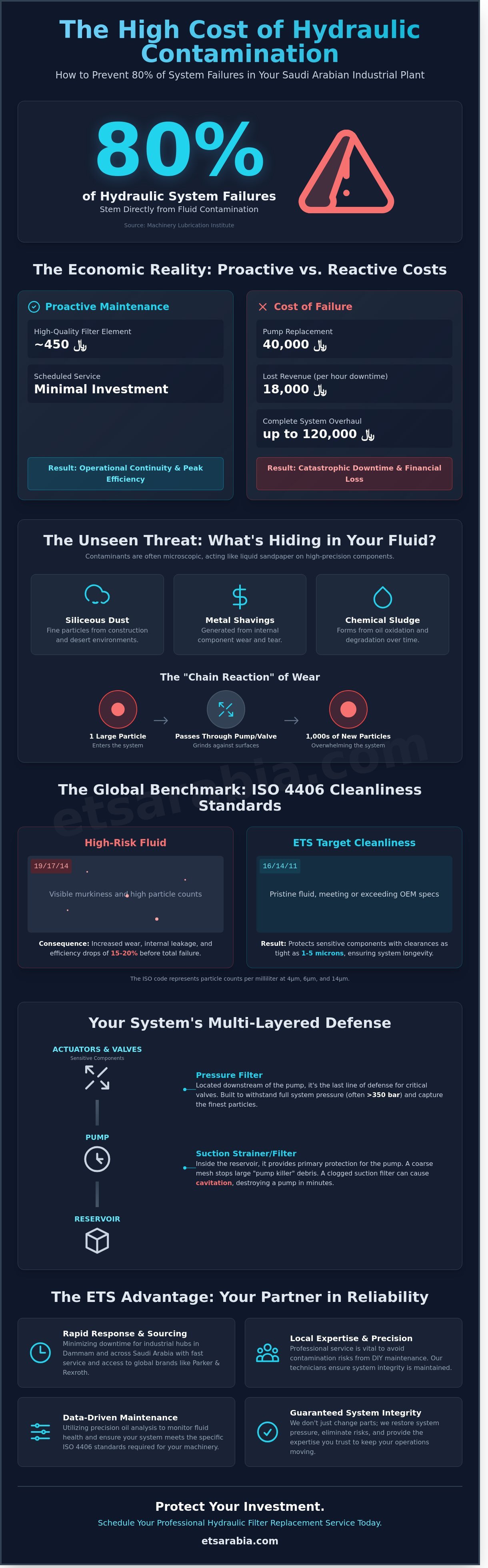
The 80/20 Rule of hydraulics isn't just a theoretical concept; it's a hard reality for industrial operations across Saudi Arabia. Statistics from the Machinery Lubrication Institute confirm that 80% of hydraulic system failures originate directly from fluid contamination. This makes a scheduled hydraulic filter replacement service the single most effective pillar of proactive maintenance. When microscopic debris enters a system, it doesn't just sit in the reservoir. It acts like an abrasive polishing paste, grinding down the internal tolerances of high-value components. A Rexroth A10VSO piston pump or a Parker D3W directional valve relies on clearances as tight as 1 to 5 microns. If these surfaces are compromised, internal leakage increases, heat rises, and system efficiency drops by 15% to 20% before a total failure occurs.
The primary defense against this degradation is the Oil filter, which captures suspended solids before they reach sensitive actuators. In a typical manufacturing plant in Jubail, the cost of a high-quality filter element might be 450 ﷼. Contrast this with the 40,000 ﷼ price tag for a replacement pump or the 18,000 ﷼ lost for every hour of unplanned downtime. The math is clear. Investing in a professional hydraulic filter replacement service is an investment in operational continuity. At ETS, we focus on these economic realities to ensure your machinery stays in motion without costly interruptions.
The Science of Contamination: Why Clean Fluid Isn’t Optional
Contaminants aren't always visible to the naked eye. Siliceous dust from Saudi construction sites, metal shavings from component wear, and chemical sludge from oil oxidation all threaten system health. These particles cause a "chain reaction" of wear. A single metal chip can break off a cylinder wall, travel through the return line, and generate thousands of smaller particles as it passes through a valve. This geometric progression of debris quickly overwhelms standard filters if they aren't serviced on a strict schedule. We've seen systems where neglecting a 250 ﷼ filter led to a 120,000 ﷼ overhaul within six months of operation. Understanding micron ratings is vital. A 10-micron filter won't protect a component that has 3-micron clearances. You need the right media for the specific application.
ISO 4406 Cleanliness Standards Explained
Fluid purity is measured by the ISO 4406 standard. This is a three-digit code representing particle counts at 4, 6, and 14 microns. For example, a code of 18/16/13 is the standard target for general industrial hydraulics. However, high-pressure Oil and Gas systems in the Eastern Province often demand a stricter 16/14/11 rating to protect sensitive servo-valves. ETS utilizes precision oil analysis to monitor these benchmarks. We don't just change parts; we ensure your fluid meets the specific global purity standards required for your machinery. This data-driven approach allows us to optimize your maintenance schedule and guarantee reliable performance in harsh desert environments. We provide the expertise you trust to keep your ISO codes within the safe zone, reducing the risk of sudden component seizure.
Understanding Filter Types: Low, Medium, and High-Pressure Systems
Selecting the correct hydraulic filter replacement service involves more than just matching a part number. Every hydraulic circuit has unique pressure zones that dictate filter placement and construction. Suction filters serve as the primary defense for the pump. These are typically coarse mesh strainers located inside the reservoir. They prevent large particles from entering the pump inlet. While they don't capture fine silt, they stop "pump killers" like stray bolts or shop rags from causing catastrophic mechanical failure. If these filters clog, they cause cavitation, which can destroy a 15,000 SAR pump in minutes.
Pressure filters are the most robust components in the system. They sit downstream of the pump and handle the full system pressure, often exceeding 350 bar in heavy industrial HPUs. These filters act as the last line of defense for sensitive proportional valves and actuators. To effectively control hydraulic system contamination, pressure filters must utilize high-collapse strength elements. They ensure that even if the pump begins to shed internal wear particles, those contaminants won't reach the expensive control valves downstream.
Return-line filters capture debris generated by the moving parts of the system before the oil returns to the tank. This is often where 70% of system contaminants are caught. For systems requiring ultra-clean oil, such as those used in precision manufacturing in Jubail, offline or "kidney loop" filtration is the gold standard. This system operates independently of the main circuit. It continuously polishes the oil through a dedicated pump and filter, even when the main machine is idle. This method is highly effective for optimizing downtime and extending the life of your fluid.
The Danger of the Bypass Valve
Most filter housings include a bypass valve to protect the element from collapsing. During cold starts or when the filter is full of debris, the valve opens to allow oil to flow around the media. It's a safety feature that creates an "invisible failure" because the machine continues to operate while running on unfiltered oil. If your system stays in bypass mode for too long, you'll notice erratic valve behavior or increased heat. Regular monitoring through our professional maintenance programs helps identify these hidden risks before they lead to a 40,000 SAR overhaul.
Spin-on vs. Cartridge Filters
Spin-on filters are popular for low-pressure applications due to their ease of replacement. They're common in mobile equipment but generate more environmental waste since the entire canister is discarded. Cartridge filters are the preferred choice for heavy-duty industrial systems in Saudi Arabia. They use a permanent housing, meaning you only replace the internal element. This reduces waste and allows for specialized housing materials. In corrosive coastal environments like Dammam or Jeddah, we recommend anodized aluminum or stainless steel housings. These materials resist salt-air corrosion far better than standard painted steel, ensuring the housing lasts for the entire life of the machine. High-collapse elements are essential here; they're designed to withstand pressure spikes without bursting, providing a level of reliability that standard spin-ons can't match.
5 Red Flags Your Hydraulic Filter Needs Immediate Replacement
Ignoring a clogged filter is a gamble that usually ends in an expensive repair bill. While some systems run until a total failure occurs, smart operators watch for specific warning signs. The most obvious indicator is the differential pressure gauge. When this needle enters the red zone, the filter's bypass valve opens. This allows unfiltered, contaminated oil to circulate through your sensitive valves and pumps to prevent the element from collapsing. It's a fail-safe that protects the filter but destroys the system. If you see that indicator pop up, your hydraulic filter replacement service is already overdue.
Heat is another silent killer. A restricted filter forces the pump to work harder, creating intense friction. In the industrial zones of Dammam, where ambient temperatures often exceed 45°C, this internal heat buildup can push oil temperatures past the 82°C threshold. High heat oxidizes the oil, turning it into a sludge that sticks to internal components. If your hydraulic tank feels significantly hotter than usual or your cooling system is running constantly, check your filters first. Excessive heat often indicates that 90% of the filter's surface area is already blocked by debris.
Listen to your equipment. A healthy pump hums, but a starving pump screams. When a suction filter is clogged, it causes cavitation. This occurs when air bubbles form in the oil and implode against metal surfaces with extreme force. It sounds like marbles rattling inside the pump housing. This process can pit metal components in less than 48 hours of continuous operation. If you notice increased noise or a loss of precision in your cylinder movements, the flow is likely restricted. Sluggish actuators are a clear sign that the system isn't receiving the volume of oil required for peak performance.
The Impact of the Saudi Arabian Climate
The Eastern Province presents unique challenges for hydraulic maintenance. Fine silica sand, common in Dammam and Jubail, is small enough to penetrate standard seals. These particles are roughly 5 to 10 microns in size, making them invisible to the naked eye but devastating to hydraulic tolerances. During shamal wind events, atmospheric dust levels increase by 400%, meaning filters reach their holding capacity much faster than manufacturer "standard" ratings suggest. We recommend adjusting your replacement intervals to "Extreme Environment" protocols, often reducing the service life by 30% to ensure the system remains clean.
Scheduled vs. Condition-Based Replacement
Waiting for a warning light is a reactive strategy that risks pump health. A proactive approach involves a 500-hour or 1,000-hour fixed schedule, depending on your specific machinery. However, the most sophisticated operators use oil analysis to determine the "True Life" of their filters. By measuring the ISO 4406 cleanliness code of your fluid, you can see exactly when your filtration efficiency drops. Investing in better oil filtration practices allows you to spot abnormal wear patterns before they cause a breakdown. Our hydraulic filter replacement service includes a visual inspection of the used element to identify brass or steel shavings, which often signal internal component failure. Don't just swap the part; understand what the old filter is telling you about your machine's health.
Professional Replacement vs. DIY: Why Precision Matters
Many industrial operators view filter changes as a simple maintenance task, but 80% of hydraulic system failures stem directly from fluid contamination. Attempting a DIY hydraulic filter replacement service without a controlled environment often introduces more harmful particles than it removes. A single speck of dust, roughly 5 microns in size, is enough to score a precision valve spool and cause internal leakage. ETS technicians operate with surgical cleanliness to ensure your system remains sealed against the harsh, sandy environments typical in Saudi Arabian industrial zones. We also manage the disposal of hazardous waste oil in strict accordance with KSA General Environmental Regulations. Improper disposal can lead to environmental damage and heavy fines exceeding 10,000 SAR for non-compliance.
Precision extends beyond cleanliness to the mechanical integrity of the assembly. Improper torque or a misaligned O-ring leads to external leaks and air ingestion. These "minor" leaks often waste 20 liters of oil per month, costing your facility over 400 SAR in lost fluid alone, not to mention the slip hazards created. During every service, our team performs a "mini-system check." We don't just swap parts; we inspect the spent filter for metal shavings or "glitter" that signal internal pump wear. This proactive approach identifies a 2,000 SAR repair today before it turns into a 50,000 SAR catastrophic failure tomorrow. When downtime costs your operation up to 5,000 SAR per hour, precision isn't a luxury; it's a financial necessity.
The Replacement Process: A Step-by-Step Overview
Our technicians follow a rigorous protocol to protect your machinery and personnel. The process begins with strict Lockout/Tagout (LOTO) procedures to eliminate residual pressure risks that can cause severe injury. We thoroughly clean the housing exterior before opening the system to prevent debris entry. After removing the element, we inspect the housing for "varnishing," a sticky resin that indicates oil oxidation. We always pre-fill new filters with pre-filtered oil. This prevents "dry starts" and air entrapment, which cause pump cavitation and immediate component damage. It's a level of detail that ensures your system returns to peak performance immediately.
Beyond the Filter: When You Need High-Velocity Flushing
A standard filter swap isn't enough if your system has suffered a major component failure or if the oil has turned cloudy. In these cases, 95% of the contaminants remain trapped in the reservoir or the dead-ends of the hydraulic lines. ETS utilizes high-velocity flushing and offline filtration carts to "polish" the entire fluid volume while the machine is offline. We don't guess if the oil is clean enough. We use on-site laser particle counters to verify the fluid meets ISO 4406 cleanliness standards before we sign off on the job. This ensures that the new filter isn't immediately overwhelmed by old debris.
Ensure your machinery stays operational and compliant with local regulations by booking a professional hydraulic filter replacement service today.
ETS Hydraulic Filter Services: Minimizing Downtime in Saudi Arabia
Operational delays in industrial zones like Dammam 2nd Industrial City often stem from a single, overlooked component: the hydraulic filter. When a system fails due to contamination, the financial impact is immediate. For a mid-sized manufacturing plant in the Eastern Province, an hour of unplanned stoppage can exceed 45,000 SAR in lost productivity and labor costs. Emdad Technical Services (ETS) eliminates these risks by providing a rapid-response hydraulic filter replacement service tailored to the rigorous demands of the Saudi Arabian climate and industrial standards.
We've built our reputation on availability and technical precision. While many suppliers wait for international shipments, our Dammam warehouse maintains a massive inventory of over 18,000 SKUs. We stock genuine components from global leaders like Parker, Rexroth, and Danfoss. This local availability means we cut lead times from weeks to hours. You don't have to wait for a part to clear customs when your production line is sitting idle; we likely have the exact element you need ready for immediate dispatch.
Our team doesn't stop at simple part swapping. We specialize in custom Hydraulic Power Unit (HPU) filtration design and retrofitting. If your existing system struggles with the fine desert sand or high ambient temperatures of the Jubail industrial area, we re-engineer the filtration circuit. We've successfully retrofitted systems for 14 major petrochemical facilities since early 2023, enhancing their filtration efficiency by up to 35 percent. Our goal is simple: we don't just sell parts; we optimize your system uptime through engineering excellence.
Why Dammam Industries Trust ETS
Local manufacturers often face a "Parts Gap" where specialized filters aren't available locally. ETS bridges this gap with a robust supply chain that keeps critical components on the shelf in Saudi Arabia. Our technical support team consists of certified engineers who provide solutions rather than just repairs. In a recent 2023 case study, a local plastic extrusion plant reduced its annual maintenance costs by 85,000 SAR after we identified that their hydraulic filter replacement service interval was mismatched with their oil viscosity. We corrected the filtration grade, and their pump failure rate dropped to zero over the following twelve months.
- Immediate Stock: Access to Parker, Rexroth, and Danfoss elements.
- Expert Engineering: Root cause analysis for recurring contamination issues.
- Regional Knowledge: Solutions designed for Saudi Arabia's high-heat environments.
- Rapid Mobility: Field technicians ready to deploy to your site within hours.
Request Your Filtration Audit Today
The best way to prevent a crisis is through a comprehensive oil and filter health check. Our technicians use calibrated particle counters to provide an instant ISO 4406 cleanliness report on-site. This data-driven approach allows you to see exactly what's happening inside your machines before a component fails. A long-term maintenance partnership with ETS ensures your equipment receives the right care at the right time, moving your operations from reactive firefighting to predictable, profitable performance. Don't let a 500 SAR filter cause a 500,000 SAR system failure. Ensure your systems stay in motion-contact our Dammam experts today for a professional consultation and site visit.
Secure Your Industrial Performance with Precision Filtration
Ignoring contaminated fluid leads to catastrophic component failure. Industrial systems in the Oil & Gas and Mining sectors require precise high-pressure filtration to maintain peak efficiency. By identifying the 5 red flags early, you prevent repair costs that often exceed SAR 75,000 for a single system overhaul. Our hydraulic filter replacement service ensures your machinery meets international ISO 4406 cleanliness standards through professional intervention.
Emdad Technical Services (ETS) provides the technical edge your facility needs. Located strategically near Dammam 2nd Industrial City, we offer rapid response times to minimize your operational interruptions. Our engineers leverage partnerships with global leaders like Rexroth and Parker to deliver genuine, high-performance components. Don't risk your system's integrity with improper DIY swaps. Trust a partner who understands the high-stakes environment of Saudi Arabian industry.
Minimize your downtime; book a professional filtration check now
Your equipment represents a significant investment. Let's keep it running at maximum capacity together.
Frequently Asked Questions
Can I clean a hydraulic filter instead of replacing it?
You shouldn't attempt to clean modern high-efficiency filters because the process often damages the delicate synthetic media. Cleaning attempts typically leave 15% of trapped contaminants behind or create microscopic tears that allow dirt to pass through. Replacing the unit ensures 100% filtration efficiency and protects your 55,000 SAR pump from catastrophic failure. It's a small investment that prevents massive repair costs later.
How often should I replace hydraulic filters in a high-dust environment?
In high-dust environments like Eastern Province construction sites, you should replace filters every 250 to 500 operating hours. This is 50% more frequent than standard 1,000-hour intervals used in cleaner settings. Monitoring the pressure differential is vital for your system's health. If the indicator hits the red zone at 2.5 bar, change the filter immediately to prevent the system from entering bypass mode.
What's the difference between a nominal and an absolute micron rating?
An absolute rating means the filter captures 99.9% of particles at that specific size, while a nominal rating might only capture 50% to 80%. For critical industrial systems, we always recommend absolute-rated filters to ensure maximum protection. A 10-micron absolute filter is significantly more effective than a 10-micron nominal version. Using the wrong standard can lead to 40% more wear on internal valves and actuators.
Will a clogged hydraulic filter cause the pump to fail?
Yes, a clogged filter leads to pump cavitation or fluid starvation, which causes total system failure. When the filter is blocked, the pump works harder to pull fluid, creating a vacuum that forms destructive vapor bubbles. These bubbles can destroy a high-pressure pump in under 20 minutes of operation. Regular hydraulic filter replacement service prevents this costly 20,000 SAR repair bill and protects your machinery.
Does ETS provide on-site hydraulic filter replacement in Dammam?
Yes, ETS provides rapid on-site hydraulic filter replacement service across Dammam, Al Khobar, and Jubail. Our mobile service teams aim to reach your facility within 120 minutes of a confirmed service call. We arrive with fully equipped vans to handle urgent maintenance tasks immediately. This local support helps minimize your downtime and keeps your Saudi-based industrial operations moving forward without delay.
How do I read a hydraulic filter clogging indicator?
You read the indicator by checking the visual color-coded gauge or the integrated electrical signal status. A green zone means the filter is clean and functioning correctly. The yellow zone appears when 75% of the dirt-holding capacity is reached, signaling it's time to order parts. Once it hits the red zone, usually at a 2.0 to 3.0 bar pressure drop, the filter is bypassed and no longer protects your system.
What happens if I use the wrong micron rating for my filter?
Using a rating that's too coarse allows 35% more contaminants to reach sensitive components like servo valves. Conversely, a rating that's too fine causes premature clogging and frequent bypass events that leave the system unprotected. Most Saudi industrial systems require a specific Beta ratio for optimal performance. Miscalculating this requirement can reduce the lifespan of your hydraulic oil by 1,500 hours or more.
Can ETS source replacement filters for older or obsolete machinery?
Yes, we can source or custom-fabricate filters for machinery that's over 25 years old. Our global procurement network allows us to find exact matches or high-quality equivalents for discontinued brands. We successfully supported 50 different legacy systems in the petrochemical sector last year alone. If a standard part doesn't exist, our engineering team will identify a technical solution that fits your specific flow and pressure requirements.