
In the demanding industrial landscape of Saudi Arabia, unplanned downtime is more than an inconvenience-it's a direct threat to your productivity and profitability. A single equipment failure, often stemming from incorrect lubrication, can result in thousands of Riyals in repairs and crippling operational delays. Navigating the complex world of industrial lubricants-from hydraulic oils to high-temperature greases-can feel overwhelming, especially when the fear of choosing the wrong product is ever-present and expert technical support is hard to find.
This comprehensive guide is engineered to eliminate that uncertainty. We provide the expert, solution-oriented insights Saudi industries need to confidently select, manage, and optimize their lubrication strategy. Prepare to transform your maintenance approach from reactive to proactive, ensuring you maximize equipment lifespan, enhance performance, and significantly reduce the costly interruptions that hinder your growth. Let's ensure your critical systems are always protected and in motion.
What Are Industrial Lubricants and Why Are They Critical for Operations?
At their core, industrial lubricants are far more than just 'oil'; they are highly engineered fluids and greases formulated for specific, demanding applications. Their fundamental purpose is to create a separating film between moving surfaces, drastically reducing friction and wear. A deeper understanding of what industrial lubricants are reveals their complex chemical composition, tailored to perform under immense pressure and extreme temperatures. In critical Saudi Arabian sectors like oil & gas, manufacturing, and construction, these substances are the lifeblood of machinery. Effective lubrication is not merely a task; it is the cornerstone of any proactive maintenance strategy, directly safeguarding productivity and operational continuity.
The Four Core Functions of a Lubricant
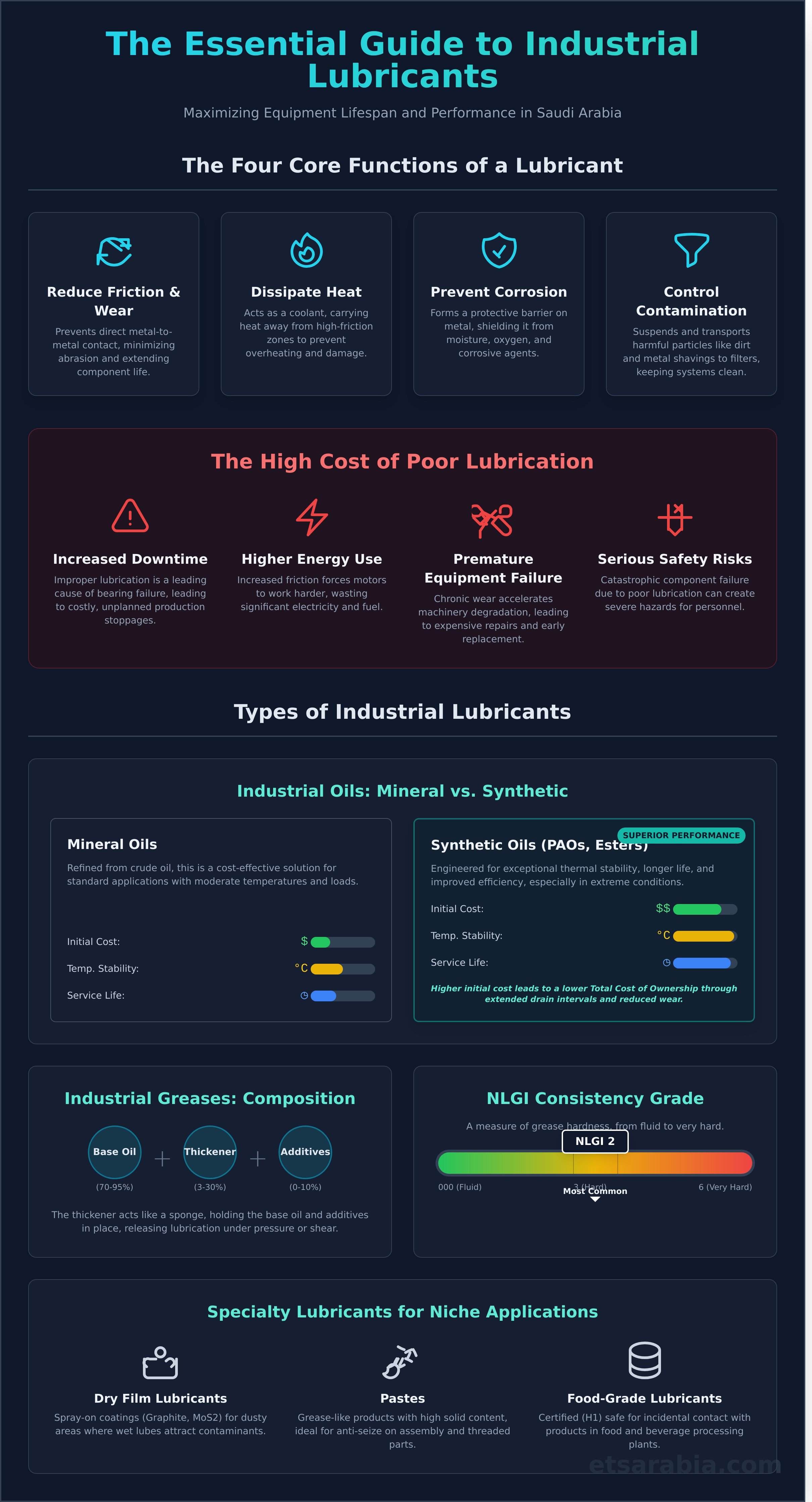
Beyond their primary role, high-performance lubricants fulfill four essential functions to ensure equipment reliability and longevity:
- Reduce Friction & Wear: By preventing direct metal-to-metal contact, lubricants minimize abrasive wear, extending the life of critical components.
- Dissipate Heat: They act as a coolant, carrying heat away from high-friction zones like bearings and gears to prevent overheating and component damage.
- Prevent Corrosion: Lubricants form a protective barrier on metal surfaces, shielding them from moisture, oxygen, and other corrosive agents.
- Control Contamination: They suspend and transport harmful particles-like dirt, metal shavings, and soot-to filters, keeping internal systems clean and functioning optimally.
Industrial vs. Automotive Lubricants: Key Differences
It is a common misconception to equate industrial lubricants with standard automotive oils. Industrial machinery operates under vastly different conditions, such as continuous, heavy loads and sustained high temperatures. Consequently, their lubricants are formulated with specific additive packages, like Extreme Pressure (EP) agents for gearboxes, that are not found in typical engine oil. Furthermore, they are designed for much longer service intervals to minimize operational downtime, a critical factor in any industrial setting.
The High Cost of Poor Lubrication
Neglecting a proper lubrication strategy is one of the most expensive mistakes a facility can make, often costing thousands of Riyals in secondary damages. The consequences extend far beyond a single component failure:
- Increased Downtime: Improper lubrication is the leading cause of bearing failure, resulting in unplanned and costly production stoppages.
- Higher Energy Consumption: Increased friction forces motors and engines to work harder, leading to significant waste in electricity and fuel consumption.
- Premature Equipment Failure: Chronic wear accelerates the degradation of expensive machinery, leading to costly repairs and premature capital replacement.
- Safety Risks: The catastrophic failure of a critical component due to poor lubrication can create serious safety hazards for personnel.
Types of Industrial Lubricants: Oils, Greases, and Specialty Fluids
Selecting the correct lubricant is a critical decision that directly impacts equipment reliability and operational efficiency. The choice is not arbitrary; it depends entirely on the application's design, load, speed, and operating environment. At their core, all industrial lubricants begin with a base oil, which can be either mineral or synthetic. This foundation is then enhanced with additives to achieve specific performance characteristics. For a deeper understanding of the core principles, the Society of Tribologists and Lubrication Engineers provides a comprehensive guide on Lubrication Fundamentals.
A simple way to differentiate the main categories is by their viscosity and application method: oil flows to lubricate and cool, while grease stays in place to provide long-lasting protection.
Industrial Oils: Mineral vs. Synthetic
Industrial oils are the most common type of lubricant, used in everything from hydraulic systems to gearboxes. The primary distinction lies in their base oil:
- Mineral Oils: Refined from crude oil, they are a cost-effective solution for standard applications with moderate temperatures and loads. They offer reliable performance where conditions are not extreme.
- Synthetic Oils (PAOs, Esters): These are man-made lubricants engineered for superior performance. They provide exceptional thermal stability at high and low temperatures, longer service life, and improved efficiency. While the initial investment is higher-often double the cost of mineral oils in the Saudi market-the extended drain intervals and reduced wear can significantly lower total cost of ownership.
Industrial Greases: Composition and Grades
Grease is essentially a sponge-like structure. It consists of a base oil held in place by a thickener (like a lithium or calcium soap), plus performance-enhancing additives. The thickener releases oil when under pressure or shear, providing lubrication exactly where it's needed. The consistency of grease is measured by its NLGI (National Lubricating Grease Institute) grade, which ranges from 000 (fluid, like cooking oil) to 6 (very hard, like a cheese block). NLGI 2 is the most common multi-purpose grade for applications like wheel bearings and chassis points.
Specialty Lubricants for Niche Applications
Beyond standard oils and greases, certain conditions demand highly specialized industrial lubricants:
- Dry Film Lubricants: Materials like graphite or Molybdenum Disulfide (MoS2) are used as a spray-on coating in dusty environments where a wet lubricant would attract contaminants.
- Pastes: These are grease-like products with a very high concentration of solid lubricants, ideal for anti-seize applications during assembly or on threaded components.
- Food-Grade Lubricants: Essential for food and beverage processing plants in Saudi Arabia, these lubricants are certified (H1, H2, H3) to be safe in case of incidental contact with products.
How to Select the Right Lubricant for Your Industrial Application
Selecting the correct industrial lubricant is a precise technical process, not an estimation. Choosing a product based on price or convenience alone often leads to premature equipment failure, unscheduled downtime, and significant operational losses. The common practice of using a single 'general purpose' lubricant across multiple applications is a costly mistake. The primary goal is to meticulously match the lubricant's chemical and physical properties to the specific demands of your machinery and its operating environment.
Matching Lubricants to Common Machinery
Different equipment types have unique lubrication requirements. A precise match ensures optimal performance and extends component life. Key examples include:
- Hydraulic Systems: These demand high-performance anti-wear (AW) hydraulic oils that offer excellent filterability and rapid water separation (demulsibility) to protect sensitive pumps and valves.
- Industrial Gearboxes: To protect gear teeth under intense pressure, lubricants must contain Extreme Pressure (EP) additives. These additives form a sacrificial layer on metal surfaces, preventing seizure and wear.
- Air Compressors: Compressor oils must have superior thermal and oxidative stability to resist the formation of carbon deposits (varnish) at high temperatures, ensuring clean operation and preventing blockages.
- Bearings: Selection is driven by speed. High-speed applications typically require lower-viscosity oils for heat dissipation, while low-to-moderate speed bearings are often best served by grease, which stays in place and provides a durable lubricating film.
Analyzing Your Operating Environment
Your facility's conditions directly impact lubricant performance. A comprehensive analysis of the operating environment is critical for selecting robust industrial lubricants that can withstand operational stresses.
- Temperature: Extreme heat or cold significantly alters a lubricant's viscosity. Synthetic base oils provide a much wider operating temperature range, ensuring consistent performance where conventional mineral oils would fail.
- Load & Speed: High-load applications require EP additives to prevent metal-to-metal contact. Conversely, high-speed machinery needs lower-viscosity fluids to minimize fluid friction and heat buildup.
- Contamination: Dusty or humid environments, common throughout Saudi Arabia (KSA), demand lubricants with excellent sealing properties and resistance to water. Controlling contamination also means adhering to strict lubricant storage and handling best practices to prevent ingress of dust and moisture before use.
The Importance of OEM Recommendations
Your first and most reliable source of information is always the Original Equipment Manufacturer (OEM). The OEM manual provides the definitive specifications for keeping your equipment running as designed. It will detail the required viscosity grade (e.g., ISO VG 46), base oil type (mineral or synthetic), and necessary performance standards (e.g., API, AGMA). Deviating from these recommendations can not only cause catastrophic equipment damage but will almost certainly void your warranty. When in doubt, always follow the OEM's guidance. Confused by your options? Get expert advice from our technical team.
Decoding the Technical Data Sheet (TDS): Key Properties to Understand
Think of the Technical Data Sheet (TDS) as the official identification card for any high-performance industrial lubricant. This document provides the precise technical specifications guaranteed by the manufacturer. Understanding how to read a TDS empowers your team to move beyond brand names and make data-driven decisions that enhance equipment reliability. The most critical step is to compare the lubricant's TDS directly against the requirements specified by your Original Equipment Manufacturer (OEM). This ensures perfect compatibility and prevents premature component failure, a key factor in minimizing operational downtime.
Viscosity: The Most Important Property
Viscosity is the single most important property of a lubricant, defining its resistance to flow at a specific temperature. It is classified using the standard ISO Viscosity Grade (VG) system, with common grades including ISO VG 32, 46, and 68 for hydraulic and circulating systems. Just as crucial is the Viscosity Index (VI), which measures how much the viscosity changes with temperature. A higher VI indicates greater stability, ensuring the lubricant maintains its protective film in the demanding high-temperature conditions common across Saudi Arabia.
Performance Additives and Their Meanings
Modern industrial lubricants are complex formulations where the additive package determines their performance under specific stresses. Key additives to identify on a TDS include:
- Anti-Wear (AW): These additives form a sacrificial film on metal surfaces to protect components like pumps, motors, and bearings from friction and wear under moderate to high loads.
- Extreme Pressure (EP): Designed for severe conditions, EP additives prevent catastrophic failure, such as welding and seizure, in high-load applications like industrial gearboxes and heavy machinery.
- Rust & Oxidation (R&O) Inhibitors: A fundamental additive package that protects metal surfaces from corrosion and slows the oil's chemical degradation, significantly extending its service life and optimizing maintenance schedules.
Other Critical Data Points
Beyond viscosity and additives, other data points provide a complete performance and safety picture. Always check for these metrics:
- Pour Point: The lowest temperature at which the oil will still flow. This is crucial for equipment that may experience cold starts or operate in cooler environments.
- Flash Point: The temperature at which the lubricant's vapors can ignite when exposed to a flame. This is a vital safety metric for high-temperature applications to prevent fire hazards in your facility.
- Water Separability (Demulsibility): The oil's ability to shed water. This is essential for hydraulic and circulating systems where water contamination can cause severe damage, corrosion, and lubricant failure.
Best Practices for Lubricant Storage and Management
Selecting the right lubricant is only the first step. The highest-quality formula will fail if it is contaminated or degraded before use. A structured management program for your industrial lubricants is essential to safeguard asset reliability, optimize performance, and generate significant cost savings. The foundation of this program is simple: keep your lubricants clean, cool, and dry.
Proper Storage and Handling Techniques
Effective handling begins with a controlled environment. To prevent contamination from dust, water, and the extreme temperatures common in Saudi Arabia, follow these proven techniques:
- Designated Indoor Storage: Always store lubricant drums and containers indoors in a clean, organized, and temperature-controlled area. This prevents degradation from UV exposure and contamination from environmental debris.
- Dedicated Transfer Equipment: Use sealed, dedicated pumps, containers, and funnels for each type of lubricant. This is the most effective way to prevent cross-contamination, which can compromise lubricant performance and damage machinery.
- Clear Labeling System: Implement a robust labeling system using color codes, tags, or clear text to identify the lubricant type and its intended application. This simple step prevents costly misapplication errors.
Implementing Lubrication Schedules
Proactive scheduling prevents lubrication-related failures and extends equipment life. A robust program moves beyond reactive maintenance and focuses on precision and planning. Start by developing a master schedule for all plant equipment based on Original Equipment Manufacturer (OEM) guidelines for re-lubrication intervals and volumes. For critical assets, consider implementing condition-based monitoring, such as regular oil analysis, to optimize change-out intervals and detect potential issues before they cause downtime.
Safety and Environmental Responsibility
Operating with a commitment to safety and environmental stewardship is non-negotiable. Before handling any lubricant, your team must consult its Safety Data Sheet (SDS) to understand potential hazards and handling requirements. Always use appropriate Personal Protective Equipment (PPE), including gloves and safety glasses. Furthermore, ensure all used oil, filters, and contaminated materials are disposed of responsibly and in full compliance with the environmental regulations set forth in Saudi Arabia. This protects your personnel and ensures your operations remain compliant.
Implementing these best practices will transform your lubrication strategy from a routine task into a powerful tool for enhancing operational efficiency. For expert support in designing and managing a world-class lubrication program for your facility, contact the reliability specialists at ETS.
Partnering with a Lubrication Expert in Saudi Arabia
Selecting the correct product is a critical first step, but optimizing its performance requires a strategic approach. To move from general knowledge to specific, high-performance solutions, you need more than a supplier-you need a technical partner. In the demanding industrial landscape of Saudi Arabia, partnering with a local expert is the key to minimizing downtime and maximizing equipment longevity.
Why Local Expertise Matters in the Kingdom
Operating machinery in Saudi Arabia presents unique challenges. Extreme ambient heat can degrade lubricant viscosity and accelerate oxidation, while pervasive dust and sand can contaminate systems and cause premature wear. A local partner like Emdad Technical Services (ETS) understands these realities intimately. Our value is built on:
- Local Insight: Deep understanding of how KSA’s climate impacts equipment and the specific needs of industries from petrochemicals to manufacturing.
- Rapid Response: With a central hub in Dammam, we provide fast access to extensive stock, prompt technical support, and on-site services across the Kingdom.
- Supply Chain Mastery: We efficiently navigate local supply chains to source both common and specialty industrial lubricants, ensuring you get what you need, when you need it.
Emdad's Value-Added Services
At ETS, our relationship doesn’t end with the sale. We provide comprehensive support designed to enhance your operational efficiency. We act as an extension of your team, offering services that deliver tangible results and reduce long-term costs.
- Lubricant Selection & Consolidation: We help you choose the most effective products for your applications and work to consolidate your inventory, reducing complexity and carrying costs.
- Troubleshooting & Analysis: Our experts assist in diagnosing lubrication-related failures, identifying root causes to prevent future occurrences and protect your assets.
- Integrated Solutions: Our deep expertise in hydraulics and power transmission means we understand how lubricants affect entire system performance, ensuring a holistic approach to reliability.
Optimize Your Operations with ETS
Your choice of lubrication partner directly impacts your bottom line. Our primary goal is to enhance your productivity by providing reliable products and the expert guidance to use them effectively. It’s time to move beyond simply buying oil and invest in a comprehensive lubrication strategy that reduces operational costs and guarantees performance. Let us show you how the right partnership can keep your operations moving forward with confidence. Contact ETS today to discuss your lubrication needs in Saudi Arabia.
Your Partner in Optimizing Industrial Lubrication
In the demanding industrial environment of Saudi Arabia, the strategic selection, application, and management of your lubricants are fundamental to operational success. As we've explored, understanding the nuances of different lubricant types and decoding technical data sheets are not just best practices-they are essential for protecting your high-value assets, minimizing wear, and ensuring peak performance. This proactive approach to using industrial lubricants is the first line of defense against costly, unplanned downtime.
Choosing the right partner is just as critical as choosing the right product. At Emdad Technical Services (ETS), we deliver reliability. With expert technical support dedicated to Saudi Arabia's core industries and strategic partnerships with leading global lubricant brands, we have a proven track record of reducing equipment downtime for clients in Dammam and beyond. Let our specialists provide a solution engineered for your specific challenges.
Take the next step towards unparalleled efficiency and reliability. Request a consultation with our lubrication specialists to optimize your equipment performance. Let's work together to keep your operations moving forward.
Frequently Asked Questions About Industrial Lubricants
How often should I change the oil in my industrial machinery?
The ideal oil change interval depends on several factors: the Original Equipment Manufacturer's (OEM) recommendations, operating conditions like temperature and contamination levels, and the hours of operation. For optimal performance and to prevent costly downtime, we recommend implementing a regular oil analysis program. This data-driven approach provides the most accurate assessment of oil condition, ensuring you change lubricants only when necessary, which maximizes asset life and reduces waste.
Can I mix different brands or types of industrial oils or greases?
It is strongly advised not to mix different industrial lubricants, even if they are of the same type. Different brands use unique additive packages that can be incompatible, leading to a loss of performance, sludge formation, and potential equipment failure. This can cause unexpected and expensive operational interruptions. For reliable performance, always drain and flush a system completely before introducing a new lubricant, or consult with a lubrication expert to ensure compatibility.
What is the difference between hydraulic oil and gear oil?
While both are vital lubricants, they serve distinct functions. Hydraulic oil is primarily designed to transfer power in hydraulic systems, while also cooling and lubricating components. It contains anti-wear, anti-foam, and anti-oxidation additives. Gear oil is formulated for high-pressure applications in gearboxes, containing extreme pressure (EP) additives to protect gear teeth from wear under intense loads. Using the wrong fluid can lead to catastrophic system failure and significant downtime.
How do I know if I'm using too much or too little grease on a bearing?
Both over- and under-greasing can cause bearing failure. Over-greasing can lead to increased friction, high operating temperatures, and damaged seals. A key sign is grease purging excessively from the seals. Under-greasing results in metal-to-metal contact, indicated by unusual noises like squealing or grinding and elevated temperatures. The most reliable method is to follow the OEM's guidelines for grease volume and frequency or utilize ultrasonic equipment for precise application.
What are the signs that a lubricant is failing or needs to be replaced?
Visual and sensory checks can reveal lubricant degradation. Key signs include a significant change in color (e.g., darkening), a burnt or acrid odor, or a noticeable change in viscosity (feeling thicker or thinner). A milky or cloudy appearance indicates water contamination, while the presence of sludge, sediment, or metal particles points to severe degradation. Regular oil analysis is the most effective way to detect these issues before they cause equipment damage.
Are synthetic lubricants worth the extra cost compared to mineral oils?
While the initial purchase price of synthetic lubricants can be higher, often ranging from 150 ﷼ to over 300 ﷼ per litre, they frequently provide a lower total cost of ownership. Synthetics offer superior thermal stability, extended drain intervals, and enhanced equipment protection in extreme conditions. These benefits lead to reduced maintenance, lower energy consumption, and most importantly, minimized operational downtime, making them a cost-effective solution for critical applications in the demanding Saudi industrial environment.