
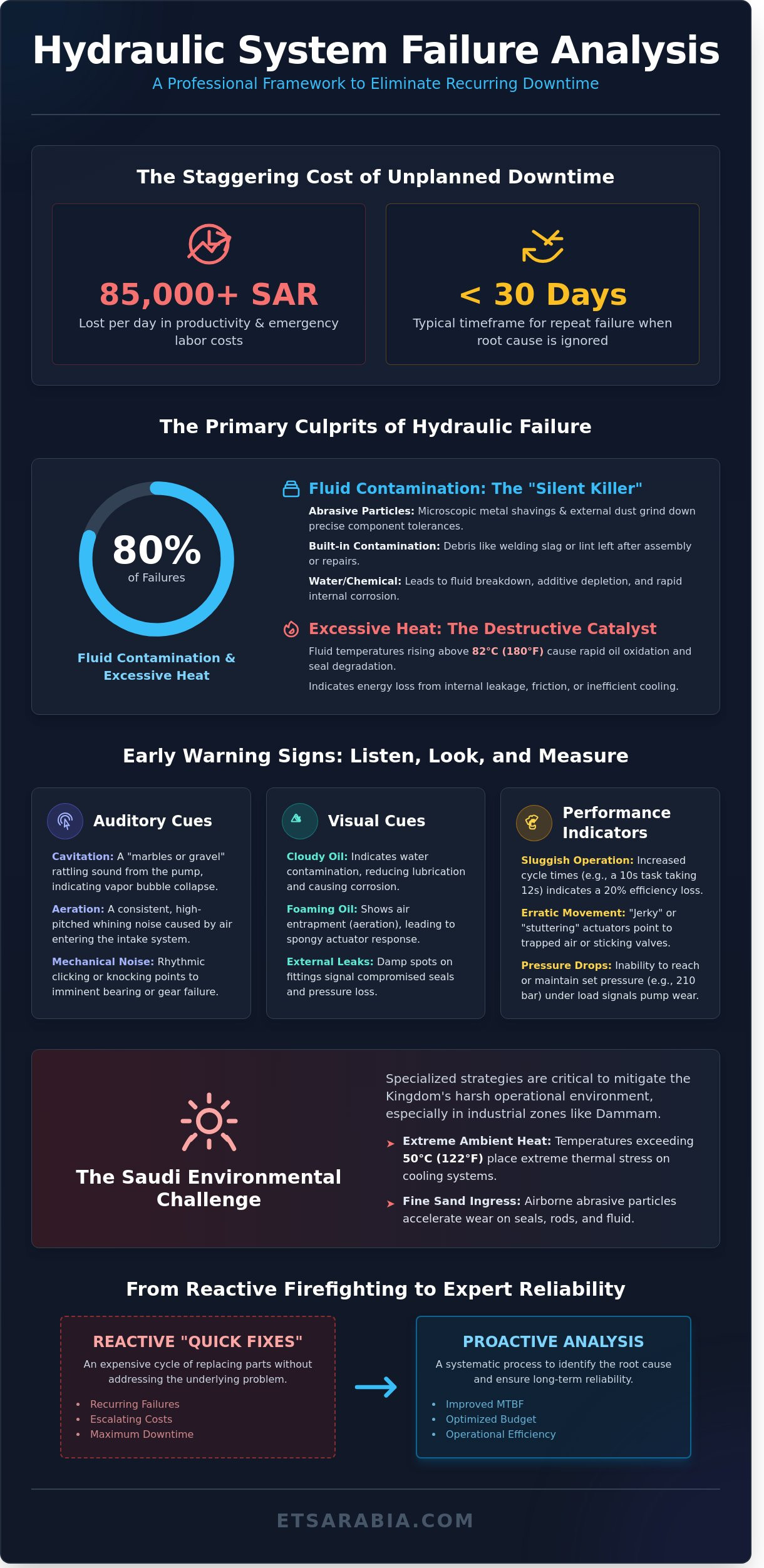
A single day of unplanned downtime at a Saudi industrial facility can drain more than 85,000 SAR from your bottom line in lost productivity and emergency labor costs. It's a common frustration to replace a damaged component only to have the system fail again within 30 days because the underlying issue was never addressed. You understand that quick fixes are often just expensive bandages that don't solve the core problem. This guide delivers a professional framework for hydraulic system failure analysis, designed to help you identify root causes with surgical precision. By adopting this systematic approach, you'll stop the cycle of recurring repairs, reduce your annual maintenance spend, and significantly improve your Mean Time Between Failures (MTBF). We'll outline a proven six-step diagnostic sequence used by ETS experts to shift your strategy from reactive firefighting to expert reliability management, ensuring your operations in the Kingdom remain efficient and profitable.
Key Takeaways
- Learn to identify early warning signs of system degradation by distinguishing between sudden catastrophic failures and subtle indicators like abnormal high-pitched whining.
- Understand why fluid contamination and extreme heat are the primary drivers of hydraulic system failure analysis, accounting for up to 80% of industrial breakdowns.
- Master a systematic diagnostic process that utilizes visual inspections and historical maintenance logs to uncover recurring patterns and prevent future downtime.
- Discover specialized strategies to mitigate the impact of Saudi Arabia’s 50°C+ ambient temperatures and fine sand ingress on cooling system efficiency in industrial zones like Dammam.
- Implement a professional "Repair vs. Replace" decision matrix for pumps and cylinders to optimize your maintenance budget and ensure long-term operational reliability.
Recognizing the Symptoms of Hydraulic System Failure
Early detection is the most effective way to minimize operational downtime. While a sudden catastrophic failure stops production instantly, 80% of hydraulic issues develop through gradual performance degradation. This slow decline often goes unnoticed until it leads to a total breakdown. Identifying these signs early through a systematic Failure Mode and Effects Analysis (FMEA) approach allows operators to schedule repairs before costs escalate. In the industrial sectors of Saudi Arabia, where high-pressure environments are standard, conducting a regular hydraulic system failure analysis is a critical maintenance pillar.
Heat serves as both a primary symptom and a destructive catalyst. In Saudi Arabia, ambient temperatures frequently exceed 45°C, placing extreme thermal stress on machinery. If your fluid temperatures rise above 82°C, seal damage and oil oxidation occur rapidly. Excessive heat indicates that the system is losing energy through internal leakage or friction. Beyond temperature, visual indicators provide immediate clues. Cloudy oil suggests water contamination, while foaming indicates air entrapment. External leakage patterns, even small damp spots on fittings, signal that internal pressure is already compromised.
Auditory Cues: What Your System is Telling You
Listening to your equipment is a fundamental diagnostic step. You must distinguish between cavitation and aeration to identify the root cause. Cavitation is the formation and collapse of vapor bubbles in the fluid. It creates a distinct sound similar to marbles or gravel rattling inside the pump. Aeration produces a consistent, high-pitched whining sound caused by air entering the system through a loose intake connection or a damaged shaft seal. Mechanical clicks or rhythmic knocking often signal that bearings or gear teeth are failing. These sounds aren't just annoyances; they're warnings of imminent component destruction.
Performance Indicators: Sluggishness and Pressure Drops
Changes in machine speed are clear indicators of health. When cycle times increase, it's a sign of internal bypass or pump inefficiency. For example, if a standard 10-second cylinder extension now takes 12 seconds, your system has suffered a 20% loss in efficiency. This sluggishness often stems from fluid bypassing worn seals. Erratic actuator movement, such as "jerky" or "stuttering" strokes, typically points to air entrapment or sticking control valves. You should also monitor pressure gauge fluctuations during peak loads. If the needle bounces or fails to reach the required 210 bar (3,000 PSI) set point, the pump is likely struggling to maintain flow under resistance. Addressing these performance drops immediately ensures your systems stay in motion and helps avoid the ﷼50,000+ costs associated with major pump replacements.
The 4 Primary Root Causes of Hydraulic Failure
Effective hydraulic system failure analysis begins with the realization that mechanical breakdowns are rarely random events. Most issues stem from identifiable environmental or operational factors. Industry data confirms that 75% of component failures are directly linked to the condition of the hydraulic fluid. These problems often develop slowly, remaining hidden until a critical component fails and brings production to a standstill. In the Saudi industrial sector, where a single day of unplanned downtime can cost an operation upwards of 75,000 SAR, understanding these root causes is essential for maintaining a competitive edge.
Fluid contamination is widely recognized as the "Silent Killer" of hydraulic machinery. It's responsible for 70% to 80% of all system failures. When microscopic particles enter the high-pressure stream, they act as an abrasive grinding paste. This destroys the tight tolerances required for pumps and valves to function correctly. Beyond particles, temperature extremes and human error play significant roles in degrading system health. A thorough hydraulic system failure analysis must account for the interplay between these variables to prevent recurring issues.
Contamination: Particle and Chemical
Abrasive wear is frequently caused by metal shavings from internal wear or external dust entering through damaged seals. However, "built-in" contamination is a hidden threat. This occurs when systems aren't properly flushed after assembly or repair, leaving welding slag or lint inside the circuit. Water contamination is equally destructive. It leads to additive depletion and rapid component corrosion. This chemical breakdown is detailed in this official FMEA report, which demonstrates how fluid degradation triggers cascading mechanical failures across complex systems.
The Viscosity Trap: Temperature and Fluid Selection
Saudi Arabia’s climate presents a unique challenge, with summer ambient temperatures often exceeding 50°C. When oil becomes too thin due to overheating, it loses the film strength necessary to prevent metal-on-metal contact. This leads to rapid scuffing and pump seizure. Conversely, using the wrong fluid grade for the local environment is a common mistake that compromises efficiency. While less frequent in the desert, cold-start cavitation can occur in temperature-controlled food processing plants if proper heaters aren't utilized. Choosing the right hydraulic lubricants and filtration solutions is the first step in stabilizing these thermal variables.
Human error and air ingress round out the primary causes of failure. Approximately 22% of service calls result from improper installation or the use of incorrect replacement parts. Air entering the system causes aeration and cavitation, which creates loud knocking noises and erodes metal surfaces. When air mixes with oil under high pressure, it leads to oxidation. This process thickens the oil and creates a sludge that plugs filters and restricts flow, eventually starving the pump of necessary lubrication.
A Step-by-Step Guide to Hydraulic System Failure Analysis
Executing a precise hydraulic system failure analysis requires a methodical approach to minimize downtime and avoid unnecessary component replacement. At ETS, we emphasize a structured five step process to identify the root cause of any malfunction quickly. This protocol ensures your operations in Saudi Arabia maintain peak efficiency while reducing the risk of repeat issues.
Initial Inspection and Documentation
The process begins by securing the area to ensure technician safety. Perform a visual inspection before applying power. Check fluid levels and quality immediately. Dark, cloudy fluid suggests oxidation or water contamination, which accounts for nearly 75% of hydraulic failures in high-temperature environments. Inspect every fitting, hose, and cylinder rod for external leaks. A single leak dripping once per second wastes over 1,500 SAR of hydraulic oil annually. Interviewing the operator is vital; ask for the exact time of the failure and any unusual sounds heard during the previous shift. This historical context often points directly to the source of the trouble.
Technical Testing and Component Isolation
Review the maintenance logs for recurring patterns or recent part replacements. Once history is established, conduct sensory checks under controlled operation. Listen for the high-pitched whine of aeration or the rattling of cavitation. Feel for localized heat at valves, which indicates internal bypass. Applying a systematic approach similar to a Failure Mode and Effects Analysis (FMEA) case study ensures no critical failure point is overlooked during this phase. Use calibrated flow meters to verify pump output against the original manufacturer specifications. If a pump rated for 100 liters per minute only delivers 80, internal wear is likely. Test relief valves to ensure they crack at the correct pressure. You can isolate cylinder bypass by monitoring the rod movement under a static load while the control valve is centered.
Teardown and Root Cause Determination
The final step in a comprehensive hydraulic system failure analysis is the physical teardown of suspected components. Open the pump or motor to inspect the internals for scoring, pitting, or heat-related discoloration. Analyze seal failures with precision. Brittle seals usually indicate excessive operating temperatures, often exceeding 85°C, while torn seals suggest installation errors or pressure spikes. Document every finding with photos and measurements. This data allows for the implementation of corrective actions, such as upgrading filtration or adjusting cooling cycles, to prevent the same failure from recurring in future maintenance cycles. By following these steps, you protect your investment and keep your industrial equipment moving forward without costly interruptions.
Environmental Factors: Failure Analysis in Saudi Arabia
Saudi Arabia's climate presents a hostile environment for industrial machinery. Ambient temperatures regularly exceed 50°C during the summer months, creating a massive thermal load on every component. This extreme heat reduces the temperature differential required for efficient cooling, often causing systems to run at dangerous levels. A comprehensive hydraulic system failure analysis frequently reveals that standard components designed for European or North American climates cannot dissipate heat effectively in the Gulf. High UV indices also accelerate the degradation of standard rubber hoses, leading to premature cracking and catastrophic leaks within 12 to 18 months of service.
Heat Management in the Gulf Region
Standard heat exchangers often fail in the Saudi summer because the narrow temperature delta between the oil and the scorching ambient air prevents effective heat transfer. When ETS engineers conduct onsite inspections, we find that sand accumulation in cooling fins reduces airflow by up to 40% in desert sites. This leads to rapid seal hardening and internal leakage that degrades system precision. Lubricants used in KSA must maintain a high viscosity index and superior thermal-oxidative stability to prevent additive depletion and varnish formation during peak summer operations. Monitoring oil coolers for external clogging is a daily requirement, not a weekly one, to prevent thermal runaway.
Dust and Contamination Control
Contamination control is critical in Dammam’s 2nd Industrial City and surrounding industrial zones. The local environment is saturated with fine silica dust that easily bypasses standard 10-micron filters. Selecting high-efficiency breathers with desiccant stages is the only reliable way to protect the reservoir from both dust and the high humidity found in coastal operations like Jubail or Jeddah. Humidity leads to water contamination, which causes oil emulsification and loss of lubricity.
- Chrome Shaft Protection: Specialized bellows or heavy chrome plating are necessary for cylinders to prevent abrasive scoring in desert environments.
- High-Efficiency Breathers: Systems should utilize 3-micron absolute-rated breathers to block microscopic particles.
- UV-Resistant Hoses: Hoses must be rated for extreme thermal cycles to prevent the outer cover from "alligatoring" under intense sunlight.
Our hydraulic system failure analysis protocols show that 82% of premature pump failures in the Eastern Province stem from inadequate filtration in these high-dust environments. Implementing upgraded filtration and cooling protocols can save operators over 18,500 SAR per year in avoidable component replacement costs. We've seen that systems using standard configurations fail 3 times faster than those optimized for local Saudi conditions.
Minimizing Downtime: Moving from Analysis to Action
Completing a detailed hydraulic system failure analysis is only the first step toward operational excellence. To achieve 99% equipment availability, you must convert diagnostic data into a structured action plan. This transition shifts your operations from reactive firefighting to a controlled, proactive environment where downtime is a planned event rather than an emergency.
Implementing Proactive Maintenance
Data from industrial studies confirms that 80% of hydraulic failures stem from fluid contamination. Implementing a rigorous oil analysis program every 500 operating hours allows you to detect microscopic wear particles before they cause a total breakdown. Training your on-site staff to recognize early warning signs, such as a 10% increase in cycle times or a 5-degree Celsius rise in reservoir temperature, can save your facility over 50,000 SAR in catastrophic repair costs. For immediate assistance with ongoing issues, it's vital to leverage Fast Hydraulic Repair Services to restore your system's integrity quickly.
- Predictive Sampling: Test fluid quarterly to monitor additive depletion and particle counts.
- Staff Empowerment: Ensure technicians can identify aeration and cavitation by sound alone.
- Documentation: Log every hydraulic system failure analysis to identify recurring patterns in specific machinery.
The "Repair vs. Replace" decision is a critical financial junction. At ETS, we recommend the 60% rule: if the cost to refurbish a pump or cylinder exceeds 60% of a new unit's price, replacement is the more economical long-term strategy. We prioritize sourcing high-quality components from industry leaders like Parker and Rexroth. By utilizing local KSA suppliers, you reduce lead times by up to 12 days, ensuring that high-performance parts are on your floor when you need them most.
Partnering with ETS for Technical Support
Our Dammam-based workshop is specifically designed to accelerate the repair cycle for the Kingdom’s industrial sector. We understand that every hour of lost production impacts your bottom line. Our team doesn't just replace seals; we conduct deep-dive engineering reviews to solve the root causes of recurring system-wide failures. Since 2021, our custom HPU designs have helped petrochemical and construction partners in the Eastern Province reduce their annual maintenance spend by 22%.
Whether you're facing a sudden pressure drop or need a complete system overhaul, our experts provide the technical precision required for high-stakes environments. We offer a level of assurance that only comes from decades of local experience and global technical standards. Contact ETS for professional hydraulic failure analysis and repair to ensure your operations stay in motion with reliable, expert-backed solutions.
Master Your System Reliability Through Expert Analysis
Effective hydraulic system failure analysis transforms reactive repairs into a strategic maintenance advantage. You've learned how recognizing early symptoms like aeration or overheating prevents high-cost failures that can exceed 50,000 SAR in lost production time. In the harsh operating environments of Saudi Arabia, temperature extremes and dust ingress make these diagnostic steps essential for industrial survival. Don't let a minor seal leak turn into a catastrophic pump failure. As an authorized distributor for global leaders like Parker and Rexroth, Emdad Technical Services (ETS) provides the precision parts and engineering expertise required for complex systems. We're strategically located in the heart of Dammam 2nd Industrial City to ensure rapid response times across the Eastern Province. Our team provides 24/7 Emergency Repair Support because we know every minute of downtime impacts your bottom line. Your operations deserve the highest standard of technical care.
Minimize your downtime; Book an Expert Hydraulic Inspection with ETS today
Frequently Asked Questions
What is the most common cause of hydraulic system failure?
Particulate contamination is the primary cause of breakdown, accounting for 80% of all hydraulic system failures in industrial environments. These microscopic particles damage precision components like valves and cylinders, which leads to internal leakage and significant loss of efficiency. By implementing a strict filtration protocol, you can extend your component life by up to 300%. ETS provides the filtration solutions needed to maintain peak performance and prevent these costly interruptions.
How can I tell if my hydraulic pump is failing?
Increased noise levels and reduced cycle times are the most immediate indicators that your hydraulic pump is failing. If you hear a high-pitched whining or grinding sound, it often signals internal wear or air ingestion. A pump's external temperature exceeding 82°C is another critical warning sign that requires attention. We recommend an immediate inspection to avoid total system collapse; a proactive pump replacement costs significantly less than a full system flush.
Why is my hydraulic oil turning milky or cloudy?
Milky or cloudy oil indicates that water has contaminated your hydraulic fluid, often due to condensation or a leaking heat exchanger. Even a water concentration as low as 0.1% can reduce the fluid's lubricity and cause rapid corrosion of internal parts. You should use a water removal filter or perform a complete oil change if moisture levels exceed 500 ppm. This ensures your system maintains the reliable performance guaranteed by ETS standards.
What are the signs of cavitation in a hydraulic system?
Cavitation produces a distinct rattling sound that resembles gravel shaking in a metal bucket. This occurs when vapor bubbles form in the oil and collapse violently against metal surfaces, creating localized pressure spikes up to 1,000 bar. You'll notice metallic debris in your filters and a sudden loss of hydraulic pressure during operation. Addressing suction line restrictions immediately is vital to prevent permanent damage to your pump housing and internal components.
How often should I perform oil analysis on my hydraulic equipment?
You should conduct a comprehensive oil analysis every 500 to 1,000 operating hours depending on the intensity of your specific application. For critical equipment in the Saudi Arabian petrochemical sector, a monthly sampling schedule is the industry standard. Regular testing allows for a precise hydraulic system failure analysis by identifying wear metals like iron or copper before a catastrophic breakdown occurs. This data-driven approach helps in optimizing downtime for your entire facility.
Can I continue to operate a hydraulic system that is overheating?
No, you shouldn't operate a system if the oil temperature exceeds 85°C. High temperatures cause the oil's viscosity to drop, leading to inadequate lubrication and the rapid degradation of rubber seals. Operating at these levels for even 60 minutes can cut the lifespan of your hydraulic hoses by 50%. It's more cost-effective to pause operations for a cooling circuit check than to face a SAR 20,000 repair bill for a seized motor.
What is the difference between hydraulic system troubleshooting and failure analysis?
Troubleshooting is the process of identifying and fixing a specific symptom to get the machine running again, while hydraulic system failure analysis focuses on identifying the root cause to prevent recurrence. Troubleshooting might involve replacing a blown fuse or a leaking hose. Failure analysis involves metallurgical testing or fluid chemistry reviews to understand why that hose failed after only 200 hours. ETS experts specialize in both to ensure long-term operational reliability.
How does Saudi Arabia’s climate affect hydraulic hose lifespan?
The extreme Saudi climate, with summer temperatures regularly hitting 50°C, accelerates the thermal degradation of hydraulic hose covers. Intense UV exposure causes the outer rubber to crack within 18 months if the hoses aren't properly shielded or treated. These cracks allow moisture and sand to reach the wire reinforcement, leading to premature bursts and safety hazards. We recommend using hoses with high-temperature ratings and UV-resistant coatings to ensure your equipment survives the harsh local environment.