A single catastrophic hydraulic hose failure can halt production for over 12 hours, costing a typical Saudi industrial facility upwards of 300,000 SAR in lost revenue and emergency repair costs. You already know that in a 24/7 operational environment, every component's reliability is non-negotiable. The risk of high-pressure fluid injection injuries and costly environmental cleanups is a constant concern for any safety-conscious manager, and reactive maintenance is a drain on your bottom line.
This guide moves beyond basic checklists to deliver expert-level solutions. We will provide the definitive strategies on how to prevent hydraulic hose bursts, ensuring your equipment meets rigorous SAE and ISO standards for maximum operational integrity. From advanced inspection techniques to selecting the correct hose assemblies for the demanding climate of the Kingdom, you'll gain the practical knowledge needed to achieve zero unplanned downtime and enhance the lifespan of your critical hydraulic systems.
Key Takeaways
- Master the STAMPED framework to ensure you select the correct hose for your specific industrial application, preventing premature failure and optimizing performance.
- Discover why proper routing and allowing for a 5% slack during installation are critical steps that significantly extend hose life and enhance operational safety.
- Learn how to prevent hydraulic hose bursts by implementing a proactive maintenance schedule, shifting from a costly 'run-to-fail' model to a predictive one.
- Identify the hidden environmental and operational factors-from pressure spikes to abrasion-that cause most hose failures, allowing you to mitigate risks before they lead to expensive downtime.
The Critical Impact of Hydraulic Hose Bursts on Industrial Productivity
A hydraulic hose burst is more than a simple equipment malfunction; it's a catastrophic failure that instantly halts operations. Defined as the sudden rupture of a hose assembly due to extreme internal pressure or external physical damage, a burst releases high-pressure fluid, posing immediate and severe risks. For industries across Saudi Arabia, from manufacturing hubs in Dammam to petrochemical plants in Jubail, these events trigger a domino effect of financial loss, safety hazards, and regulatory scrutiny. The core challenge isn't just fixing the break; it's understanding how to prevent hydraulic hose bursts from ever occurring. In modern industrial settings, a reactive approach is no longer sustainable; prevention is the only viable strategy to guarantee operational continuity and personnel safety.
The Financial Reality of Unplanned Downtime
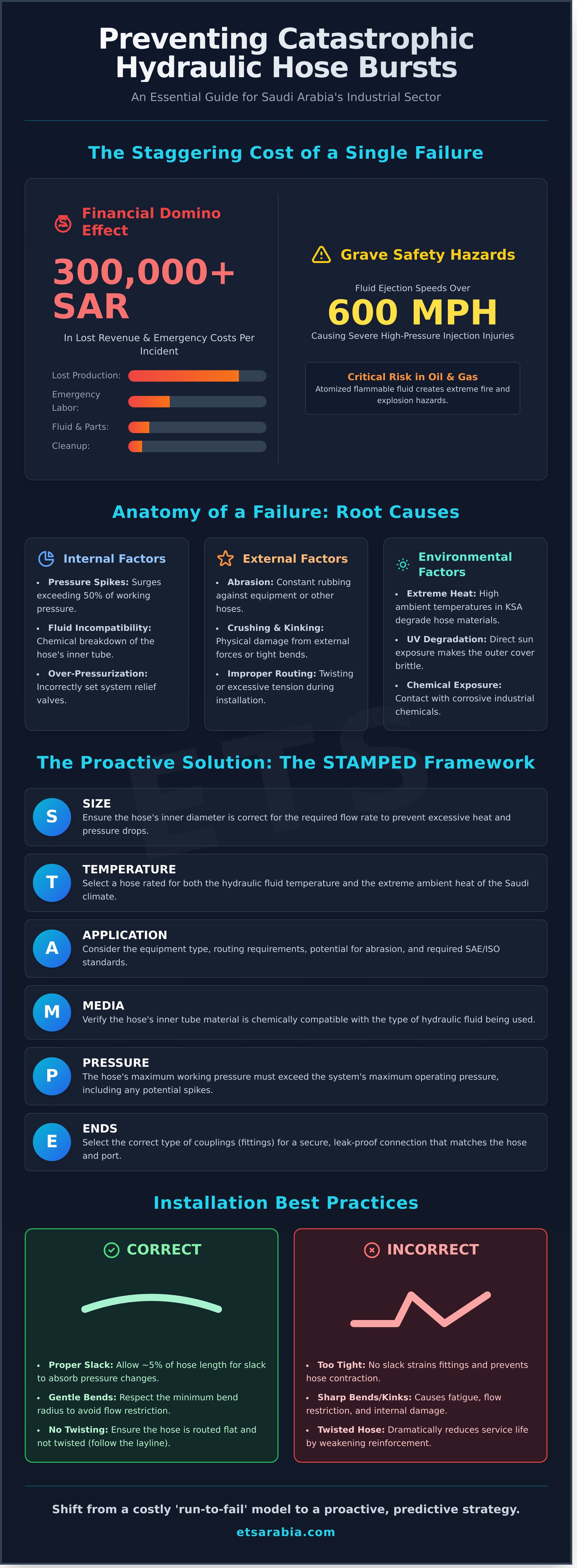
The true cost of a hose failure extends far beyond the component's price. Consider a mid-sized Dammam manufacturing plant where operational downtime costs an estimated ﷼15,000 per hour. A single burst hose, which might cost only ﷼400 to replace, can easily trigger a three-hour shutdown. The result is a staggering operational loss of at least ﷼45,000 from lost production alone. When you add the cost of replacing 200 liters of specialized hydraulic fluid (﷼2,500), emergency labor, and environmental cleanup (﷼5,000), a seemingly minor component failure escalates into a ﷼52,500 incident. Furthermore, the sudden loss of pressure can cause catastrophic long-term damage to pumps and valves, leading to future failures and even greater expenses.
The safety implications of a hose burst are severe and cannot be overstated. A pinhole leak in a hose operating at 3,000 PSI can eject fluid at over 600 mph, fast enough to penetrate skin and cause high-pressure injection injuries. These are serious medical emergencies that can lead to amputation or worse. In Saudi Arabia's vital oil and gas sector, the risk is amplified. A burst can atomize flammable hydraulic oil, creating a highly combustible vapor cloud. In the presence of an ignition source-a common reality on rigs and at refineries-the result can be a catastrophic fire, endangering lives and threatening multi-million riyal assets.
Regulatory and Safety Compliance in Saudi Arabia
Meeting stringent safety standards is non-negotiable. While global benchmarks like SAE J1273 provide a framework for hose assembly quality, major industrial operators in the Kingdom often have their own site-specific requirements. Adhering to these local standards is critical for securing and maintaining contracts. High-quality, certified components are not just best practice; they are a prerequisite for compliance. Under Saudi labor law, employers are liable for ensuring a safe working environment. Meticulous preventive maintenance records serve as crucial evidence of due diligence, protecting the company and its leadership in the event of an incident. These records prove that proactive steps were taken to mitigate risks.
Ultimately, a proactive maintenance culture is essential. Beyond regular inspections, understanding how to prevent hydraulic hose bursts involves adopting engineered solutions. This includes specifying hoses that meet or exceed SAE standards for the application's pressure and temperature demands. It also means considering advanced safety mechanisms like a hydraulic fuse safety feature, which can automatically shut off fluid flow during a catastrophic failure, minimizing fluid loss and equipment damage. By shifting focus from reactive repair to proactive prevention, Saudi industries can protect their people, their productivity, and their profitability.
Common Causes of Hydraulic Hose Failure in Extreme Environments
A hydraulic hose burst is rarely a spontaneous event. It's the final, catastrophic result of accumulated damage from a combination of internal, external, and environmental pressures. In demanding industrial settings across Saudi Arabia, from the construction sites of Riyadh to the petrochemical plants in Jubail, these factors are amplified. Understanding these distinct failure modes is fundamental to knowing how to prevent hydraulic hose bursts and protect both personnel and assets.
The primary culprits can be categorized into three groups:
- Internal Factors: These originate within the hydraulic system itself. Transient pressure spikes, which can exceed a hose's maximum working pressure by over 50%, cause immense stress. Fluid incompatibility, where the hydraulic fluid chemically degrades the hose's inner tube, leads to contamination and eventual rupture. Finally, simple over-pressurization from an incorrectly set relief valve places the entire assembly under constant, unsustainable strain.
- External Factors: Mechanical damage is a leading cause of premature failure. This includes abrasion from hoses rubbing against machine parts, crushing from equipment impact, and improper routing that creates sharp bends, putting excessive stress on the fittings and hose structure.
- Environmental Factors: The operational environment, particularly in the Kingdom, plays a decisive role in a hose's lifespan. Extreme heat, UV radiation, and abrasive dust all conspire to accelerate degradation and weaken the hose assembly from the outside in.
Temperature and UV Degradation
The intense Saudi sun is a formidable adversary for rubber compounds. During summer months, ambient temperatures regularly exceed 50°C, a condition that significantly accelerates the aging process of a hose's outer cover. This prolonged exposure to heat and UV radiation leaches the plasticizers from the rubber, causing it to become hard and brittle. Operators should look for tell-tale signs of "cracking" or "sun-checking" on the hose exterior. This isn't just a cosmetic issue; it's a clear indicator that the hose has lost its flexibility and is vulnerable to failure. This external heat is compounded by the internal fluid temperature, which can weaken the crucial reinforcement layers, creating a two-front assault on the hose's integrity.
Mechanical Wear and Abrasion
In any dynamic system, constant vibration and movement are unavoidable. When hoses are routed improperly, they can rub against each other or against metal components, gradually wearing away the protective outer cover. This seemingly minor issue can quickly escalate. We call this the "Dammam Factor": the pervasive sand and dust in the region act as a highly effective abrasive agent. These fine silica particles work their way between contact surfaces, essentially functioning like 80-grit sandpaper on the hose's exterior. This constant friction compromises the protective layer, exposing the steel reinforcement to moisture and corrosion. The resulting weakness dramatically increases the risk of a burst, a hazard detailed in the NIOSH Alert on Hydraulic Hose Injuries, which documents the severe consequences of such failures. A proactive approach, including professional hose inspection and management programs, is the most effective strategy to mitigate these risks and ensure operational continuity.
The STAMPED Method: A Professional Framework for Hose Selection
In high-stakes industrial environments, precision isn't optional; it's the foundation of safety and operational uptime. The most effective strategy for how to prevent hydraulic hose bursts begins long before a hose is ever installed. It starts with a rigorous selection process guided by the industry-standard STAMPED method. This proven framework ensures every aspect of the hose assembly is perfectly matched to its operational demands, eliminating guesswork and significantly reducing the risk of catastrophic failure.
The STAMPED acronym provides a comprehensive checklist for any technician or engineer:
- Size: The hose's inner diameter (ID), outer diameter (OD), and overall length.
- Temperature: The maximum internal fluid temperature and external ambient temperature.
- Application: The equipment type, routing requirements, and environmental conditions.
- Material: The type of fluid being conveyed and the required chemical compatibility.
- Pressure: The system's maximum working pressure, including any potential surges or spikes.
- Ends: The style, type, orientation, and attachment methods for fittings.
- Delivery: The volume of fluid that must be moved within a specific timeframe.
Opting for a generic, "cheaper" hose might seem like a minor cost-saving measure, perhaps saving 200-300 SAR on an initial purchase. However, this decision often leads to the most expensive failures. A single burst hose on a critical production line in Jubail can halt operations, costing a facility upwards of 150,000 SAR for every hour of downtime. When you factor in cleanup costs, potential equipment damage, and serious safety risks, the true cost of a low-quality hose becomes clear. Using the STAMPED method to select a premium hose from a trusted brand like Parker or Rexroth isn't an expense; it's an investment in guaranteed reliability.
Pressure and Temperature Rating
A hose's pressure rating is its most critical safety specification. Reputable manufacturers engineer hoses with a 4:1 safety factor, meaning a hose with a 3,000 PSI maximum working pressure is designed to withstand a minimum burst pressure of 12,000 PSI. This buffer is essential for absorbing unexpected pressure surges. For operations in Saudi Arabia, consider specialized covers for high-heat zones or abrasion-resistant guards for equipment exposed to sand and dust, ensuring the hose's integrity in harsh conditions.
Ends and Fittings Compatibility
A hose assembly is only as strong as its weakest link, which is often the connection point. Mixing a hose from one manufacturer with a fitting from another creates an unvalidated, high-risk assembly that voids warranties and introduces dangerous failure points. Proper crimping with manufacturer-specified equipment is non-negotiable. Our technicians at ETS are trained to precisely identify thread types like NPT, JIC, and BSP to guarantee a secure, leak-proof seal that withstands system pressure and vibration.
Best Practices for Installation and Protective Routing
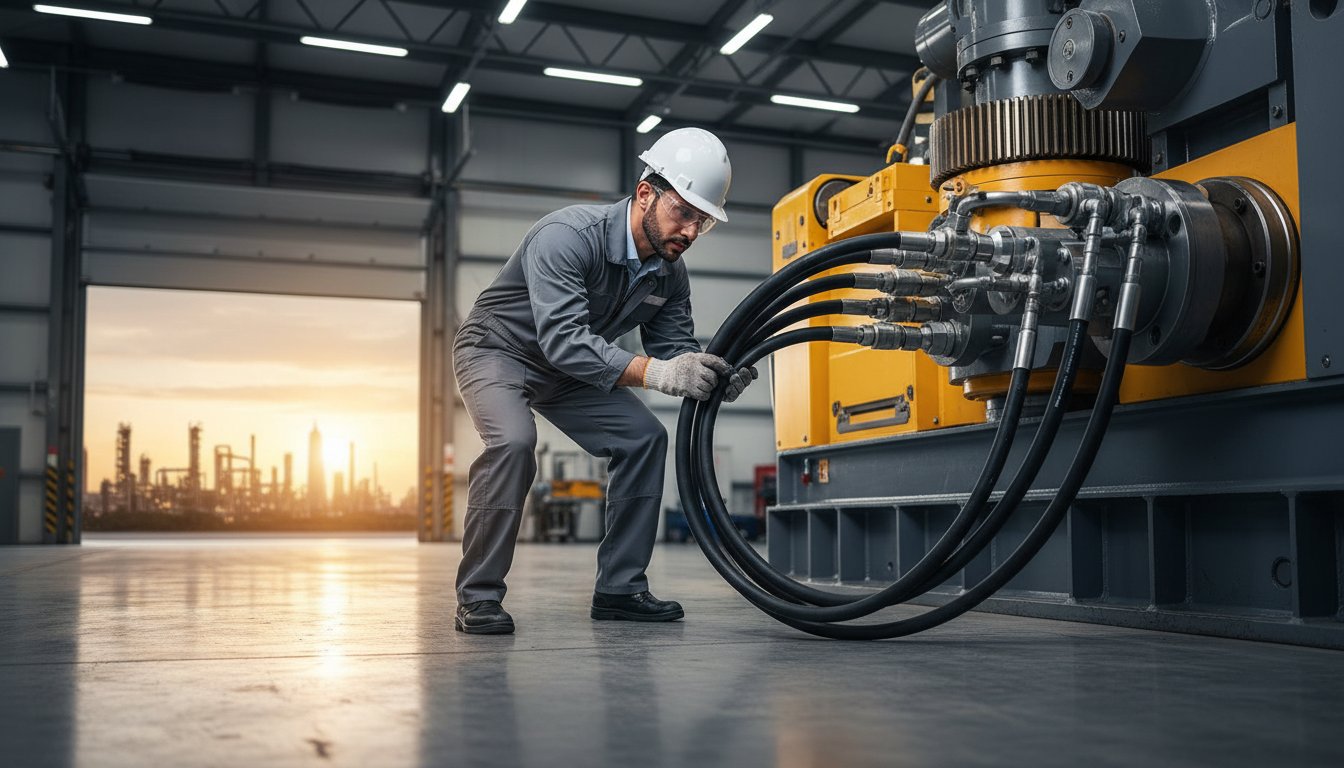
Selecting a premium-grade hydraulic hose is only half the battle. The long-term reliability and safety of your system are determined during installation. Improper routing and inadequate protection are primary contributors to premature hose failure, leading to costly operational downtime and significant safety hazards. A hose forced into an unnatural position is a system under constant, unnecessary stress. Following professional installation protocols is not just a recommendation; it's a critical investment in your equipment's performance and longevity.
The geometry of the hose assembly is paramount. Every hose has a manufacturer-specified minimum bend radius, and violating this specification drastically shortens its life. Forcing a hose into a bend tighter than its design limit compresses the inner lining and stretches the outer cover, placing immense strain on the wire reinforcement. This stress concentration can reduce the hose's service life by over 70%. Equally damaging is torsional stress, or twisting the hose during installation. A hose should always bend in a single plane, following its "natural" curve. A simple visual indicator of a twisted hose is its layline; if the printed line spirals, the hose has been twisted and must be corrected immediately.
A crucial detail often overlooked is accounting for pressure-induced contraction. When a hydraulic system is pressurized, a hose can contract in length by as much as 4%. Without sufficient slack, this contraction pulls on the fittings, creating a major failure point. The industry standard is to install hoses with at least 5% extra length to allow for this change. This small allowance prevents tensile stress on the couplings and ensures the assembly can flex and move as designed without compromising its integrity. For dynamic applications on heavy equipment, such as excavators or loaders common on construction sites across Saudi Arabia, using correctly placed clamps and pivots is non-negotiable. Clamps prevent abrasive rubbing against the machine frame, while pivots guide the hose through its intended arc of movement, preventing kinks and twists.
Optimizing Hose Routing
Effective routing involves visualizing the hose's path during the machine's full range of motion. The goal is to achieve a natural bend that avoids all torsional stress. In tight spaces where a natural bend isn't possible, high-quality 90-degree or 45-degree adapters are the superior solution to a forced, tight bend. This approach extends hose life significantly. Finally, ensure the hose is accessible for routine inspections but shielded from external impact zones and high-traffic areas.
Advanced Protective Sleeving
Adding a physical barrier is one of the most effective strategies for how to prevent hydraulic hose bursts in harsh environments. The choice of sleeve depends entirely on the operational risks.
- Nylon Sleeves: These provide excellent abrasion resistance, meeting ISO 6945 standards. They are ideal for applications where hoses are bundled or may rub against non-critical components. Some designs also offer burst containment, redirecting fluid spray in the event of a failure.
- Fire-Resistant Sleeves: Essential for high-temperature environments found in petrochemical plants in Jubail or steel fabrication facilities. These silicone-coated fiberglass sleeves can withstand direct flame and extreme radiant heat, protecting the hose and preventing the ignition of hydraulic fluid.
- Spiral Guards: In the demanding mining and construction sectors, heavy-duty polyethylene spiral guards are the ultimate defense. They physically deflect impacts from rocks, debris, and crushing forces, safeguarding the hose assembly from catastrophic physical damage.
Implementing these installation and routing best practices is the most reliable way to enhance system safety and maximize productivity. A single hose failure can halt an entire operation, costing a business upwards of 15,000 SAR per hour in lost production. Protective measures are a small price to pay for operational certainty. Protect your assets with professionally installed hoses and protective systems. Consult with our ETS experts today to engineer a routing solution that minimizes downtime.
Implementing a Proactive Maintenance and Inspection Schedule
Relying on a "run-to-fail" strategy for hydraulic systems is a high-stakes gamble. A single catastrophic hose failure during peak production can halt operations, leading to unplanned downtime costs that can exceed 75,000 SAR per hour in Saudi Arabia's demanding industrial sector. Shifting to a proactive, predictive maintenance model is not just a best practice; it's a critical business decision that protects your personnel, machinery, and profitability. The most effective strategy for how to prevent hydraulic hose bursts begins with empowering your team and partnering with technical experts.
This proactive approach transforms maintenance from a reactive expense into a strategic investment. It starts with simple, consistent checks performed by the people who know the equipment best: your operators. A trained eye can spot the earliest warning signs of degradation, long before they escalate into a system failure.
The Operator Inspection Checklist
Equip your operators with a daily checklist to identify potential failures before they happen. This five-minute inspection is the first line of defense in a robust maintenance program. Key items to check include:
- Leaking or "Weeping" Fittings: Look for any oily residue or drips around hose connections and crimps. Even a minor weep signifies a compromised seal that can fail under pressure surges.
- Bubbles or Blisters: Check the outer hose cover for any blisters, soft spots, or bubbles. This is a critical red flag indicating the inner tube has likely failed, allowing high-pressure fluid to become trapped within the hose layers.
- Excessive Heat and Vibration: Place a hand near (but do not touch) the hose during operation. Unusual heat can point to restrictions or inefficient flow, while excessive vibration can fatigue components and loosen fittings over time.
While daily operator checks are essential, they can't reveal everything. Internal wear, microscopic cracks, and fluid contamination require specialized diagnostic tools and expert analysis. Scheduling regular, professional hydraulic system audits provides a comprehensive health check, identifying hidden weaknesses that visual inspections will miss. This is the definitive step in understanding how to prevent hydraulic hose bursts and ensuring long-term system reliability.
ETS: Your Partner in Minimizing Downtime
For businesses in Dammam and across the Kingdom, Emdad Technical Services (ETS) is your dedicated partner in implementing and executing a world-class hydraulic maintenance strategy. We provide the expertise and rapid response needed to keep your operations moving. Our services are engineered to optimize your uptime, not just react to downtime. We offer:
- Urgent Repair & Quality Parts: Our Dammam facility stocks a comprehensive inventory of high-quality hoses, fittings, and components from leading global brands, ensuring we can provide fast and reliable repairs to minimize operational interruptions.
- Custom Fabrication: When standard parts won't do, our expert technicians can custom-fabricate hydraulic hoses and even complete Hydraulic Power Units (HPUs) to meet the unique specifications of your site's machinery, guaranteeing a perfect fit and optimal performance.
Don't wait for a failure to reveal the weaknesses in your system. Take control of your maintenance schedule and protect your investments. Contact ETS for a professional hydraulic system audit today and build a proactive strategy that delivers safety, reliability, and peace of mind.
Fortify Your Hydraulic Systems Against Failure
Preventing hydraulic hose failure isn't just a maintenance task; it's a critical strategy for operational continuity. Implementing the STAMPED selection method and adhering to a proactive inspection schedule are your first lines of defense against catastrophic downtime. Mastering how to prevent hydraulic hose bursts means shifting from a reactive mindset to one of calculated prevention. You don't have to manage this alone. ETS provides the expert partnership required for absolute system reliability. As an authorized distributor for global leaders like Parker and Rexroth, we guarantee quality components. Our strategic location in Dammam 2nd Industrial City ensures rapid response across Saudi Arabia, and our technical team specializes in everything from emergency repairs to custom HPU fabrication. Don't let a failed hose derail your productivity. Maximize your uptime with ETS expert hydraulic repair and parts supply and keep your operations moving forward with confidence.
Frequently Asked Questions
How often should I replace hydraulic hoses to prevent bursts?
There is no universal replacement timeline; it depends entirely on the application and operating conditions. However, for high-cycle or high-pressure applications common in Saudi Arabia's industrial sector, a proactive replacement every 12 to 24 months is a standard best practice. For equipment operating under severe conditions, such as extreme temperatures or constant abrasion, a 6-month inspection and replacement cycle is recommended by experts to minimize the risk of failure and costly downtime.
Can I repair a hydraulic hose that has a small leak?
No, you should never attempt to repair a leaking hydraulic hose. Even a pinhole leak releases fluid at velocities over 180 meters per second, which can easily penetrate skin and cause a fatal fluid injection injury. A leak signifies that the hose's structural integrity is compromised. The only safe and reliable solution is to immediately shut down the system, depressurize it, and replace the entire hose assembly with a new, properly rated one.
What are the first signs that a hydraulic hose is about to fail?
The earliest warning signs are often visible during routine inspections. Look for cracks, blisters, or deep abrasions on the outer cover of the hose. You should also check for fluid weeping or dampness around the fittings, which indicates a failing seal. A hose that feels unusually stiff, brittle, or has permanently flattened areas has lost its flexibility and is at a significantly higher risk of bursting. Catching these signs early is crucial for preventing accidents.
Does the Saudi Arabian heat affect hydraulic hose lifespan?
Yes, absolutely. The extreme ambient heat in Saudi Arabia, which regularly exceeds 45°C, can reduce a standard hydraulic hose's service life by as much as 50%. This intense heat accelerates the aging of the rubber compounds, causing them to become brittle and crack prematurely. For equipment operating outdoors in the Kingdom, it's essential to use hoses specifically rated for high-temperature environments to ensure reliable performance and prevent unexpected failures.
What is the STAMPED method in hydraulic hose selection?
The STAMPED method is a globally recognized acronym used to ensure the correct hose and fittings are selected for any application. It covers seven critical variables: Size (inside diameter), Temperature (of fluid and ambient air), Application (the equipment it's on), Media (the type of fluid), Pressure (maximum working pressure), Ends (fitting types), and Delivery. Using the STAMPED process is a foundational step in learning how to prevent hydraulic hose bursts by guaranteeing system compatibility.
Is it safe to use a hydraulic hose from a different manufacturer than the fitting?
No, it is extremely unsafe to mix hose and fitting brands. Manufacturers engineer their hoses and fittings as a matched system with specific dimensional tolerances. Using a fitting from one brand on another brand's hose creates an "intermix" assembly which has no validated pressure rating and voids all warranties. This practice is a leading cause of premature coupling failure and can result in catastrophic hose bursts and severe safety incidents on-site.
What should I do immediately if a hydraulic hose bursts on-site?
Your first action must be to shut down the machine's power source to stop the flow of hydraulic fluid. Do not approach the failed hose, as the escaping fluid is likely hot and under extreme pressure. Immediately secure the area, keeping all personnel at least 10 meters away to prevent injection injuries. Once the system is safely powered down and depressurized, you should contact a professional service like ETS for a prompt and safe hose replacement.
How do I choose the right protective sleeve for my hoses?
The right protective sleeve is determined by the specific hazards in your hose's environment. For protection against abrasion and rubbing, a woven nylon textile sleeve is an excellent choice. If the hose is near a high-heat source, a silicone-coated fiberglass firesleeve is necessary to prevent heat damage. In applications where hoses are bundled, a polyethylene spiral guard can prevent them from chafing against one another. Matching the sleeve to the risk is key to extending hose life.