An unexpected component failure can bring your entire operation to a grinding halt, costing thousands of Riyals in lost productivity and unplanned maintenance. The critical link between seamless performance and catastrophic failure often comes down to a single, vital component: the hydraulic hose. Yet, navigating the complex world of pressure ratings, temperature limits, and material compatibility can be a daunting task, leading to choices that compromise both safety and operational efficiency.
This comprehensive guide provides the expert knowledge you need to eliminate that uncertainty. We will demystify the technical specifications and detail the selection process, ensuring you can confidently choose a durable hose that precisely matches your application's demands. Learn how to prevent premature failures, extend the service life of your equipment, and secure reliable components right here in Saudi Arabia. Arm yourself with the insights needed to minimize costly downtime and keep your operations moving forward.
The Anatomy of a Hydraulic Hose: Understanding the Core Components
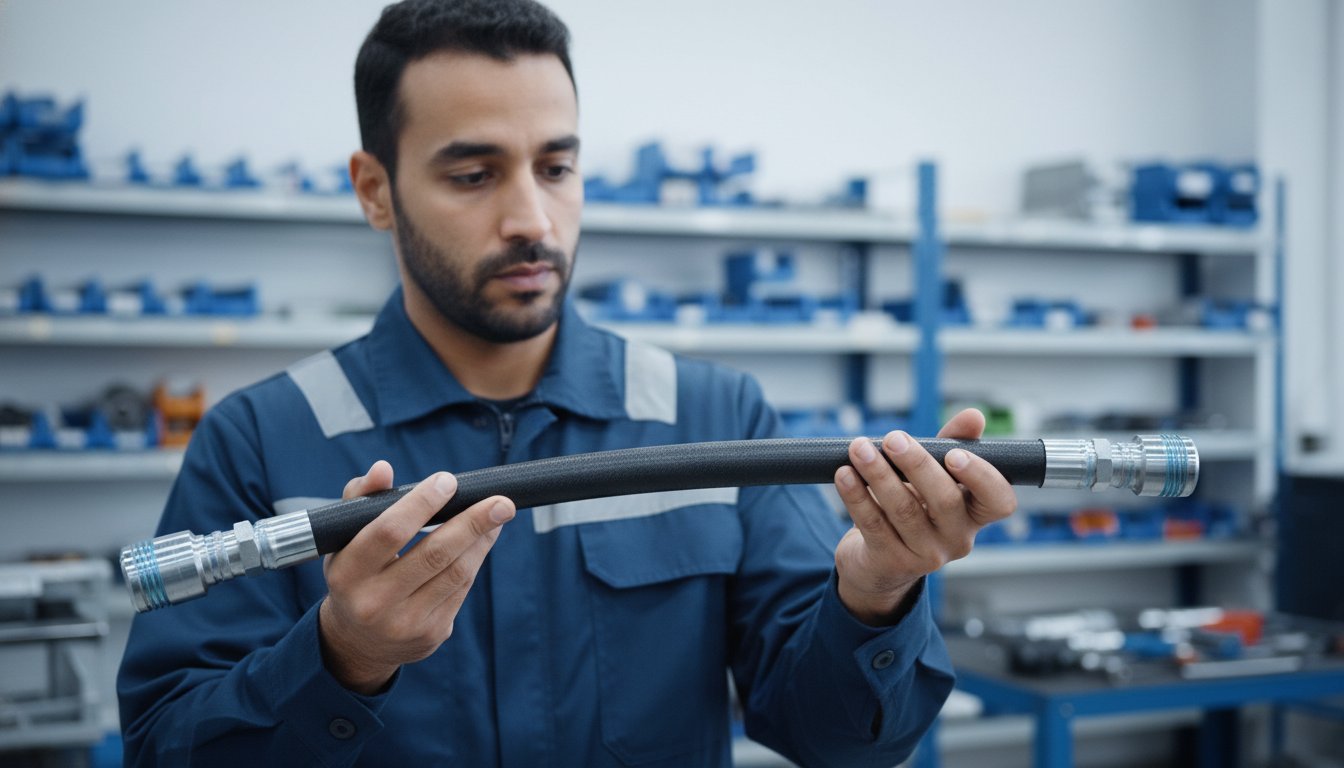
At first glance, a hydraulic hose may seem like a simple rubber tube. However, it is a precision-engineered assembly, meticulously designed to operate under extreme pressure and demanding conditions. Each component plays a critical role in ensuring reliable performance, safety, and longevity, which is essential for minimizing operational downtime. Understanding the fundamental hydraulic hose construction reveals how these layers work in concert to deliver power. The choice of materials for each layer directly determines the hose's suitability for specific applications, from mobile construction equipment to stationary industrial machinery.
The Inner Tube: Containing the Flow
The innermost layer, the inner tube, is a seamless, flexible tube designed for direct contact with hydraulic fluid. Its primary function is to contain the fluid and ensure it flows with minimal resistance. Chemical compatibility is paramount; selecting the wrong material can lead to degradation, contamination, and premature failure. Common materials include:
- Synthetic Rubber (Nitrile - NBR): Excellent resistance to petroleum-based fluids.
- Neoprene (CR): Offers good resistance to oils, weather, and flame.
- Teflon (PTFE): Provides superior chemical and temperature resistance for specialized applications.
The Reinforcement Layer: Withstanding the Pressure
This is the strength-bearing component of the hose, designed to withstand the immense internal pressures of a hydraulic system. The material and construction of this layer dictate the hose's pressure rating. Reinforcement is typically achieved with one or more sheaths of braided or spiral-wound material. A braided hose offers excellent flexibility for routing in tight spaces, while a spiral-wound hose provides superior strength and impulse resistance for very high-pressure, heavy-duty applications.
The Outer Cover: Protecting from the Elements
The outer cover is the hose's first line of defense against the external environment. Its function is to protect the internal layers from abrasion, chemicals, UV radiation, and other physical hazards common in industrial settings across Saudi Arabia. Made from durable materials like synthetic rubber or Neoprene, this protective shield is crucial for preventing external damage that could compromise the reinforcement layer and lead to catastrophic failure. A robust cover significantly extends the service life and reliability of the entire hose assembly.
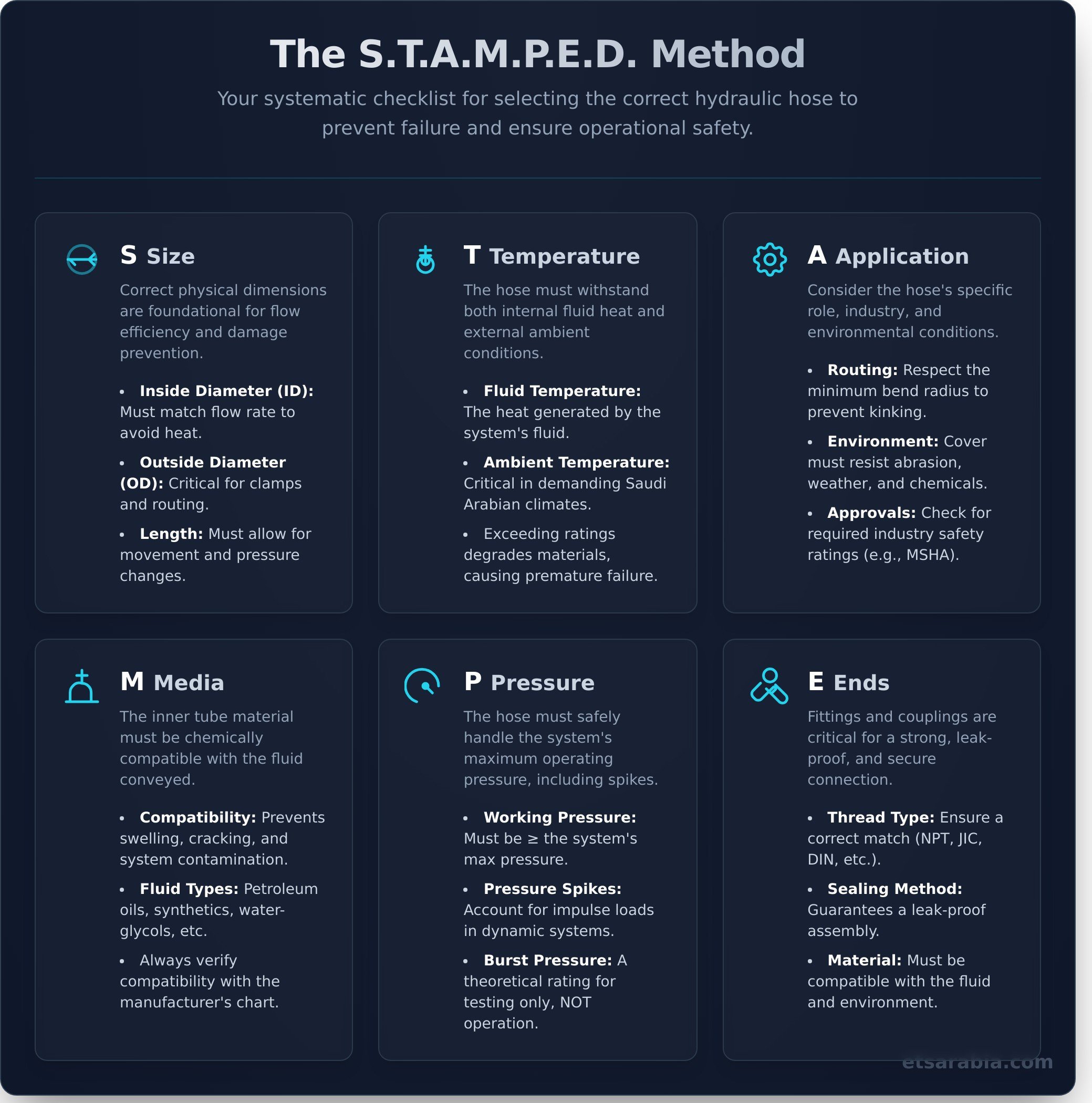
The S.T.A.M.P.E.D. Method for Hydraulic Hose Selection
Selecting the correct hydraulic hose is not a matter of guesswork; it is a precise science crucial for operational safety and efficiency. To eliminate errors and prevent costly downtime, the industry relies on the S.T.A.M.P.E.D. method. This systematic acronym ensures every critical factor is considered, leading to a reliable and long-lasting hose assembly that enhances system performance and guarantees safety.
S - Size (Inside Diameter, OD, Length)
The physical dimensions are foundational. The Inside Diameter (ID) must be large enough to handle the required flow rate without creating excessive fluid velocity, which can cause heat and system damage. The Outside Diameter (OD) is vital for proper routing and compatibility with clamps. Finally, the correct Length allows for movement and pressure changes without causing stress or kinking. For precision, a hose ID nomograph is often used for proper sizing.
T - Temperature (Fluid and Ambient)
A hose must withstand both internal fluid temperature and the external ambient temperature of its environment. In demanding Saudi Arabian climates, ambient heat can be as damaging as the fluid’s heat. Exceeding a hose's temperature rating degrades its materials, leading to premature failure. Specialized hoses are available for extreme high or low-temperature applications.
A - Application (The Equipment and Industry)
Consider the hose's specific role. Is it for a static application or a dynamic one with constant flexing? You must respect the minimum bend radius to prevent damage. The external environment-be it an offshore rig, a dusty quarry, or a manufacturing plant-dictates the required cover material for abrasion and weather resistance. Certain industries may require agency approvals (e.g., MSHA) for safety compliance.
M - Media (The Fluid Being Conveyed)
The type of fluid being transferred determines the required inner tube material. Petroleum-based oils, synthetic fluids, water-glycols, and chemicals all have different compatibility requirements. Using an incompatible hose will cause the inner tube to swell or crack, contaminating the system. Always verify fluid compatibility using a manufacturer's chart.
P - Pressure (Working, Proof, and Burst)
Every system operates under pressure. The hose's Maximum Working Pressure must be equal to or greater than the system's maximum operating pressure, including potential spikes. A proper safety factor is essential for high-impulse applications. Note that Burst Pressure is a theoretical value for testing only and should never be used as an operating pressure.
E - Ends (Fittings and Couplings)
A hose assembly is only as strong as its connections. The fittings must have the correct thread type (e.g., NPT, JIC, DIN) and sealing method for a leak-proof connection. The fitting material must also be compatible with the fluid and environment. Getting this right is paramount, which is why ETS provides expert fitting identification and assembly services.
Common Causes of Hydraulic Hose Failure and How to Prevent Them
A hydraulic hose failure is more than an inconvenience; it is a primary cause of dangerous and expensive operational downtime. In Saudi Arabia's demanding industrial sectors, a single failure can halt production, costing operations thousands of Riyals and posing significant safety risks. The vast majority of these failures are not random but are the direct result of incorrect hose selection, routing, or assembly. Understanding the common causes is the first step toward implementing a proactive prevention strategy that ensures reliability and maximizes productivity.
Abrasion and External Damage
This is the most common cause of external failure, occurring when a hose rubs against equipment components, sharp edges, or even another hose. Visual Cue: Look for a worn, frayed, or scored outer cover, which may expose the steel wire reinforcement. Prevention: Ensure proper routing with adequate clearance. Use clamps to secure the hose and, in high-wear areas, install protective sleeves or guards. Selecting a hose with a modern, abrasion-resistant cover provides a robust first line of defence.
Improper Assembly and Contamination
The connection point between the hose and fitting is a critical stress area. Incorrect fitting installation or introducing contaminants like dirt or metal shavings can lead to premature failure. Visual Cue: Leaks at the fitting, or in severe cases, a complete hose blow-off from the fitting. Prevention: Always rely on professional assembly services to ensure correct crimping and fitting orientation. Ensure all components are meticulously cleaned and flush the new assembly before final installation to remove any residual debris.
High-Temperature Degradation
Operating a hose above its maximum rated temperature-whether from the fluid inside or ambient heat outside-will "bake" the rubber compounds, causing them to lose flexibility. Visual Cue: The hose cover and inner tube will become hard, stiff, and brittle, often showing visible cracks when flexed. Prevention: Verify the hose's temperature rating is suitable for your application's highest expected temperature. Where possible, re-route hoses away from heat sources or install protective heat shields.
Fluid Incompatibility
The inner tube of a hydraulic hose is engineered for specific fluids. Using a fluid that is chemically incompatible will cause the inner tube to deteriorate, swell, and delaminate. Visual Cue: The hose may feel soft, spongy, or mushy. Internal delamination can lead to particles contaminating the system. Prevention: Always confirm fluid compatibility using the manufacturer’s specification charts before installation. Never mix fluid types in a system without first verifying hose compatibility.
Proactive inspection and correct initial selection are the keys to reliable hydraulic system performance. By identifying these potential failure modes early, your maintenance teams can prevent unscheduled downtime and enhance operational safety. For expert guidance on selecting the right components for your specific application, contact the specialists at ETS.
Choosing the Right Hose for Key Industries in Saudi Arabia
Saudi Arabia's demanding industrial sectors require more than just standard components. From the intense heat of the desert to corrosive coastal air and abrasive on-site conditions, every part must be engineered for resilience. Selecting the correct hydraulic hose is not just a matter of performance-it is a critical decision for operational safety, efficiency, and minimizing costly downtime. At ETS, we leverage our deep understanding of these local challenges to provide solutions that guarantee reliability.
Oil & Gas and Petrochemical Applications
In the high-stakes oil, gas, and petrochemical industry, performance is non-negotiable. Operations demand hoses that can withstand aggressive chemicals and extreme pressures. We recommend solutions featuring chemically inert PTFE tubes or specialized synthetic rubber compounds. For enhanced safety in hazardous zones, fire-resistant covers are essential, paired with 316 stainless steel fittings to prevent corrosion from saline air and sour gas, ensuring long-term system integrity.
Construction and Heavy Machinery
Construction sites and heavy machinery operations across the Kingdom face a constant battle with abrasion and heat. A standard hydraulic hose can fail prematurely under these conditions. Our solution is to specify hoses with exceptionally tough outer covers, such as UHMW (Ultra-High Molecular Weight Polyethylene), for maximum abrasion resistance. To handle the intense pressure spikes from equipment like excavators, we recommend multi-spiral hoses that provide superior strength and durability, all while being rated to perform reliably in high ambient desert temperatures.
Manufacturing and Industrial Plants
For manufacturing and industrial plants, the priorities are long service life, reliability, and ease of maintenance. Standard 1-wire and 2-wire braided hoses are often the ideal choice, offering a proven balance of performance and value for general-purpose applications. To further optimize plant efficiency and safety, consider using color-coded hoses, which simplify the identification of hydraulic lines during routine maintenance and troubleshooting. Unsure which specification is right for your facility? Contact our experts for industry-specific recommendations.
Ensure Operational Excellence with the Right Hydraulic Hose Partner
Selecting the correct hydraulic hose is not merely a procurement task; it is a critical decision that directly impacts your operational safety, efficiency, and profitability. By systematically applying the S.T.A.M.P.E.D. method and understanding the root causes of hose failure, you can significantly reduce costly downtime and enhance the reliability of your machinery, a non-negotiable requirement in Saudi Arabia’s demanding industrial sectors.
At Emdad Technical Services (ETS), we are your dedicated partners in achieving this precision. Our expert technical support ensures you make the correct product selection every time. Leveraging our partnerships with leading global hydraulic brands, we supply only the highest quality components. With rapid supply and delivery from our Dammam service center, we help you keep critical operations in motion.
Secure the performance and longevity of your systems. Request a quote for high-performance hydraulic hoses and assemblies today. Choose ETS for a partner who delivers expertise, reliability, and solutions that keep your operations moving forward.
Frequently Asked Questions About Hydraulic Hoses
Can I repair a damaged hydraulic hose?
Repairing a damaged hydraulic hose is strongly discouraged and violates industry safety standards. Attempting to patch a hose compromises its structural integrity, creating a significant risk of catastrophic failure, fluid injection injuries, and costly operational downtime. The only reliable and safe solution is a complete replacement of the hose assembly. This ensures the system operates at its specified pressure ratings, guaranteeing both personnel safety and optimal equipment performance, which is a core principle at ETS.
What is the difference between a braided and a spiral hydraulic hose?
The primary difference lies in the construction of the reinforcement layer. Braided hoses feature crisscrossing layers of woven wire, offering excellent flexibility suitable for applications with constant movement, such as mobile equipment. Spiral hoses have parallel strands of wire wrapped around the tube, providing superior strength and resistance to high-pressure impulses and shock loads. They are less flexible but are essential for heavy-duty static applications found in large industrial machinery and excavation equipment.
How often should I inspect and replace my hydraulic hoses?
We recommend daily visual inspections for obvious damage like leaks, cracks, or abrasions. A more thorough inspection by trained personnel should occur quarterly. While there is no universal replacement schedule, hoses in demanding applications or harsh environments, such as those in many industrial sites across Saudi Arabia, may need replacement every 1-2 years. Always follow the equipment manufacturer's guidelines and replace any hose assembly showing wear to prevent unexpected failures and minimize downtime.
What does the layline on a hydraulic hose tell me?
The layline is a continuous line of text printed on the hose that provides critical identification information. It acts as the hose's specification sheet, detailing the manufacturer, part number, hose size (dash size), maximum working pressure, and often the date of manufacture. This information is essential for correct identification, ensuring you select the right replacement hose to maintain system compatibility and safety standards. The layline also helps verify that the hose has not been twisted during installation.
How do I measure a hydraulic hose fitting correctly?
To measure a fitting accurately, you need a set of calipers. First, measure the outside diameter (OD) of the male thread or the inside diameter (ID) of the female thread. Next, use a thread pitch gauge to determine the number of threads per inch or the distance between threads for metric fittings. Combining these two measurements allows you to identify the fitting type and size using a standard chart. Correct measurement is critical for achieving a leak-proof seal and ensuring system integrity.
Why is minimum bend radius so important for hydraulic hoses?
The minimum bend radius is the tightest curve a hydraulic hose can be bent without causing damage or restricting flow. Exceeding this limit can cause the reinforcement layers to kink or separate, leading to premature hose failure, reduced service life, and potential system blockages. Adhering to the specified bend radius is crucial for ensuring optimal performance, preventing catastrophic failures, and minimizing costly, unscheduled downtime. Always ensure proper routing to protect your investment and maintain operational efficiency.
Are all hydraulic fluids compatible with all hose types?
No, fluid compatibility is absolutely critical for system reliability. The inner tube of a hose is made from specific synthetic rubber compounds designed to resist certain fluids, such as petroleum-based oils, synthetic esters, or water-glycols. Using an incompatible fluid can cause the inner tube to swell, crack, or dissolve, leading to contamination, leaks, and complete hose failure. Always verify that the hose material is compatible with the system's hydraulic fluid to ensure reliable performance and longevity.