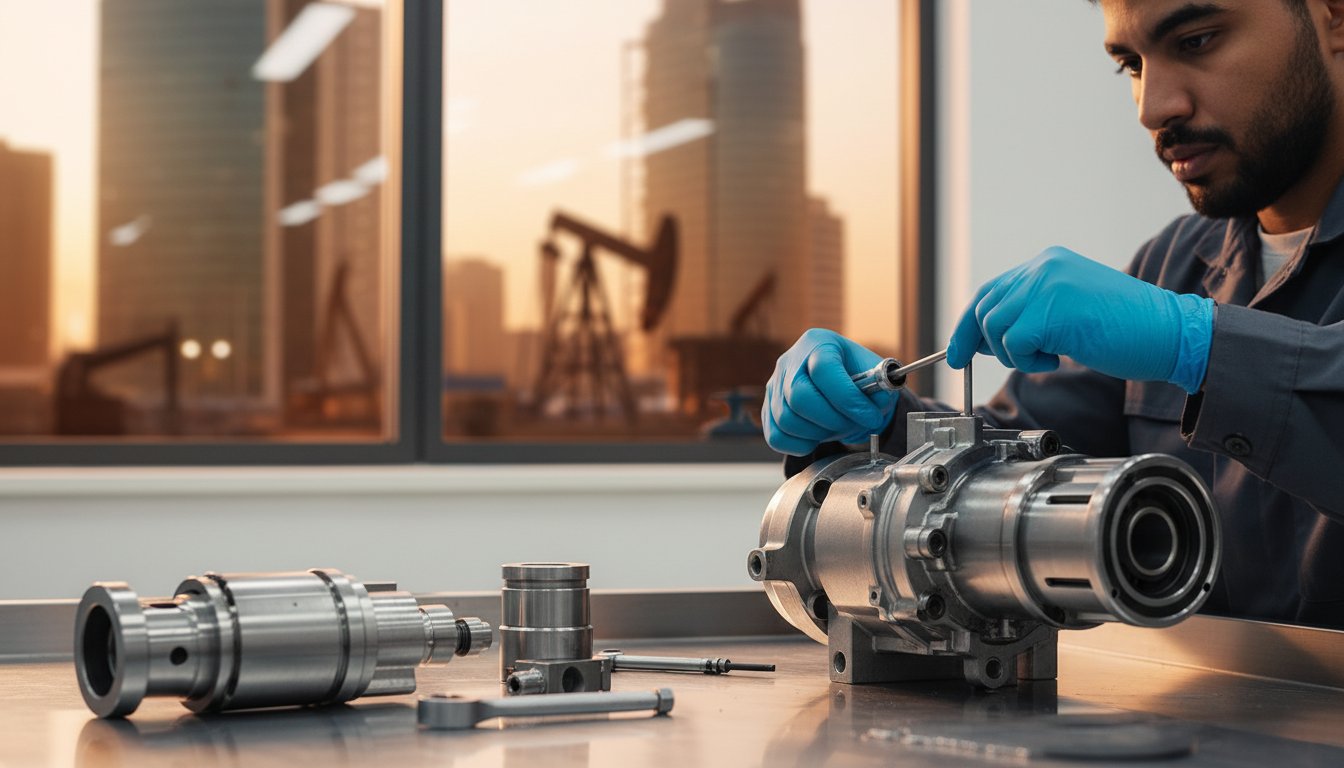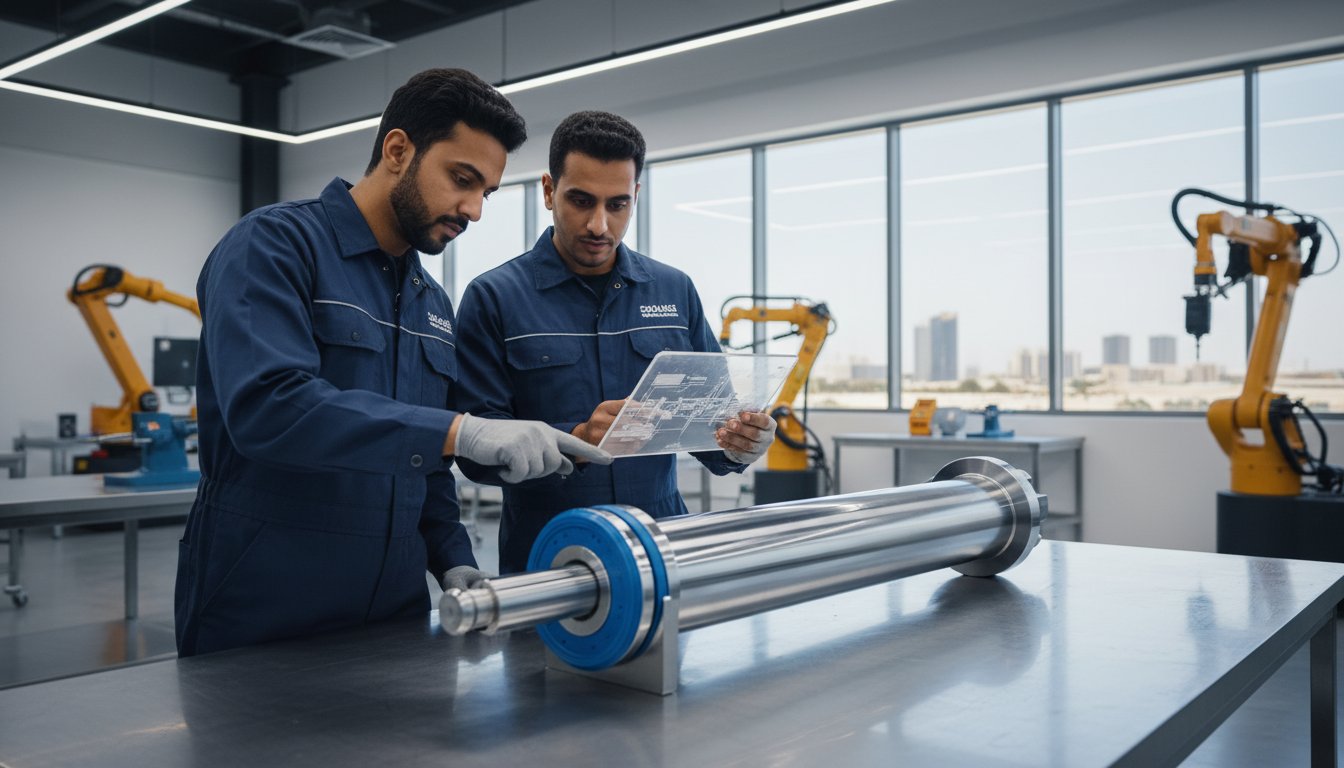

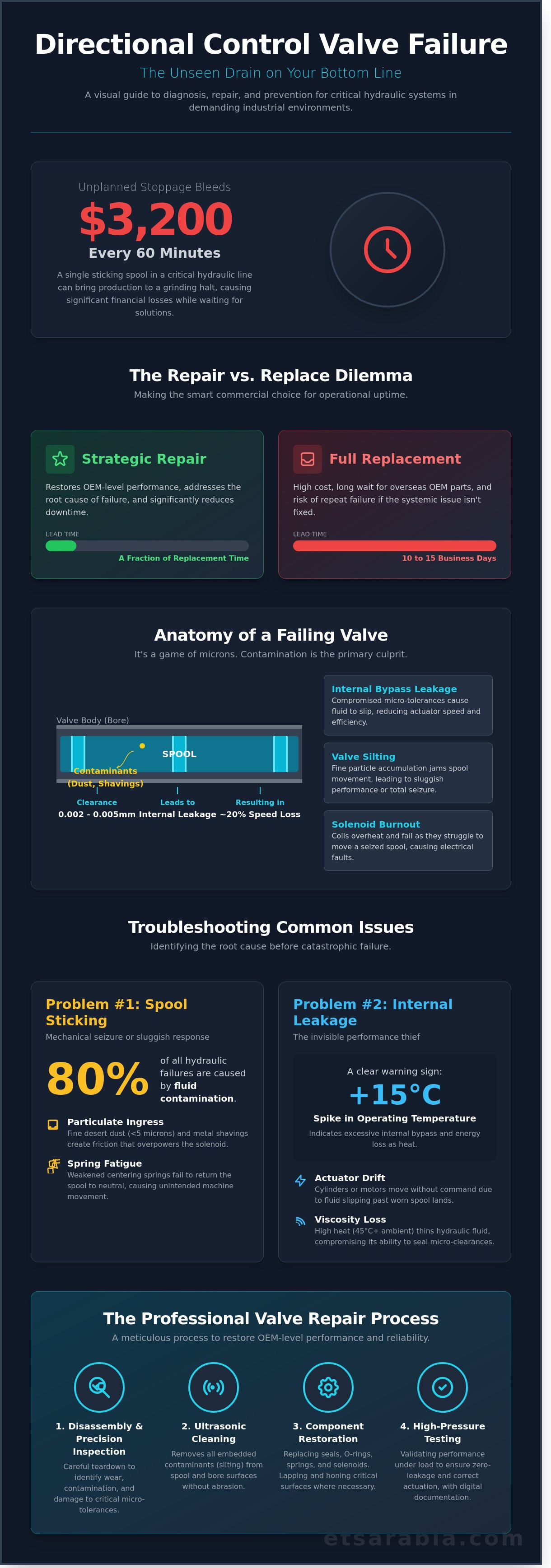
On a Tuesday at 2:00 PM, a production manager in Dammam watches a critical hydraulic line shudder to a halt because of a single sticking spool. Every 60 minutes of this unplanned stoppage bleeds roughly $3,200 from the facility's bottom line, yet waiting for a replacement part from an overseas OEM can take 10 to 15 business days. Professional directional control valve repair isn't just a temporary fix; it's a strategic necessity that restores system pressure in a fraction of the time it takes to source new hardware.
You already know that your operations depend on the precise timing of these components, and any hesitation in the circuit leads to a significant loss of efficiency. We're here to ensure that doesn't happen. This guide provides the expertise you need to identify internal leakage, troubleshoot solenoid failures, and execute professional repairs that rival the longevity of brand-new components. We will walk through the essential steps of disassembly, precision inspection, and high-pressure testing to ensure your hydraulic systems return to peak performance without the high cost of total replacement.
Key Takeaways
- Identify critical symptoms like sticking spools and hidden internal leaks before they lead to total system failure.
- Learn to perform a cost-benefit analysis to determine when restoration is more commercially viable than a full replacement.
- Explore the precision directional control valve repair process that utilizes ultrasonic cleaning and digital documentation to restore OEM-level performance.
- Discover how expert valve maintenance optimizes actuator timing and system pressure to significantly reduce costly industrial downtime.
- Access specialized hydraulic expertise in Saudi Arabia for leading global brands to ensure your operations remain in motion.
What is Directional Control Valve Repair and Why Does it Matter?
Directional control valve repair is the precise technical process of disassembling, cleaning, and restoring the internal components of a valve to ensure fluid flow paths function exactly as engineered. It's a specialized service that goes far beyond basic maintenance. These components act as the primary logic gates of a hydraulic circuit. They dictate the timing of actuators and maintain the critical system pressure required for heavy industrial loads. When a valve fails, the entire sequence of operation breaks down, leading to erratic machinery behavior or total system lockup.
Many operators attempt a "part swapping" approach when a machine halts. This rarely solves the underlying issue. Swapping a damaged valve without addressing the root cause, such as fluid contamination or pump cavitation, ensures the new part will fail just as quickly. At ETS, we've seen how a single $500 valve failure can trigger $50,000 in lost production revenue during a single 12-hour shift. Professional directional control valve repair focuses on identifying these systemic triggers to guarantee long-term reliability and optimize your operational uptime.
Common Types of Valves We Service
- Spool Valves: These are the standard industrial workhorse. We focus on the spool lands and bore surfaces where tolerances are tightest.
- Poppet and Rotary Valves: These require specific seating checks. We ensure zero-leakage performance by restoring the metal-to-metal seals.
- Solenoid vs. Manual Controls: Whether your system relies on automated electrical signals or manual lever action, we calibrate the actuation force to prevent sticking.
The Anatomy of a Failing Valve
The core of any valve is the relationship between the spool and the bore. In high-performance systems, these clearances are often as tight as 0.002mm to 0.005mm. When these micro-tolerances are compromised by heat or friction, internal bypass leakage occurs, which can reduce actuator speed by 20% or more. We also inspect the seals and O-rings, which are the first line of defense against external environmental contamination. Valve silting is the accumulation of fine particles that jam spool movement. If silting isn't addressed through professional directional control valve repair, the solenoid coils can burn out as they struggle to move a seized spool, leading to even more expensive electrical repairs.
Troubleshooting Directional Valve Issues: Sticking, Leaks, and Heat
Identifying the root cause of hydraulic failure requires a methodical approach. In high-demand industrial hubs like Dammam, where ambient temperatures often exceed 45°C, directional control valves face extreme thermal and mechanical stress. Fine desert dust, often measuring less than 5 microns, can bypass standard filtration and enter the hydraulic circuit. This leads to accelerated wear that compromises precision. Effective directional control valve repair begins with distinguishing between mechanical seizing and fluid-related bypass issues.
Problem #1: Spool Sticking and Mechanical Failure
Contamination causes 80% of all hydraulic system failures. When microscopic particles lodge between the spool and the valve body, the valve refuses to shift or becomes sluggish. Beyond grit, mechanical fatigue in centering springs or worn detent pins can prevent the spool from returning to its neutral position. You can verify solenoid health without a full teardown by checking the coil resistance with a multimeter. A reading outside the manufacturer's specified range, typically 10 to 30 ohms for most DC coils, indicates a burnt-out component that needs immediate replacement.
- Particulate Ingress: Dust and metal shavings create friction that overpowers the solenoid's magnetic force.
- Spring Fatigue: Weakened springs fail to center the spool, leading to unintended machine movements.
- Solenoid Burnout: Voltage fluctuations or blocked spools cause coils to overheat and fail.
Problem #2: Excessive Internal Leakage
Internal leakage is often invisible but results in actuator drift, where a cylinder moves without a command. This happens when the clearance between the spool and bore exceeds the standard 0.005mm to 0.015mm tolerance range. In the Eastern Province's humidity and heat, hydraulic fluid loses viscosity, often falling below the 13 centistokes (cSt) minimum required for a proper seal. This thinning allows fluid to slip past the spool lands more easily. If your system's operating temperature spikes by 15°C above its baseline, it's a clear signal of internal bypass. For high-precision systems, expert diagnostic testing can quantify these leakage rates before they lead to total system shutdown.
Spool scoring is another culprit. It's usually caused by large contaminants or "lacquering," which is a varnish-like buildup from oxidized oil. Timely directional control valve repair prevents these minor bypass issues from evolving into expensive pump failures or catastrophic pressure loss. Maintaining fluid cleanliness at an ISO 4406 level of 18/16/13 or better is the most effective way to extend the life of these components in harsh Saudi Arabian environments.
The Repair vs. Replace Dilemma: Making the Commercial Choice
Deciding between a rebuild and a new purchase is a critical financial crossroads for any maintenance manager. It's not just about the price tag on the component; it's about the total cost of ownership and the speed of returning to full production. Most directional control valve repair projects cost between 40% and 60% of the price of a brand-new unit. This margin provides significant capital relief, especially when managing a fleet of hydraulic machinery.
A valve reaches the "beyond repair" threshold when the physical integrity of the casting is compromised. If our technicians detect structural cracks in the housing or bore scoring deeper than 0.25mm, the pressure integrity is lost. In these specific cases, even the most advanced honing won't restore the tight tolerances required for high-pressure systems. However, for 85% of industrial failures, a professional rebuild is the superior commercial path.
Factors Favoring Professional Repair
- Lead Time Advantages: Sourcing a new Rexroth or Parker valve from international suppliers often involves a 12 to 16-week wait. A local directional control valve repair in Dammam can be completed in 3 to 5 business days, drastically reducing expensive operational pauses.
- Legacy Hardware Support: Many plants operate with reliable machinery from the 1990s. If the original manufacturer has discontinued the valve series, a precision repair is the only way to avoid a total system retrofit.
- Sustainability Targets: Reclaiming a 50kg steel valve body instead of scrapping it supports corporate green initiatives by reducing industrial waste and the carbon footprint associated with manufacturing new heavy components.
When Replacement is the Better Option
Standard, small-scale "disposable" valves, such as basic CETOP 3 models costing under $300, rarely justify the labor hours required for a rebuild. If a valve fails repeatedly every 4 to 6 months, the issue is likely a fundamental system design flaw or fluid contamination rather than simple wear. In these instances, we recommend replacing the unit and investigating the root cause. Furthermore, severe housing erosion caused by cavitation often makes the component unsafe for high-pressure service, necessitating an immediate replacement to ensure site safety.
ETS focuses on optimizing downtime by providing clear, data-backed recommendations. We don't guess; we measure. Our team evaluates the spool-to-bore clearance and seal surfaces to give you an honest assessment of whether a repair will deliver the 100% performance you expect. We ensure your systems stay in motion with reliable, expert solutions that respect your maintenance budget.
The ETS Professional Valve Repair Process
Restoring a hydraulic system requires more than just replacing seals. At Emdad Technical Services, our directional control valve repair protocol follows a rigorous, five-step methodology designed to eliminate the root causes of failure and extend component life. We prioritize precision because even a minor oversight leads to catastrophic system downtime. Our process is engineered to provide the reliability your operations demand.
- Step 1: Precision Disassembly. Technicians perform a complete teardown while creating a digital map of every internal component. This documentation ensures that complex multi-spool configurations are reassembled with 100% accuracy, matching the original factory geometry.
- Step 2: Ultrasonic Cleaning. We submerge components in industrial ultrasonic tanks. This process removes 98% of baked-on varnish and microscopic metallic silt that manual cleaning or solvent spraying cannot reach.
- Step 3: High-Precision Inspection. Our team uses calibrated micrometers and bore gauges to measure wear. We identify deviations as small as 0.0001 inches to determine if the valve body requires specialized honing or if the spool has lost its tolerance.
- Step 4: Honing and Lapping. To restore optimal spool-to-bore tolerances, we utilize precision honing equipment. This step is critical for maintaining internal pressure seals and preventing fluid bypass that degrades system efficiency.
- Step 5: Dynamic Bench Testing. Every valve undergoes a final validation on our 3,000 PSI test bench. We verify flow rates and pressure ratings against the original manufacturer specifications to ensure peak performance.
Contamination Control Protocols
Hydraulic systems are incredibly sensitive to debris. We maintain a controlled environment for every directional control valve repair to prevent environmental pollutants from entering the assembly. Our flushing procedures utilize high-velocity fluid to purge the internal galleries. It's a proven fact that even 5-micron particles can cause immediate valve failure post-repair by scoring the polished surfaces of the spool. We eliminate this risk through multi-stage filtration and strict clean-room standards.
Testing and Quality Assurance
Reliability is non-negotiable. Our quality assurance process involves simulating real-world operating conditions, including peak pressure spikes and rapid cycling. We perform pressure-drop testing to ensure the valve operates at maximum efficiency without internal leakage. Every client receives a detailed performance report that confirms response times and seal integrity. This transparent data gives you the confidence that your equipment is ready for high-stakes industrial use.
Minimize your operational delays with our expert restoration services. Choose ETS for a partner who delivers expertise and solutions that keep your operations moving forward.
Why Choose ETS for Hydraulic Valve Services in Saudi Arabia?
Emdad Technical Services (ETS) operates from a strategic 2,000 square meter facility in Dammam, specifically located to serve the 2nd Industrial City. We understand that every hour of halted production costs your business thousands of Riyals. Our engineering team specializes in directional control valve repair for industry-leading brands including Rexroth, Parker, Danfoss, and Eaton. We've optimized our workflow to provide a 24-hour turnaround on initial diagnostics for 95% of the valves we receive at our workshop.
We focus on "Optimizing Downtime" by maintaining an extensive local stock of genuine parts and seals. Our technicians don't simply treat the symptoms; we analyze the entire hydraulic circuit to identify root causes like fluid contamination or pressure spikes. This comprehensive support has helped our clients in the petrochemical and manufacturing sectors reduce their year-over-year maintenance costs by 22% since 2022. We provide the technical depth needed to ensure your systems remain reliable under heavy loads.
- Strategic Proximity: Our Dammam location ensures rapid mobilization to industrial sites across the Eastern Province within hours.
- Brand Expertise: Certified technical knowledge across all major global hydraulic brands ensures OEM-level precision.
- Local Stock: Immediate access to over 4,500 OEM-spec components to bypass international shipping delays.
- System Analysis: Root cause identification is a standard part of our process to prevent recurring valve failures.
Local Expertise, Global Standards
Our team of 15 specialized hydraulic technicians in Saudi Arabia undergoes rigorous training to meet international quality benchmarks. We partner with global leaders to ensure every directional control valve repair utilizes genuine seals and high-grade replacement parts. This commitment to quality ensures that your repaired equipment performs with the same reliability as a brand-new unit. You can explore our full range of hydraulic repair services to learn more about our holistic approach to industrial maintenance.
Get Your Equipment Back in Motion
Scheduling a diagnostic or emergency repair is straightforward. Our service desk operates 24/7 to handle urgent requests from the construction and oil and gas sectors. Beyond valve services, we provide custom HPU fabrication and system upgrades to ensure your machinery stays ahead of modern performance demands. Don't let a faulty valve stall your operations. Contact Emdad Technical Services for Expert Valve Repair to secure a solution that keeps your systems in motion. We guarantee a technical response to all inquiries within four hours of contact.
Optimize Your Hydraulic Performance Today
Maintaining peak hydraulic performance requires more than just reactive maintenance; it demands technical precision. Addressing issues like spool sticking or internal leaks early prevents the catastrophic failure of your high-pressure machinery. Choosing professional directional control valve repair instead of immediate replacement often saves industrial facilities 40% to 60% in component costs while significantly reducing lead times. At Emdad Technical Services (ETS), we combine ISO-certified repair processes with technical partnerships from 12 leading global hydraulic brands to ensure your equipment meets original factory specifications. Our facility is strategically located near Dammam 2nd Industrial City, allowing our team to provide the rapid response times your Saudi Arabian operations require. Don't let a faulty valve stall your production schedule or compromise your safety protocols. Our technicians specialize in optimizing downtime and restoring the reliable performance your industrial systems need to stay in motion. We're ready to help you regain full control of your hydraulic output and maximize the lifespan of your critical assets.
Request a Quote for Valve Repair
Frequently Asked Questions
How long does a typical directional control valve repair take?
Most directional control valve repair projects are completed within 24 to 48 hours. This timeframe includes initial inspection, component replacement, and pressure testing. For complex multi-spool valves, the process might extend to 72 hours. We prioritize rapid turnaround because we know that every hour of downtime costs your facility money. Our workshop operates with a 95% on-time delivery rate to ensure your machinery returns to service quickly.
Can you repair valves from brands like Rexroth and Parker in Saudi Arabia?
Yes, we provide expert repair services for premium brands like Rexroth, Parker, Vickers, and Eaton throughout Saudi Arabia. Our technicians use genuine OEM-spec components to restore these high-precision valves to factory standards. We maintain a local inventory of over 500 critical seal kits and spare parts. This allows us to service international brands locally in our Dammam facility without waiting for long international shipping cycles.
What are the most common signs that my hydraulic valve is failing?
You'll notice erratic actuator movement or a 15% drop in system pressure when a valve begins to fail. Excessive heat generation, where the valve body exceeds 65°C, often indicates internal bypass leakage. Listen for unusual buzzing sounds or "hunting" behavior in the spool. If you spot external oil weeping around the solenoids, it's time to schedule a professional directional control valve repair to prevent total system failure.
Is it cheaper to repair a directional control valve or buy a new one?
Repairing a valve typically costs between 40% and 60% of the price of a new replacement unit. For large-scale industrial valves, this represents a savings of several thousand Riyals. Beyond the direct cost, repairing is often faster than waiting 8 to 12 weeks for new imports. We only recommend replacement if the housing is cracked or if the internal bore wear exceeds 0.015mm tolerances.
Do you provide on-site valve troubleshooting in Dammam?
We dispatch mobile technical teams across Dammam and the Eastern Province with a 4-hour response time. Our engineers arrive with portable diagnostic flow meters and pressure gauges to identify faults directly on your machine. We resolve 70% of solenoid-related issues on-site. If the valve requires precision machining or bench testing, we'll manage the secure transport to our local service center for a deeper overhaul.
What kind of warranty do you provide on hydraulic valve repairs?
Every repair comes with a standard 6-month warranty covering both parts and labor. For critical applications, we offer extended 12-month protection plans. Each valve undergoes a 100% performance test on our hydraulic test stand before it leaves our facility. You receive a detailed test report documenting that the valve holds pressure and shifts correctly under full load conditions, ensuring 100% reliability upon installation.
How can I prevent my directional valves from sticking in the future?
Maintain your hydraulic oil to ISO 4406 cleanliness levels of 18/16/13 to prevent 80% of spool sticking issues. Contamination is the primary cause of valve failure; therefore, you should replace return-line filters every 1,000 operating hours. We also recommend annual oil analysis to check for varnish buildup. These proactive steps reduce friction and ensure the spool moves freely, significantly extending the service life of your hydraulic components.