In the high-stakes industrial environments of Saudi Arabia, the sound of a diesel engine is the sound of productivity. But what happens when that power becomes uncontrollable? A diesel engine runaway event or an ignition in a hazardous area isn't just a mechanical failure-it's a potential catastrophe that threatens personnel, assets, and operational continuity. The pressure to comply with complex safety regulations while preventing costly downtime is immense. That is why understanding and implementing expert diesel engine safety solutions is not just a best practice; it is an operational necessity.
This ultimate guide provides the critical knowledge you need to move from concern to confidence. We will explore the primary risks, from runaway to explosions, and detail the proven systems required to mitigate them effectively. By the end, you will have a clear roadmap to enhance worksite safety, achieve full regulatory compliance, and protect your high-value equipment, ensuring your operations in the Kingdom run safely and without interruption.
The Critical Risk: Understanding Diesel Engine Runaway in Hazardous Areas
In the high-stakes environments of Saudi Arabia's oil, gas, and petrochemical industries, diesel engines are the workhorses that power critical operations. However, this same essential equipment carries a hidden but severe risk. A standard diesel engine, when exposed to a hydrocarbon-rich atmosphere, can use those ambient vapors as an unintended fuel source, transforming it from a vital asset into an uncontrolled ignition source. Think of it as a vehicle that suddenly starts fueling itself from the air around it-it will accelerate uncontrollably until it violently tears itself apart.
What is Diesel Engine Runaway?
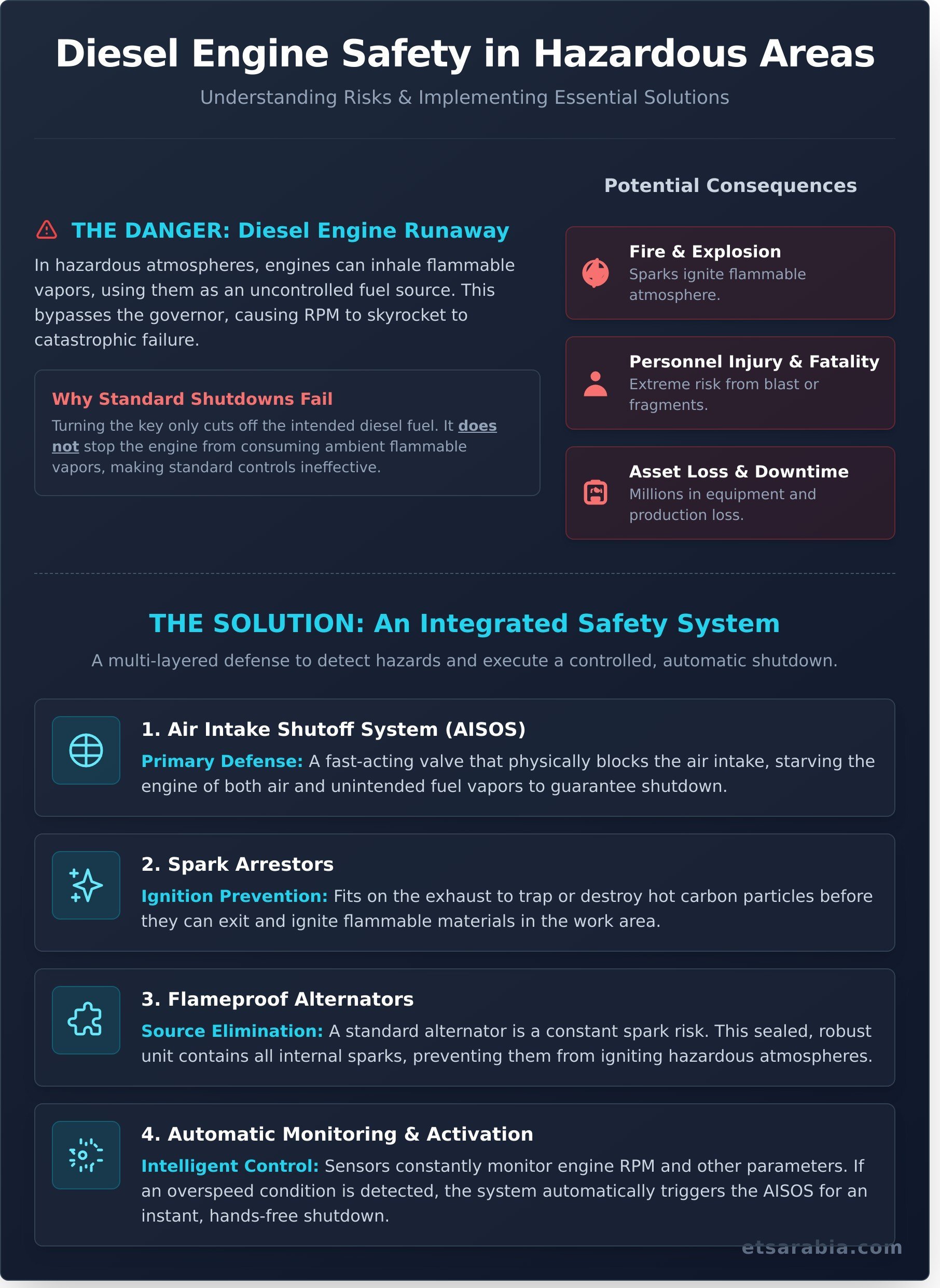
Diesel engine runaway occurs when flammable gas or vapor is drawn into the engine’s air intake system. This external fuel source bypasses the engine’s own fuel governor, which is designed only to control the flow of diesel from the tank. For a more technical explanation, a great resource is the Wikipedia page for Understanding Diesel Engine Runaway. As the engine consumes this atmospheric fuel, its speed (RPM) increases uncontrollably, leading to a dangerous overspeed condition that can result in catastrophic mechanical failure.
Why Standard Engine Shutdowns Fail
A common and dangerous misconception is that simply turning the ignition key or pressing the stop button will halt a runaway engine. This action only cuts the supply of diesel fuel. It does nothing to stop the engine from consuming the flammable vapors it is inhaling from the surrounding environment. The engine will continue to accelerate as long as the external fuel source is present, making standard shutdown mechanisms completely ineffective. This critical vulnerability is precisely why specialized diesel engine safety solutions are mandated for equipment operating in hazardous zones.
The Catastrophic Consequences of Inaction
Failing to implement proper automatic air intake shutoff systems can lead to devastating outcomes. The potential consequences of an uncontrolled engine runaway event are severe and multifaceted, directly threatening both personnel and profitability. These include:
- Fire and Explosion: An overspeeding engine can create sparks or experience a mechanical failure that ignites the surrounding flammable atmosphere.
- Personnel Injury and Fatality: The risk to site personnel from a resulting fire, explosion, or fragmenting engine components is extreme.
- Total Asset Loss and Downtime: The financial impact is immense, encompassing not only the loss of the engine and equipment-often valued in the millions of Saudi Riyals (SAR)-but also the crippling costs of operational downtime and production stoppage.
Investing in proven diesel engine safety solutions is not an operational expense; it is an essential safeguard for your people, your assets, and your bottom line.
Core Components of a Complete Diesel Engine Safety System
A single safety device is not enough to guarantee protection against diesel engine runaway. A comprehensive approach requires an integrated system where each component plays a critical role in a layered defense. This is the essential toolkit for mitigating risk, forming the core of effective diesel engine safety solutions. These components work in unison to detect hazardous conditions and execute a controlled shutdown, protecting your personnel and high-value assets from catastrophic failure.
Air Intake Shutoff Systems (AISOS)
Considered the primary defense against engine overspeed, an Air Intake Shutoff System (AISOS) provides a positive, mechanical method to stop a runaway engine. It functions by physically blocking the air intake path, instantly starving the engine of the air and unintended fuel vapors it needs to operate. This system is the most direct and effective method for preventing diesel engine runaway. Common designs include fast-acting butterfly valves and swing gate valves.
Spark Arrestors
In environments common to Saudi Arabia's oil and gas sector, the risk of fire from exhaust sparks is significant. A spark arrestor is a critical device fitted to the exhaust system that traps or destroys hot carbon particles before they can exit and ignite flammable materials, such as combustible gas or dust. For many industrial sites, a certified spark arrestor is a non-negotiable minimum requirement for equipment to gain access and operate safely.
Flameproof Alternators
A standard alternator is a constant potential ignition source due to the internal sparking of its brushes and electrical components. A flameproof alternator is engineered with a sealed, robust enclosure that contains any internal sparks, preventing them from igniting hazardous atmospheres. This component is essential for achieving compliance in classified hazardous areas, such as those governed by ATEX or IECEx standards, which are frequently enforced on petrochemical and refinery sites.
Engine Monitoring and Automatic Activation
The intelligence behind modern diesel engine safety solutions lies in automated monitoring. A network of sensors continuously tracks critical parameters like engine RPM, coolant temperature, and oil pressure. If these sensors detect a dangerous condition-such as an overspeed event-they automatically trigger the Air Intake Shutoff System to shut the engine down without requiring human intervention. This provides a rapid, reliable response that far exceeds the reaction time of a manual emergency stop.
Integrating a Cohesive Safety System for Maximum Protection
Effective diesel engine safety solutions are not merely a collection of individual parts; they are a fully integrated, cohesive system designed to work in unison. In a high-stakes industrial environment, every component must communicate flawlessly to prevent a catastrophic failure. Think of it as a dedicated nervous system for your engine, with a central control panel acting as the brain. This panel receives data from sensors and makes instantaneous decisions to activate protective measures, mitigating risks before they escalate. The dangers of uncontrolled engine operation are significant, encompassing not just mechanical failure but also serious personnel risks, as outlined in guides like the OSHA Diesel Exhaust Hazards overview. Proper installation and configuration by expert technicians are therefore critical to ensure this system functions as a single, reliable unit.
The Shutdown Sequence: What Happens During an Overspeed Event
To understand the system's effectiveness, consider a common runaway scenario. In a fraction of a second, the integrated safety system executes a precise, life-saving sequence:
- Ingestion: Flammable gas or vapor from the surrounding environment is drawn into the engine's air intake, causing it to accelerate uncontrollably.
- Detection: An electronic or mechanical overspeed sensor detects that the engine's RPM has exceeded a pre-set safety limit.
- Activation: The sensor instantly sends a trip signal to the system's central controller, which in turn activates the air intake shutoff valve.
- Shutdown: The valve snaps shut, completely cutting off the engine's air supply and the external fuel source, bringing the engine to a safe and immediate stop.
Automatic vs. Manual Systems: Choosing the Right Level of Protection
While both automatic and manual shutdown systems have a role, their applications differ. Automatic systems provide constant, 24/7 monitoring and are essential for unattended equipment or in high-risk zones where human reaction time is too slow. Manual systems, such as pull cables or emergency stop buttons, serve as a vital and necessary backup. For most industrial applications in sectors like oil and gas or mining, industry regulations and best practices mandate the installation of fully automatic diesel engine safety solutions to guarantee protection.
The Importance of Regular Testing and Maintenance
An installed safety system is only effective if it is proven to be functional. Regular inspection and function-testing are non-negotiable to ensure reliability when it matters most. A routine maintenance check should include:
- Verifying the free and complete movement of the air intake shutoff valve.
- Testing all sensors and trip mechanisms to confirm activation at the correct set points.
- Inspecting all wiring and connections for signs of wear, corrosion, or damage.
Ensuring these critical systems are always ready is a core part of operational safety. Need help maintaining your safety systems? Contact our technical team.
Critical Applications in Saudi Arabia's Industrial Sector
As the Kingdom of Saudi Arabia diversifies its economy under Vision 2030, the operational integrity of its core industrial sectors has never been more critical. Diesel engines are the workhorses of this growth, but in hazardous environments, they also represent a significant ignition risk. Implementing robust safety measures is not just a regulatory requirement; it is a fundamental pillar of operational continuity and personnel protection.
Oil & Gas: Upstream and Downstream Protection
In the heart of Saudi Arabia's energy sector, from the upstream drilling rigs in the Empty Quarter to the downstream refineries in Jubail, the constant presence of hydrocarbon gases creates a high-stakes environment. Standard diesel engines on critical equipment pose a constant ignition threat. Essential machinery requiring protection includes:
- Power Generators
- Firewater Pumps
- Well Servicing Equipment
- Heavy-Duty Vehicles and Cranes
Proactive safety systems are vital to prevent engine overspeed or exhaust sparks from causing a catastrophic event.
Petrochemical Plants and Material Handling
The Kingdom's world-class petrochemical facilities handle volatile materials where a single spark can have devastating consequences. Material handling equipment like forklifts, cranes, and manlifts frequently operate within these classified zones. Even a small engine malfunction can ignite a large area. Comprehensive protection is essential, requiring both high-quality spark arrestors to manage exhaust and full automatic air intake shutoff systems to prevent diesel engine runaway.
Mining and Tunnelling Operations
With the expansion of mining for gold, phosphate, and other minerals, underground operations present unique challenges. The dual threat of flammable methane gas and combustible mineral dust demands specialized protection. Diesel equipment used in tunnelling and extraction must be fitted with flameproof components and reliable safety shutdown systems to operate safely in these confined, high-risk spaces.
Each of these sectors demands more than a one-size-fits-all approach. At Emdad Technical Services, we deliver specialized diesel engine safety solutions engineered to meet the precise demands of your industry. We ensure your critical equipment operates with guaranteed safety, minimizing downtime and protecting your most valuable assets-your people and your facility. Contact our experts to discuss a tailored safety assessment for your site.
Selecting the Right Diesel Safety Solutions Partner
Implementing the correct safety hardware is only half the battle. The long-term effectiveness, reliability, and compliance of your system depend heavily on the partner you choose for supply, installation, and support. Shifting focus from the 'what' to the 'who' is a critical step in deploying robust diesel engine safety solutions that protect your assets and personnel without compromising operational efficiency.
Verify Compliance and Certifications
In the high-stakes environments of Saudi Arabia's industrial sectors, compliance is not optional. A competent partner must demonstrate an unwavering commitment to international safety standards. Insist on documented proof that all systems and components, such as air intake shut-off valves and spark arrestors, meet rigorous standards like ATEX and IECEx for hazardous locations. Using non-certified parts in a critical safety system introduces unacceptable risks and can invalidate site compliance.
Prioritize Technical Expertise and Local Support
A true solutions partner offers more than just a product catalogue; they provide deep application knowledge and responsive local service. Your provider should be an extension of your team, capable of understanding your specific operational challenges to recommend the most effective and reliable safety configuration. Key differentiators include:
- Expert System Specification: Ensuring the selected solution is perfectly matched to your engine and environment.
- On-Site Support in KSA: The availability of local technicians for fast installation, commissioning, and troubleshooting is crucial for minimizing downtime.
- Ongoing Maintenance: A partner committed to long-term support guarantees your safety systems remain fully functional throughout their lifecycle.
Assess Product Quality and Brand Reputation
In a safety-critical application, the quality of the components is paramount. The reliability of your engine's safety system directly impacts operational continuity and personnel safety. Therefore, it is essential to choose a supplier who partners with reputable global manufacturers known for their engineering excellence and proven performance in demanding industrial conditions. This investment ensures your safety systems will perform flawlessly when they are needed most. ETS partners with leading brands to deliver proven diesel engine safety solutions. Explore our offerings.
Your Partner in Proactive Diesel Engine Safety
In the high-stakes industrial landscape of Saudi Arabia, the threat of diesel engine runaway is a reality that cannot be ignored. As we've explored, implementing a comprehensive safety system is not merely a regulatory measure-it is a fundamental pillar of operational integrity, protecting your valuable assets and, most importantly, your personnel. Selecting the right partner to engineer these systems is paramount to your success.
ETS delivers more than just components; we provide complete, reliable diesel engine safety solutions designed to minimize downtime and ensure full compliance. With expert technical support based in Dammam and partnerships with world-leading manufacturers, we are your local experts equipped to safeguard your critical operations effectively and efficiently.
Protect your people and assets. Contact ETS for an expert consultation on diesel engine safety solutions. Take the decisive step towards guaranteed operational continuity and a safer work environment today.
Frequently Asked Questions About Diesel Engine Safety
What is the primary cause of diesel engine runaway?
The primary cause of diesel engine runaway is the ingestion of an external, uncontrolled fuel source-such as flammable hydrocarbon vapor-through the air intake system. This external fuel causes the engine to accelerate beyond its governed speed, even if the primary fuel supply is shut off. This creates a highly dangerous situation that can lead to catastrophic mechanical failure. An automatic air intake shutoff system is the only reliable method to stop a runaway event.
Is a spark arrestor the same as a flame arrestor?
No, a spark arrestor and a flame arrestor are not the same; they serve distinct safety functions. A spark arrestor is installed in the exhaust system to trap or extinguish hot carbon particles, preventing them from igniting flammable materials in the surrounding environment. A flame arrestor, conversely, is designed to stop a flame front from traveling through a system, typically installed in fuel tank vents or pipelines to prevent an external fire from causing an explosion.
How do I know which safety components my equipment needs?
Determining the correct safety components requires a thorough risk assessment of your specific operating environment in Saudi Arabia. Key factors include the potential presence of flammable gases or combustible dusts (ATEX zones), ambient temperatures, and compliance with local regulations. For a reliable assessment and to select the most effective diesel engine safety solutions for your equipment, we recommend consulting with our technical experts. We ensure your machinery is fully compliant and optimized for maximum safety.
Can diesel engine safety solutions be retrofitted to older engines?
Yes, absolutely. Most modern diesel engine safety solutions are specifically designed to be retrofitted onto existing and older engines with high reliability. Components such as automatic air intake shutoff systems and spark arrestors can be installed on a wide range of legacy equipment. This provides a cost-effective path to upgrade your fleet's safety standards, ensuring compliance with current regulations and protecting your valuable assets without requiring a complete engine replacement.
What are ATEX zones and how do they relate to diesel engine safety?
ATEX zones classify hazardous areas where explosive atmospheres can occur. For gases, they are Zone 0 (continuous risk), Zone 1 (likely risk), and Zone 2 (unlikely, short-term risk). These classifications, widely adopted in Saudi Arabia's industrial sectors, are critical for diesel engine safety. Equipment operating in these zones must have certified protection to prevent it from becoming an ignition source. The specific ATEX zone rating dictates the required level of safety modifications for your engine.
How often should a diesel engine air intake shutoff system be tested?
An air intake shutoff system should undergo a daily pre-start function check to ensure it can operate freely. Beyond this, a comprehensive, documented test should be performed at regular intervals, typically monthly or as specified by the manufacturer and your site’s safety protocols. For critical operations within the Kingdom, adhering to stringent company policies and standards is paramount to guarantee reliable performance and prevent catastrophic failure, thus optimizing operational uptime.