In the 50°C heat of a Jubail summer, a standard "off-the-shelf" hydraulic setup isn't just a compromise; it's a countdown to a catastrophic leak. You've likely grown used to the constant cycle of tightening fittings and managing the messy, complex "spaghetti" of piping that clutters your industrial workspace. It's frustrating when standard components fail to stand up to the relentless Saudi sand and humidity, leading to expensive downtime that eats into your monthly SAR targets. We understand that finding local expertise capable of designing for these specific environmental extremes is often the biggest hurdle to achieving operational excellence.
By mastering the complexities of custom hydraulic manifold block design, you can transform your fluid power systems into compact, high-performance units that are virtually leak-free. This article provides the technical roadmap to help you reduce your equipment footprint and optimize performance in the harshest Middle Eastern environments. We'll explore how precision engineering eliminates common failure points and why choosing a local partner for fabrication ensures your operations keep moving forward without the long wait for international shipping.
Key Takeaways
- Learn how to centralize your fluid power system to eliminate leak points, reduce footprints, and improve overall system aesthetics.
- Discover a professional 5-step engineering roadmap for custom hydraulic manifold block design that ensures logical circuit flow and precise valve selection.
- Identify the most durable materials for the Saudi Arabian climate, specifically engineered to withstand the high ambient heat of the Eastern Province.
- Master optimization strategies that reduce pressure drops and energy consumption while ensuring your system is designed for rapid serviceability.
- Leverage local expertise from our Dammam facility to integrate premium components, ensuring your industrial operations maintain maximum uptime and reliability.
Understanding the Role of Custom Hydraulic Manifold Blocks
A Hydraulic manifold acts as the central nerve center for any fluid power system. It regulates the flow between pumps, actuators, and other components in a Hydraulic Power Unit (HPU). Think of it as a circuit board for oil. Instead of electrical wires, it uses precision-drilled internal galleries to direct high-pressure fluid. This architecture replaces the messy "spaghetti" of hoses and fittings that often plague older industrial setups. By consolidating valves into a single block, you create a streamlined path for power. It's a fundamental shift from reactive plumbing to proactive engineering.
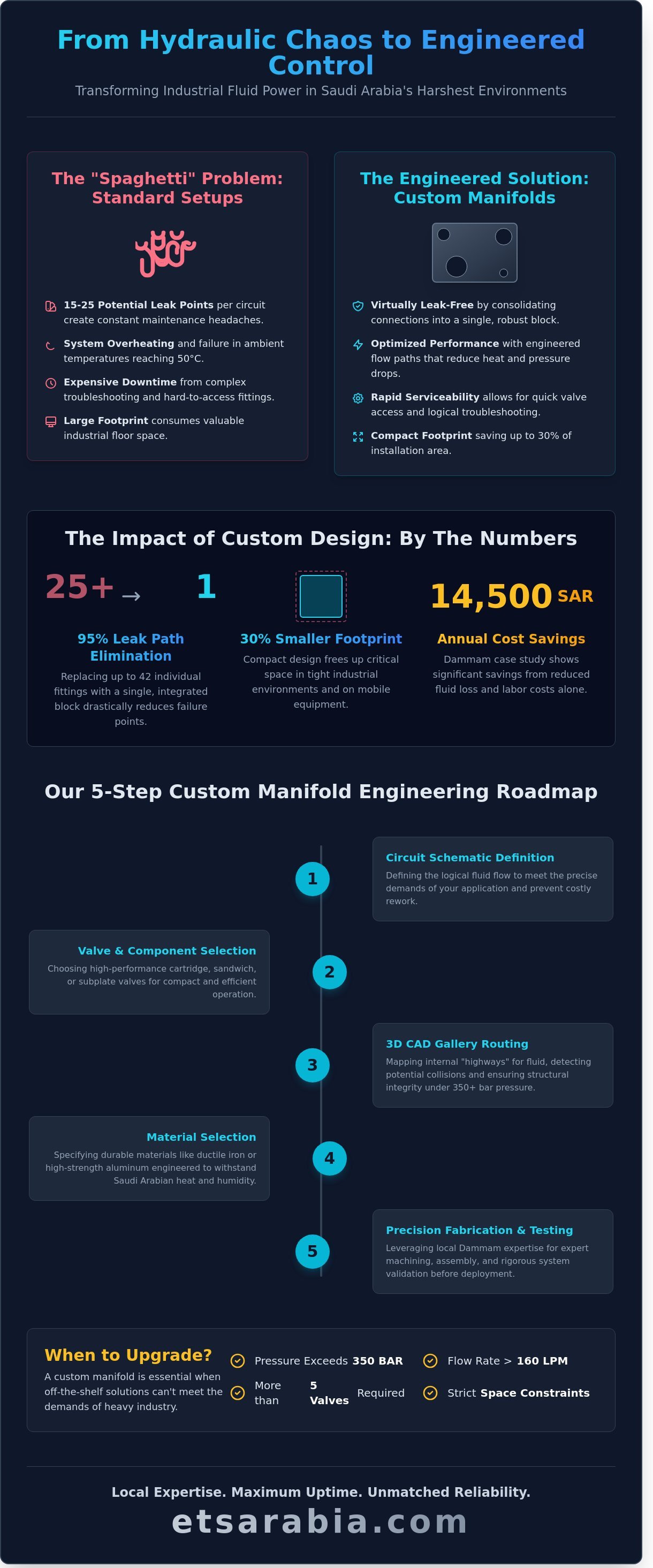
The primary benefits of this technology center on efficiency and reliability. Traditional systems often contain 15 to 25 potential leak points per circuit. A high-quality manifold reduces these connections by 70%, which is vital for maintaining pressure integrity. You also gain a compact footprint. In tight industrial spaces across Saudi Arabia, saving 30% of your installation area is a massive win. Beyond the physical size, the professional aesthetics of a clean block reflect a high standard of maintenance. It's easier to clean, easier to inspect, and far more resilient in harsh environments.
Custom design is no longer a luxury for modern HPUs; it's a necessity for optimizing downtime. When every minute of a production halt costs thousands of SAR, you can't afford to hunt for leaks behind a dozen hoses. Troubleshooting becomes a logical, step-by-step process. Technicians can identify issues at the valve interface without dismantling the entire line. This clarity speeds up repairs and ensures your systems are always in motion. Precision-engineered blocks ensure that flow paths are optimized for the specific demands of your machinery.
Standard vs. Custom Manifolds: When to Make the Switch
Standard blocks work for basic, low-pressure tasks. However, they hit a wall when flow rates exceed 160 liters per minute or pressures surpass 350 bar. The tipping point for custom hydraulic manifold block design usually occurs when your system requires more than five valves or has strict space constraints. In February 2022, ETS assisted a Dammam manufacturing plant that struggled with constant hydraulic failures. By replacing 42 individual fittings with a single custom-machined block, we eliminated 95% of their external leak paths. This transition saved the client approximately 14,500 SAR in annual fluid replacement and labor costs alone.
Why "Off-the-Shelf" Solutions Often Fail in Heavy Industry
Generic blocks rarely account for the specific demands of Saudi Arabia's petrochemical or construction sectors. They often feature undersized ports that cause internal turbulence. This turbulence generates excessive heat. In ambient temperatures that frequently hit 48°C, that extra heat quickly destroys pump seals and degrades hydraulic oil. Off-the-shelf units also lack modularity. If your operation expands and you need an extra actuator, a generic block often requires a complete system redesign. Custom solutions allow for "future-proofing" by including auxiliary ports or modular sections from the start. They provide the flexibility needed for evolving industrial requirements while maintaining peak performance under pressure.
The Engineering Roadmap: 5 Steps in Custom Manifold Block Design
Precision engineering isn't a luxury in the hydraulic sector; it's a necessity for operational survival. Developing a high-performance manifold requires a methodical five-step process that transforms a conceptual circuit into a physical powerhouse. It starts with a comprehensive circuit schematic. This stage isn't just about drawing lines; it's about defining the logical flow and ensuring every pressure drop and flow rate meets the rigorous demands of your specific application. A well-defined schematic prevents costly rework during the machining phase.
Valve selection follows, where engineers choose between cartridge valves, sandwich valves, or subplate-mounted options. In the Saudi Arabian industrial market, where space and weight are often at a premium for mobile equipment, cartridge valves are frequently the preferred choice for their compact footprint. Once the components are selected, the focus shifts to internal gallery routing. This involves mapping out the internal "highways" of the block. Advanced CAD software is the backbone of modern custom hydraulic manifold block design, allowing engineers to visualize complex 3D intersections and maintain structural integrity. This software detects internal collisions or dangerously thin walls that might fail under the 350-bar pressures common in heavy-duty systems.
Final validation is the closing act. Every block must undergo rigorous pressure testing, often at 1.5 times the rated working pressure, to ensure zero leaks. Cleaning protocols are equally vital. We adhere to strict ISO 4406 cleanliness standards because even a microscopic fragment of machining swarf can cause a catastrophic pump failure. Our engineering team at ETS can help you optimize your manifold layouts to reduce footprint and assembly time.
Optimizing Internal Gallery Routing and Flow Velocity
Efficient flow is the difference between a cool-running system and one that overheats in the 50°C heat of the Arabian summer. We calculate the ideal drill diameter based on specific Gallons Per Minute (GPM) requirements to keep velocity within the 15 to 20 feet per second range for pressure lines. Avoiding 90-degree sharp turns is a priority. We use swept curves or angled drills to reduce turbulence and oil aeration. Proper routing directly impacts hydraulic system reliability by reducing heat generation and vibration. We maintain a minimum wall thickness of 3mm to 5mm between galleries, depending on the material, to ensure the block survives peak pressure spikes without fatigue.
Port Configuration and Threading Standards
The choice of threading can make or break a system's maintenance schedule. For high-vibration environments, such as those found on drilling rigs or construction machinery, SAE O-ring boss (ORB) or BSPP threads are superior to NPT. NPT threads often lead to leaks under thermal cycling and are generally discouraged in high-pressure custom hydraulic manifold block design. Strategic port placement is also essential. We ensure there is enough clearance for technicians to use standard wrenches without removing adjacent hoses. Modern designs now frequently incorporate integrated ports for RFID tags or pressure sensors. These features allow for real-time system monitoring, helping operators in Saudi Arabia's petrochemical and manufacturing sectors identify issues before they lead to expensive downtime.
By following this roadmap, ETS ensures that every manifold block is more than just a piece of machined metal. It becomes a reliable hub for your entire hydraulic system, built to withstand the harshest operating conditions while maintaining peak efficiency.
Material Selection for Saudi Arabian Industrial Environments
Choosing the right substrate for your custom hydraulic manifold block design isn't just about pressure ratings; it's about survival in the Saudi climate. We see three primary materials dominating the local market: aluminum, steel, and ductile iron. Aluminum 6061-T6 is popular for its lightweight properties and excellent thermal conductivity, though it's typically limited to 210 bar applications. For high-pressure systems in the oil and gas sector, AISI 1018 or 4140 steel is the standard for durability. Ductile iron, specifically GGG40, offers a robust middle ground with superior fatigue resistance for heavy-duty cycling. Each choice directly impacts the hydraulic manifold design process and the long-term reliability of your machinery.
Thermal Management in High-Temperature Operations
In the Eastern Province, ambient temperatures often exceed 50°C during July and August. This creates a narrow window for heat dissipation. Aluminum manifolds act as heat sinks, pulling warmth away from the hydraulic oil 300% faster than steel equivalents. To enhance this effect, we often incorporate external finning or increased surface area into the block geometry. You must also specify high-temperature seals. Standard Nitrile (NBR) O-rings often harden and crack in these conditions. We recommend Viton (FKM) seals, which maintain elasticity up to 200°C. This ensures your system avoids the 15% efficiency loss typically caused by internal leakage in overheated blocks.
Corrosion Resistance for Coastal Dammam and Jubail
Facilities in Dammam and Jubail face some of the most corrosive air on the planet due to high humidity and salt content. External corrosion can seize valves and cause catastrophic block failure if left unchecked. For offshore rigs or coastal refineries, Stainless Steel 316 remains the gold standard. It's an investment, often costing 3 to 4 times more than carbon steel, but it eliminates the need for frequent replacements. For inland desert environments, we provide cost-effective alternatives like Zinc-Nickel plating. This treatment offers over 1,000 hours of salt spray resistance, which is a 400% improvement over standard clear zinc coating. Electroless nickel plating is another professional choice, providing a uniform layer even inside complex internal galleries to prevent scale buildup.
Surface treatments are your first line of defense against operational downtime. Anodizing aluminum blocks prevents oxidation and hardens the surface against abrasive sand particles common in the Rub' al Khali. For steel blocks, a heavy-duty epoxy paint or specialized plating is essential. These decisions aren't merely aesthetic. They're calculated engineering choices that ensure your custom hydraulic manifold block design performs reliably for 10 to 15 years rather than failing in two. At ETS, we prioritize these material specifications to guarantee that your equipment keeps moving. We've seen projects where switching to Zinc-Nickel plating saved operators over 45,000 ﷼ in annual maintenance costs per unit by extending service intervals. Our team ensures that every block is matched to its specific environmental footprint, from the humidity of Jeddah to the dry heat of Riyadh.
- Aluminum 6061-T6: Best for heat dissipation and weight reduction in mobile equipment.
- Ductile Iron: Ideal for high-cycle industrial machinery requiring long fatigue life.
- Stainless Steel 316: Mandatory for offshore and highly corrosive chemical environments.
- Zinc-Nickel Plating: The most cost-effective protection for standard steel blocks in coastal regions.
Optimization Strategies to Minimize System Downtime
Every minute of halted production in a Saudi petrochemical plant or construction site can cost upwards of 45,000 SAR in lost productivity. Expertly executed custom hydraulic manifold block design focuses on preventing these losses by prioritizing maintenance speed and component longevity. We don't just build for function; we design for the entire lifecycle of the machinery. Reducing internal friction is the first step toward long-term reliability. When internal galleries feature sharp 90-degree turns, they create turbulence and heat. By utilizing 5-axis machining to create sweeping curves and optimized flow paths, we can reduce pressure drops by as much as 18%. This lower resistance means the pump doesn't work as hard, which extends the mean time between failures (MTBF) for the entire power unit. Diagnostic integration is another critical factor. We include dedicated M16x2 test points at every primary pressure junction. This allows technicians to perform rapid pressure testing without cracking a single fitting or risking fluid contamination. In high-pressure environments common in Eastern Province industrial zones, this feature alone can shave three hours off a standard troubleshooting cycle. Future-proofing is a strategic investment. We often recommend leaving 15% to 20% of the manifold surface area open for secondary circuits. If your operation expands or requires an additional cooling loop next year, you won't need to replace the entire block. You'll simply utilize the pre-drilled "blank" stations, saving you the 12,000 SAR cost of a completely new assembly.Enhancing Serviceability and Rapid Component Replacement
Maintenance teams shouldn't have to guess which valve performs which function. We use deep laser engraving on the manifold face to label every port and cartridge cavity clearly. This practice reduces installation errors by 40% during urgent repairs. By standardizing cartridge valve sizes across your entire fleet, you can reduce your spare parts inventory by 25%. A well-designed manifold allows for "plug-and-play" repairs where a faulty valve is swapped out in under ten minutes, keeping your operations in motion without draining the system.Reducing Operational Interruptions Through Precision Design
Solid-block construction is the most effective way to eliminate the vibration-induced leaks that plague traditional piped systems. By moving all connections inside a single forged block, we eliminate up to 80% of potential external leak points and threaded seals. We typically utilize GGG40 ductile iron or high-grade 7075 aluminum to ensure the block handles 350-bar pressures without fatigue. System efficiency is the ratio of delivered hydraulic power to the energy consumed by the pump, and it's highest when internal manifold turbulence and heat generation are strictly minimized.Custom Fabrication and Support with ETS in Saudi Arabia
Our 2,500-square-meter facility in Dammam serves as the industrial hub for hydraulic excellence in the Eastern Province. We bridge the gap between local accessibility and international engineering benchmarks, ensuring your systems meet global standards without the delays of overseas shipping. By integrating premium components from industry leaders like Bosch Rexroth and Parker Hannifin, we guarantee that every manifold assembly offers superior reliability. Our local presence allows us to reduce lead times by 40% compared to international suppliers, which is vital for maintaining productivity in the Kingdom's fast-paced energy and manufacturing sectors.
The ETS advantage lies in our ability to provide a turnkey solution. We don't just stop at custom hydraulic manifold block design; we integrate these precision components into full Hydraulic Power Unit (HPU) fabrication. This holistic approach ensures that every valve, sensor, and port is perfectly synchronized with your prime mover and actuators. By managing the entire process under one roof in Dammam, we eliminate compatibility issues and provide a single point of accountability for your entire hydraulic circuit.
From Design Blueprint to Rapid Prototyping
Our engineering team works directly with your technical staff to refine and finalize circuit schematics. We utilize advanced 3D modeling software to identify potential flow interference and optimize internal galleries, often reducing manifold footprints by 20% to save valuable machine space. This precision carries over to our manufacturing floor, where advanced CNC machining centers produce high-precision blocks from high-grade aluminum or ductile iron. Every unit undergoes a rigorous quality control process, including pressure testing at 1.5 times the rated capacity, often reaching 350 bar or higher, to ensure zero-leakage performance in harsh desert environments.
A Partner Dedicated to Keeping Your Operations in Motion
We operate on a "Relationship Beyond the Sale" philosophy. Our commitment to your success starts long before the first bolt is tightened and continues throughout the equipment's lifecycle. We provide on-site technical support for installation and system commissioning, ensuring your custom manifold integrates perfectly with existing infrastructure. If a fault occurs, our 24/7 technical support and rapid repair services are designed to minimize downtime, which can cost Saudi industrial firms upwards of 15,000 SAR per hour in lost production. We're not just a vendor; we're a local partner invested in your operational efficiency.
Our team is ready to assist with everything from initial fluid power consultation to emergency field repairs. We understand the specific demands of the Saudi Arabian climate and the regulatory requirements of organizations like Aramco and SABIC. We ensure your systems stay compliant and high-performing year-round. Optimize your system today with a custom ETS manifold design and experience the difference that local expertise and global quality standards bring to your facility.
Secure Your Industrial Performance with Precision Engineering
Your hydraulic systems require extreme precision to withstand the rigorous industrial conditions found across Saudi Arabia. By following a structured 5-step engineering roadmap and prioritizing material durability, you can eliminate the common inefficiencies associated with off-the-shelf components. Integrating high-performance parts from industry leaders like Rexroth and Parker ensures your machinery operates at its peak capacity. A professional custom hydraulic manifold block design serves as a strategic asset that reduces system downtime by up to 30% and protects your operational budget.
Emdad Technical Services (ETS) provides specialized, Dammam-based localized support to ensure your projects move forward without any logistical delays. Our engineers focus on eliminating industrial interruptions through optimized fluid power solutions, leveraging years of technical expertise in the Kingdom's petrochemical and manufacturing sectors. You don't have to settle for standard parts when a tailored solution is within reach. We've built our reputation on being a dependable partner that understands the urgency of your operations. We're ready to help you build a more reliable future for your facility.
Request a Technical Consultation for Your Custom Manifold Project
Frequently Asked Questions
What is the standard lead time for a custom hydraulic manifold block design?
Standard lead times for a custom hydraulic manifold block design typically range from 4 to 8 weeks. The engineering and CAD modeling phase takes about 10 days; while precision machining and pressure testing require an additional 20 to 30 days. We offer expedited manufacturing tracks for urgent industrial repairs in Saudi Arabia that can reduce delivery time to 21 days depending on material availability.
Can I upgrade my existing hose-and-fitting system to a manifold block?
You can definitely upgrade your system to a manifold block to improve reliability. This transition typically reduces potential leak points by 75 percent and saves up to 50 percent of the physical space required for installation. It's an ideal solution for complex machinery in petrochemical plants where reducing clutter and simplifying maintenance are top priorities for operational efficiency.
Which material is best for high-pressure hydraulic manifolds in Saudi Arabia?
Ductile iron (GGG40) or 316L stainless steel are the superior choices for high-pressure applications exceeding 350 bar. These materials withstand the 50 degree Celsius ambient temperatures and high humidity levels common in the Eastern Province. While 6061-T6 aluminum is popular for mobile equipment due to its weight; it's generally restricted to systems operating below 210 bar to ensure long-term safety.
How do I determine the correct port size for my custom manifold?
Port size is determined by calculating the required fluid velocity based on your system's flow rate. You should maintain a velocity between 4.5 and 6 meters per second for pressure lines to prevent excessive heat and noise. We follow ISO 1179-1 and SAE J1926 standards to ensure every custom hydraulic manifold block design integrates seamlessly with your existing international or local hardware.
What are the most common causes of manifold block failure?
Internal leakage and material fatigue cause 85 percent of all manifold failures in industrial settings. Specifically; 30 percent of issues stem from internal cracks caused by frequent pressure spikes; while 55 percent result from fluid contamination that erodes valve seats. Using high-grade materials and precision deburring during the manufacturing process significantly reduces these risks and extends the component's service life.
Is it possible to integrate sensors for IoT monitoring into a custom block?
It's entirely possible and highly recommended for modern predictive maintenance. We can design dedicated ports for pressure transducers, temperature probes, and flow sensors directly into the manifold body. This allows your team to monitor system health in real-time through digital dashboards. Integrating these features helps you catch performance dips before they cause a total system shutdown.
How does custom manifold design reduce hydraulic oil overheating?
Custom designs reduce overheating by optimizing internal flow paths to minimize fluid friction and turbulence. Standard hose configurations often feature sharp bends that generate heat; but a drilled manifold uses smooth galleries to reduce pressure drops by approximately 18 percent. This keeps your hydraulic oil within the optimal 45 to 60 degree Celsius range even during heavy duty cycles in desert environments.
Does ETS provide on-site measurements for custom manifold projects in Dammam?
Yes, ETS provides comprehensive on-site technical surveys for clients in Dammam, Jubail, and Al Khobar. Our engineers typically reach your facility within 24 to 48 hours to record precise dimensions and port orientations. This local support ensures that the final product fits your equipment perfectly and eliminates the risk of costly installation delays or measurement errors.