
A recent analysis of industrial operations within Saudi Arabia's key economic cities revealed a startling fact: unplanned hydraulic system downtime can cost a mid-sized facility upwards of ﷼150,000 for every hour of lost production. It’s a figure that confirms what you already know. Every time a hose bursts or a pump fails, it's not just a technical problem; it's a direct hit to your profitability, forcing difficult and often rushed decisions between repairing or replacing critical assets.
This guide provides the expert framework you need for calculating ROI on hydraulic repairs with precision. We will empower you to move beyond reactive spending and transform your maintenance strategy into a predictable driver of operational efficiency and long-term financial gain. You'll discover a clear formula to justify your decisions, learn strategies to reduce the total cost of ownership, and see how expert repairs can significantly extend your equipment's reliable lifespan.
Key Takeaways
- Master the essential formula for calculating ROI on hydraulic repairs, enabling you to accurately predict the long-term financial impact of every maintenance decision.
- Discover the "50% Rule" to make data-driven decisions on repairing versus replacing critical components, preventing overspending on assets nearing the end of their lifecycle.
- Learn how Saudi Arabia's extreme climate degrades hydraulic seals and fluids, and how a targeted preventative maintenance strategy can safeguard your operational profitability.
- Uncover why an initial low repair cost, often quoted in thousands of Riyals, can lead to a negative ROI within a year due to increased downtime and repeat failures.
Understanding the Fundamentals of Hydraulic Repair ROI
In the high-stakes industrial environments of Saudi Arabia, from Dammam's manufacturing plants to Jubail's petrochemical complexes, every operational decision directly impacts the bottom line. The concept of Return on investment (ROI) is a critical performance measure used to evaluate the efficiency of an investment. When applied to heavy equipment, calculating ROI on hydraulic repairs is not merely about comparing repair invoices. It’s a comprehensive analysis of total operational cost versus the long-term value and reliability gained. A low-cost repair that fails within six months hasn't saved you money; it has generated a negative ROI by compounding expenses and crippling productivity.
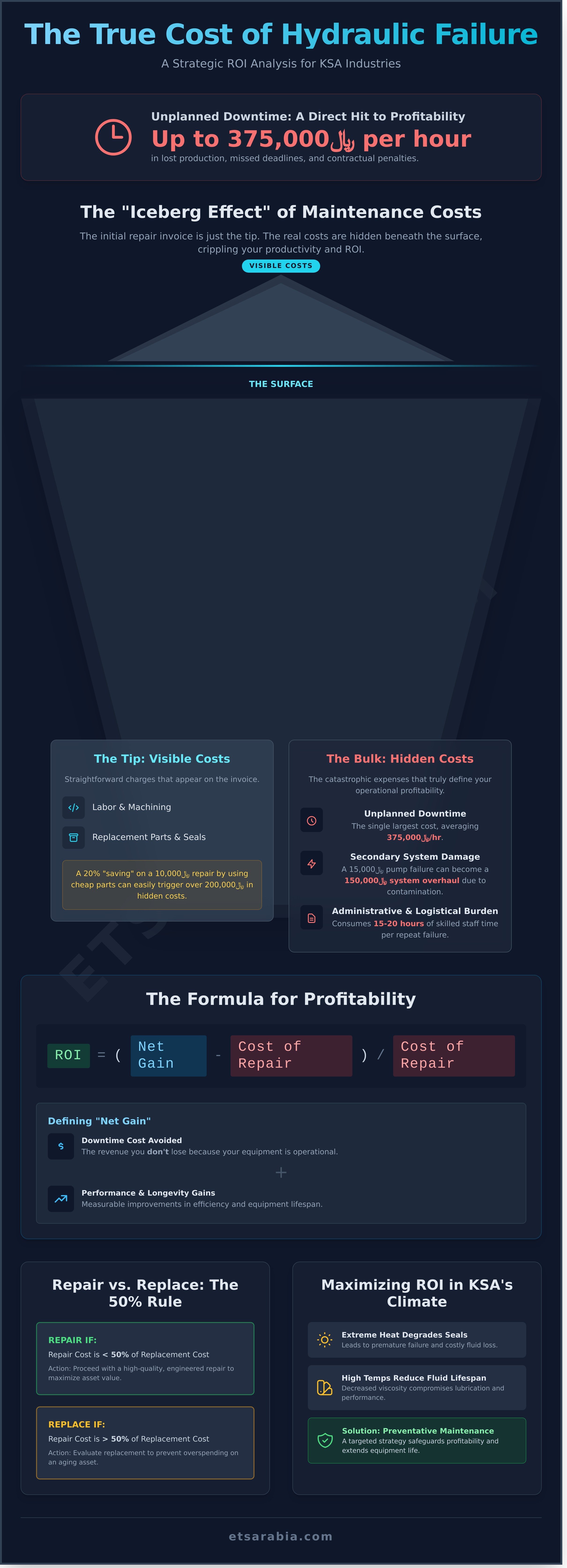
This miscalculation often stems from the "Iceberg Effect" of maintenance costs. The initial invoice for a repair is just the visible tip. Below the surface lie massive, hidden expenses like production loss, secondary system damage, and administrative overhead. A 20% savings on an initial ﷼10,000 repair can easily trigger over ﷼200,000 in hidden costs, exposing the fallacy of prioritizing upfront price over engineered quality. True ROI is achieved when a repair enhances system reliability, extends component life, and minimizes the risk of future unscheduled shutdowns.
The Visible Costs: Invoices and Parts
The direct costs on your invoice are straightforward: labor hours, replacement parts, and any necessary machining. However, the quality of these components is a primary driver of future performance. Opting for a non-OEM seal to save ﷼150 can lead to a premature failure that costs thousands in fluid loss and emergency labor. High-quality seals, fittings, and hoses are not expenses; they are investments in operational continuity. "Cheap" parts, often sourced from unverified suppliers, are the primary driver of ROI erosion, frequently failing to meet the pressure and temperature tolerances required in the demanding Saudi climate.
The Hidden Costs: What You Are Really Paying For
The most significant expenses of a poor hydraulic repair are never listed on the invoice. These are the costs that truly dictate your operational profitability and expose the risk of a "quick fix" approach. They include:
- Unplanned Downtime: This is the single largest hidden cost. For many Saudi Arabian manufacturing and petrochemical plants, unplanned downtime costs average over ﷼375,000 per hour in lost production, missed deadlines, and contractual penalties.
- Secondary System Damage: A failing hydraulic pump doesn't just stop working; it can contaminate the entire system with metal particles. This turns a ﷼15,000 pump repair into a ﷼150,000 system overhaul, requiring a complete fluid flush, filter replacement, and inspection of all connected cylinders and valves.
- Administrative and Logistical Burden: A recurring failure consumes valuable resources. Each repeat repair requires engineering diagnostics, procurement paperwork, and logistical coordination, consuming an estimated 15-20 hours of skilled staff time that could be dedicated to proactive maintenance.
Ultimately, a precision-engineered repair from a trusted partner delivers a superior return by directly addressing both visible and hidden costs. The focus shifts from a short-term transaction to a long-term reliability solution. An effective strategy for calculating ROI on hydraulic repairs must account for these powerful variables to protect your most valuable asset: operational uptime.
The ROI Calculation Formula for Hydraulic Systems
At its core, calculating ROI on hydraulic repairs is about comparing the total cost of the repair against the total value it generates. A simple formula provides the framework, but the accuracy of your calculation depends entirely on the quality of your data. We've refined the standard model to focus specifically on the high-stakes environment of industrial hydraulics.
The fundamental formula is: ROI = (Net Gain - Cost of Repair) / Cost of Repair
To make this actionable, we must define "Net Gain." For hydraulic systems, this gain is a combination of avoided losses and new efficiencies:
- Downtime Cost Avoided: The revenue you don't lose because your equipment is operational.
- Performance & Longevity Gains: The measurable improvements in efficiency, output, and equipment lifespan post-repair.
Success in calculating ROI on hydraulic repairs hinges on accurately quantifying these variables, primarily by understanding two critical metrics: Mean Time Between Failures (MTBF) and Mean Time to Repair (MTTR). These aren't just technical acronyms; they are direct inputs into your financial planning.
Quantifying Downtime and Production Losses
Every minute your equipment is offline carries a direct cost. Consider an excavator working on a critical infrastructure project in Dammam's 2nd Industrial City. Its hourly downtime cost isn't just the operator's salary. A realistic calculation includes:
- Operator & Support Staff Wages: 150 SAR/hour
- Fuel & Consumables: 200 SAR/hour
- Project Delay Penalties & Supply Chain Disruption: Potentially 2,500 SAR/hour or more
This single machine's failure results in a staggering loss of 2,850 SAR for every hour it sits idle. Understanding these figures transforms a repair from an expense into a critical investment in revenue protection. A key objective of any maintenance strategy is to extend the MTBF, and a deeper analysis of measuring preventive maintenance ROI shows that proactive repairs are far more cost-effective than reactive ones. Mean Time Between Failures (MTBF) is the average operational time between equipment breakdowns, and its direct correlation to annual profitability is absolute; a longer MTBF means more uptime and higher revenue generation.
Measuring Performance Gains Post-Repair
A professional hydraulic repair delivers more than just a return to baseline functionality; it creates new value. A correctly refurbished system runs closer to its original design specifications, unlocking tangible performance gains that directly impact your bottom line.
- Energy Efficiency: A worn hydraulic pump can increase fuel consumption by over 10%. A professional repair can restore that efficiency, saving a heavy machine that consumes 1,600 SAR in fuel per day up to 160 SAR daily.
- Cycle Time Improvements: Faster and more responsive hydraulics mean higher throughput. A repaired system might increase an excavator's cycles per hour by 8%, directly boosting productivity and project completion speed.
- The Value of "Peace of Mind": While harder to quantify, reducing the risk of catastrophic failure protects your most valuable assets: your people and your reputation. A reliable machine is a safe machine.
Finally, consider the "Longevity Multiplier." A standard repair might fix the immediate issue, but an expert service using OEM-spec parts and advanced diagnostics extends the equipment's operational life. This enhancement doesn't just prevent the next failure; it pushes it further into the future, multiplying your return over thousands of additional service hours. To understand the full ROI potential for your specific equipment, our experts can help you diagnose and quantify these critical variables.
Repair vs. Replace: The Strategic Decision Matrix
Deciding between repairing a failing hydraulic component and replacing it outright is a critical financial and operational calculation. It's not merely about the immediate invoice; it’s a strategic choice that impacts productivity, safety, and long-term costs. A superficial analysis can lead to repeated downtime, while a well-considered decision optimizes your asset's lifecycle. The core of this choice lies in accurately calculating the ROI on hydraulic repairs versus the total value of a new investment.
A common industry guideline is the "50% Rule": if the cost of a repair exceeds 50% of the price of a new replacement, you should replace it. However, this rule is an incomplete formula in high-stakes industrial environments. Consider a hydraulic cylinder repair quoted at ﷼20,000, while a new OEM replacement costs ﷼35,000. The repair is 57% of the replacement cost, suggesting replacement. But what if the new cylinder has a 5-week lead time from Germany, and your operational downtime costs your facility in Jubail ﷼15,000 per day? The ﷼262,500 in lost production far outweighs the marginal savings of the repair. A 3-day local repair at our Dammam facility becomes the clear high-ROI choice.
The physical condition of core components is non-negotiable. For a hydraulic cylinder, the assessment must focus on the structural integrity of the honed tube and chrome shaft. A visual inspection can reveal deep scoring or cracks inside the tube, which compromise its ability to hold pressure safely. For the chrome shaft, any visible pitting, flaking chrome, or a bend exceeding 0.5mm per meter of length often renders it unsalvageable. Repairing a component with a compromised core structure is a temporary fix that guarantees future failure and potential safety hazards.
Technological obsolescence is another key factor. Repairing an inefficient, 20-year-old hydraulic system might seem cost-effective, but it ignores long-term operational costs. For example, replacing an outdated fixed-displacement gear pump with a modern Rexroth variable-displacement piston pump can reduce energy consumption by up to 30%. For a medium-sized hydraulic power unit (HPU) running 12 hours a day, this can translate into annual energy savings of over ﷼18,000, delivering a clear return on the investment in under 24 months.
When to Choose Professional Repair
Opting for repair is the superior strategic move when dealing with proprietary or legacy systems, such as older-generation heavy equipment, where sourcing new OEM parts is impossible. The speed advantage of a local repair in Dammam also drastically cuts downtime compared to weeks of waiting for international shipping. Furthermore, our expert technicians can often restore equipment to "Better than OEM" specifications by using advanced sealing technologies and superior-grade materials not available at the time of original manufacture.
When Replacement is the Smarter Investment
Replacement becomes the clear winner when you evaluate the equipment's "Total Life Cycle." A new component with a 2-year warranty and a 10-year expected life offers far greater long-term value than a repaired unit that might only last another 3 years. Modernizing a system by sourcing new, efficient Parker or Rexroth components improves performance and ensures parts availability within Saudi Arabia. Upgrading can also integrate value-added technologies, like an automated lubrication system, which can prevent over 60% of bearing-related failures for a modest upfront cost.
Case Study: Custom HPU Fabrication vs. System Overhaul
A petrochemical client in Yanbu faced constant failures with their aging hydraulic system. A complete overhaul was quoted at ﷼320,000 with an estimated 25 days of downtime. ETS proposed a custom-fabricated HPU for ﷼385,000. While the initial cost was 20% higher, our solution was installed in just 7 days, saving the client 18 days of downtime valued at over ﷼450,000. The new, consolidated unit also improved energy efficiency by 18%, offering a complete ROI in less than 15 months.
Maximizing ROI through Preventative Maintenance in KSA
Reactive repairs are a drain on your bottom line. A catastrophic failure not only incurs high emergency repair costs but also results in crippling operational downtime. In the demanding industrial environment of Saudi Arabia, a proactive maintenance strategy isn't an expense; it's a powerful investment that delivers a measurable return. The most effective way of calculating ROI on hydraulic repairs involves understanding how to prevent them in the first place, transforming maintenance from a cost center into a profit driver.
Environmental Factors in the Eastern Province
Operating in Dammam, Jubail, or Al Khobar presents unique challenges. Ambient temperatures regularly exceeding 48°C accelerate hydraulic fluid viscosity breakdown, while airborne sand and dust act as a constant threat. Fine silica particles (<10 microns) can bypass standard seals and filters, causing abrasive wear on pumps and valves. Upgrading to high-performance, 3-micron absolute filtration for a cost of ﷼2,000 can prevent a premature ﷼40,000 pump failure, delivering a 20:1 return on investment. Having a technical partner with a workshop in Dammam 2nd Industrial City ensures rapid access to specialized filters and expert support, minimizing logistics-related downtime.
The Role of Predictive Maintenance
Predictive maintenance uses data to forecast failures before they occur. It's the most advanced strategy for optimizing uptime. Fluid analysis, for instance, provides a detailed report on fluid condition and the presence of wear metals. A routine ﷼1,875 fluid analysis can provide the early warning needed to prevent a ﷼187,500 catastrophic pump failure and its associated emergency repair costs. For critical Hydraulic Power Units (HPUs), remote IoT sensors can monitor pressure and temperature in real-time, providing instant alerts that allow for scheduled, low-cost interventions instead of costly, unplanned shutdowns.
A proactive approach, anchored by regular On-Site Technical Support, is your best defense against catastrophic ROI loss. Our technicians identify subtle issues like hose abrasion or minor seal leaks that often precede major system failures. A scheduled ﷼5,000 hose replacement can prevent a ﷼200,000 system failure and a full day of lost production. This preventative mindset extends to lubrication. According to studies from leading manufacturers like Parker Hannifin, a properly implemented lubrication and fluid management schedule can extend the life of critical hydraulic components by up to 200% by reducing friction, heat, and contamination.
Your first line of defense is always your on-site team. Training operators to spot early warning signs is a simple, high-return strategy. Empowering your personnel to identify these issues ensures that minor problems are addressed before they escalate into system-wide failures.
The 5 Common Signs of Hydraulic Failure:
- Abnormal Noise: A whining or knocking sound from the pump often indicates aeration, cavitation, or imminent mechanical failure.
- High Fluid Temperature: If the reservoir or components are excessively hot to the touch (above 82°C), it signals poor heat dissipation or excessive system friction.
- Slow Operation: Sluggish cylinder or motor performance points to internal leaks or a pump that is no longer generating sufficient flow.
- Visible Leaks: Any fluid pooling around fittings, seals, or hoses is a clear sign of a system breach that requires immediate attention.
- Milky or Foamy Fluid: A cloudy appearance in the sight glass indicates water or air contamination, which severely degrades lubrication and can cause corrosion.
Effectively calculating ROI on hydraulic repairs means shifting focus from reaction to prevention. To protect your assets and optimize your maintenance budget, schedule an on-site hydraulic system assessment with our Dammam-based technical team today.
Partnering for Profit: How ETS Optimizes Your ROI
A formula is only as powerful as the data you put into it. While understanding the math behind ROI is critical, the true challenge lies in controlling the variables: minimizing downtime, reducing repair costs, and extending the lifespan of your equipment. This is where a strategic technical partner becomes your most valuable asset. At Emdad Technical Services (ETS), our entire operation is engineered to positively impact every component of your ROI calculation.
Our approach combines two essential elements: precision engineering and rapid local response. We believe that a successful repair isn’t just about fixing a broken part; it’s about understanding the system's demands to prevent future failures. This philosophy, "the relationship doesn’t end at the sale," ensures we provide ongoing support that protects your initial investment. By partnering with global industry leaders like Rexroth, Parker, and Danfoss, we provide access to world-class components, but with the crucial advantage of local Saudi Arabian expertise to ensure they are specified and installed correctly for our region's demanding operational environments.
For industrial operations facing unique or persistent challenges, off-the-shelf solutions often fall short. Our ability to design and fabricate custom Hydraulic Power Units (HPUs) offers a definitive solution. By creating a system tailored to your exact workflow, pressure, and environmental needs, we can engineer out inefficiencies, reduce energy consumption, and build in reliability from the ground up, delivering a superior long-term return.
Our Dammam-Based Technical Capability
Speed is a critical factor in any downtime calculation. Our state-of-the-art facility in Dammam is equipped with in-house turnery and fabrication capabilities, allowing us to manufacture or repair critical components without waiting on international supply chains. This local advantage drastically reduces turnaround times for everything from specialized fittings and high-pressure hoses to complex cylinder repairs, directly minimizing your downtime costs.
- The Problem: A major drilling contractor was experiencing an average of two critical hydraulic hose failures per month on their primary rig, leading to 8 hours of non-productive time per incident. At an estimated cost of ﷼25,000 per hour, this translated to nearly ﷼400,000 in lost revenue monthly.
- ETS Solution: Our technical team performed an on-site audit and identified that the installed hoses were not rated for the high-pressure and high-abrasion environment. We custom-fabricated and installed a set of properly specified, robust hose assemblies from our Dammam workshop within 24 hours.
- The ROI: The client saw a 95% reduction in hose-related failures over the subsequent six months, saving an estimated ﷼2.28 million in potential downtime. This demonstrates how the right technical partner makes calculating ROI on hydraulic repairs a much more favorable exercise.
Get a Professional ROI Assessment
Your hydraulic systems may have hidden "ROI Leaks"-inefficiencies like minor pressure drops, incorrect fluid viscosity, or slight overheating that don't cause catastrophic failure but quietly drain your profitability every day. Our comprehensive technical audits are designed to identify and quantify these leaks. We provide a detailed report outlining specific actions to enhance performance and prevent costly future breakdowns.
A long-term technical support partnership with ETS moves your maintenance strategy from reactive to proactive. We help you anticipate needs, schedule preventative maintenance, and optimize system performance to ensure you consistently achieve the highest possible return on your machinery. Don't leave your profitability to chance. Optimize your downtime-contact ETS for a hydraulic system audit today.
Secure Your Profitability with Strategic Hydraulic Repair
Mastering the skill of calculating roi on hydraulic repairs is more than an accounting task; it's a strategic imperative for industrial operators across Saudi Arabia. The key takeaway is clear: a proactive strategy built on data-driven decisions transforms your hydraulic systems from a potential liability into a reliable asset. This means understanding that the true cost of failure isn't just the repair bill, but the lost production time, which can easily exceed 50,000 SAR per hour in critical sectors.
Your equipment's performance shouldn't be left to chance. As your partner, we deliver what we promise: Reliable Performance Guaranteed. With specialized expertise in complex Rexroth and Parker systems, ETS provides the solutions you need from our strategic hub in Dammam's 2nd Industrial City. It's time to move beyond simple fixes and optimize for long-term profitability. Maximize your equipment longevity-Book a Technical Consultation with ETS.
Take control of your assets and drive your operations forward with confidence.
Frequently Asked Questions
How do I calculate the ROI of a hydraulic pump repair?
You calculate the ROI by dividing the net financial gain from the repair by the repair's cost. The formula is: ROI = [(Cost of New Part + Avoided Downtime Cost) - Cost of Repair] / Cost of Repair x 100. For example, if a new pump costs ﷼25,000, the repair is ﷼7,000, and you avoid ﷼40,000 in downtime, the ROI is 828%. Effectively calculating ROI on hydraulic repairs is crucial for making sound financial decisions and justifying maintenance budgets.
Is it always cheaper to repair a hydraulic cylinder than to buy a new one?
No, repair isn't always the most cost-effective option. A reliable industry guideline is the 65% rule; if the repair cost exceeds 65% of the price of a new cylinder, replacement is often the better long-term investment. Catastrophic failures like a bent rod or a deeply scored barrel often make replacement more sensible. However, for issues like worn seals or minor leaks, a professional repair provides significant savings and a fast turnaround, minimizing operational downtime.
What is the average cost of hydraulic downtime in Saudi Arabia?
The cost of hydraulic downtime in Saudi Arabia varies significantly by industry but is consistently high. For critical sectors like petrochemicals and heavy manufacturing in industrial cities such as Jubail or Yanbu, unplanned downtime can cost from ﷼70,000 to over ﷼180,000 per hour. This figure accounts for lost production, labor costs, potential contractual penalties, and restart expenses. Minimizing this downtime is a primary driver for investing in quality repairs and preventative maintenance programs.
How does heat affect the ROI of hydraulic systems in the Middle East?
Extreme ambient heat, often exceeding 45°C in Saudi Arabia, directly shortens the life of hydraulic components and lowers your ROI. High temperatures can accelerate hydraulic fluid degradation by over 50%, forcing more frequent and costly fluid changes. It also causes seals to harden and crack prematurely, leading to leaks and failures. Investing in high-temperature seals and enhanced cooling systems provides a strong return by extending component life and reducing heat-related failures by up to 30%.
Can a repaired hydraulic system be more efficient than the original OEM setup?
Yes, a professionally repaired and upgraded system can absolutely outperform its original specifications. During a repair, we can integrate modern advancements that weren't available when the equipment was first built. Upgrading to modern low-friction polymer seals, for instance, can reduce energy consumption by 5-10%. Similarly, re-engineering certain components for improved fluid dynamics can enhance overall system efficiency, delivering tangible performance gains and long-term operational savings.
What metrics should I track to monitor hydraulic maintenance performance?
To effectively monitor performance, you should track several key metrics. The most critical indicators include Mean Time Between Failures (MTBF) to measure reliability, and Mean Time To Repair (MTTR) to gauge response efficiency. Also, monitor maintenance cost per operating hour to control budgets and fluid contamination levels using the ISO 4406 cleanliness code. Tracking these four metrics provides a clear, data-driven view of your system's health and the effectiveness of your maintenance strategy.
How often should I conduct preventative maintenance to maximize ROI?
For industrial equipment operating in Saudi Arabia's demanding environment, a structured preventative maintenance schedule is essential for maximizing ROI. We recommend a baseline of daily visual inspections, monthly hydraulic fluid analysis, and quarterly filter replacements. For mission-critical systems operating 24/7, this schedule should be accelerated. This proactive approach can reduce unexpected failures by over 70%, drastically cutting emergency repair costs and preserving production continuity.
Why does the quality of hydraulic seals matter for long-term savings?
The quality of hydraulic seals directly impacts system reliability and long-term operational costs. While a premium-grade seal from a reputable manufacturer may cost 25-40% more upfront than a standard alternative, it can last up to three times longer. This extended lifespan prevents costly fluid leaks, which are responsible for nearly 40% of all unplanned hydraulic failures. Investing in quality seals reduces repair frequency, minimizes downtime, and lowers fluid consumption, delivering substantial savings over the equipment's life.