
Every unexpected equipment failure brings the same costly consequences: production halts, missed deadlines, and maintenance expenses that can quickly escalate into thousands of Saudi Riyal. For many plant managers across the Kingdom, the root cause is often an inefficient or outdated approach to lubrication. Relying on manual methods is not only time-consuming and inconsistent but also introduces significant safety risks to your team. The key to transforming your facility's reliability and maximizing productivity lies in implementing the right automated industrial lubrication systems.
This guide provides the expert, solution-oriented insights you need to move from reactive repairs to a proactive maintenance strategy. You will learn how to confidently select, implement, and maintain the optimal system for your specific machinery. Prepare to enhance your equipment's lifespan, reduce costly downtime, and significantly lower your operational costs. Let's explore how to guarantee your systems are always in motion, ensuring your operations remain efficient, safe, and profitable.
Why Manual Lubrication Fails: The Hidden Costs of Inconsistency
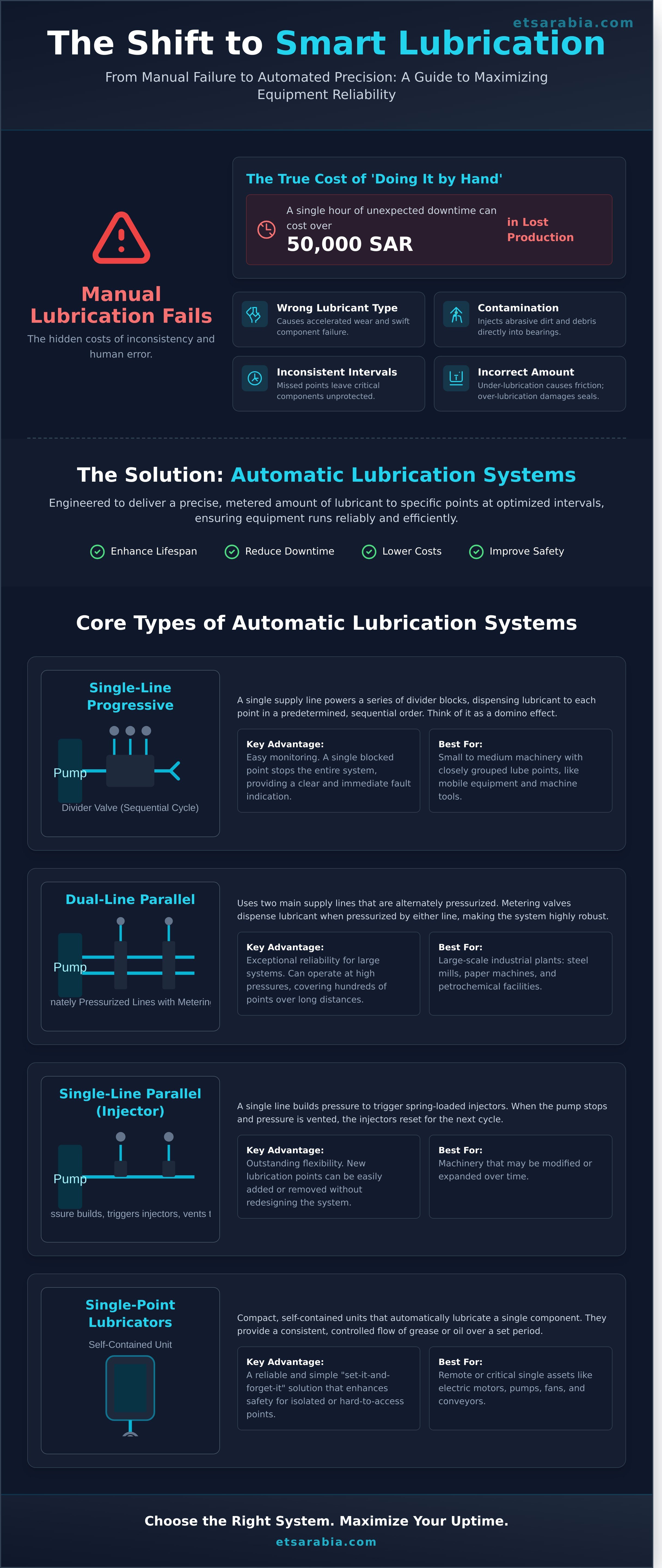
For decades, the grease gun has been the primary tool for machinery lubrication. While familiar, this manual approach is inherently flawed, relying on human consistency in an environment where precision is critical. The reality is that both under-lubrication (leading to friction and heat) and over-lubrication (causing seal damage and energy loss) result in the same catastrophic outcome: premature equipment failure. This failure is the direct cause of unplanned downtime, the most significant hidden cost impacting your bottom line and a core challenge that modern industrial lubrication systems are designed to solve.
The True Cost of 'Doing It by Hand'
The expense of manual lubrication extends far beyond a technician's labor. Over-greasing wastes a significant amount of lubricant, potentially costing your facility thousands of Riyals annually in material alone. This is dwarfed by the cost of premature bearing and component failures, which require expensive replacement parts and specialized labor. However, the most substantial financial damage comes from lost production. A single hour of unexpected downtime on a critical asset can result in losses exceeding 50,000 SAR, crippling productivity and delaying shipments.
Common Manual Lubrication Errors and Their Consequences
Manual lubrication practices are prone to frequent and costly errors that compromise machinery health. These mistakes directly contribute to reduced asset lifespan and operational inefficiency.
- Wrong Lubricant Type: Applying a general-purpose grease to a high-temperature or high-load application accelerates wear and leads to swift failure.
- Contamination: Dirt and debris on a grease fitting can be injected directly into a bearing, acting as an abrasive and drastically shortening its life.
- Inconsistent Intervals: Missed lubrication points due to shift changes, oversight, or difficult-to-access locations leave critical components unprotected.
- Incorrect Amount: The unreliability of counting 'strokes' from a grease gun stands in stark contrast to the precise, metered delivery of an Automatic lubrication system, which ensures components receive the exact amount required.
Safety and Environmental Risks
Relying on manual lubrication introduces significant risks. Technicians are often required to access dangerous, hard-to-reach lubrication points on running machinery. Furthermore, excess grease creates severe slip-and-fall hazards on floors and equipment. This wasted lubricant also poses an environmental risk, contributing to contamination and creating disposal challenges that must comply with local Saudi Arabian regulations. Effective industrial lubrication systems mitigate these risks by automating the process safely and cleanly.
Core Types of Automatic Lubrication Systems Explained
Manual lubrication is often inconsistent and prone to human error, leading to either under-lubrication (causing friction and wear) or over-lubrication (wasting resources and creating safety hazards). Automatic lubrication systems are the engineered solution to these critical failures. Their fundamental purpose is to deliver a precise, metered amount of lubricant to specific points at optimized intervals, ensuring equipment runs reliably. This precision is the cornerstone of Proper lubrication management, directly impacting asset lifespan and minimizing costly operational downtime.
Understanding the core designs is key to selecting the right solution. The most common industrial lubrication systems can be grouped into four main categories, each engineered for specific operational demands.
Single-Line Progressive Systems
This system utilizes a single supply line from a pump to power a series of divider valve blocks. Lubricant flows through the blocks in a sequential, progressive cycle, dispensing to each point in a predetermined order. Its primary advantage is simplified monitoring; if a single point becomes blocked, the entire system stops, providing a clear and immediate fault indication. This makes it an ideal, reliable choice for small to medium-sized machinery where lubrication points are grouped closely together, such as on mobile equipment or machine tools.
Dual-Line Parallel Systems
Engineered for robustness and scale, a dual-line system uses two main supply lines that are alternately pressurized and vented by a change-over valve. Metering valves at each lubrication point dispense lubricant when pressurized by either line. This design is exceptionally reliable and can operate at high pressures, covering extensive distances and serving hundreds of lubrication points. It is the preferred solution for large-scale industrial plants common in Saudi Arabia, including steel mills, paper machines, and petrochemical facilities.
Single-Line Parallel (Injector) Systems
Also known as injector systems, this type uses a single supply line to build pressure, which triggers spring-loaded injectors at each lubrication point to discharge a measured amount of lubricant. When the pump stops and the line pressure is vented, the injectors reset for the next cycle. This system offers outstanding flexibility, as new lubrication points can be added or removed from the main line without redesigning the entire system. It is best suited for machinery that may be modified or expanded over time.
Single-Point Lubricators
These are compact, self-contained units designed to lubricate a single bearing or component automatically. Typically powered by a gas cell or an electromechanical drive, they dispense a consistent, controlled flow of grease or oil over a set period (e.g., 1 to 12 months). Their simplicity makes them perfect for remote, critical, or hard-to-access equipment like electric motors, pumps, fans, and conveyors. They provide a reliable "set-it-and-forget-it" solution that enhances safety and ensures consistent lubrication for isolated assets.
How to Select the Right System for Your Application
Choosing the optimal industrial lubrication system is not a one-size-fits-all decision. The most effective solution is always the one tailored precisely to your machinery, lubricant, and operating conditions. Approaching this selection as a methodical evaluation is a cornerstone of effective lubrication best practices and is critical for minimizing downtime. To guide your decision, ask the following critical questions.
Step 1: Analyze Your Machinery and Lubrication Points
The physical layout of your equipment is the primary factor. A system designed for a compact, contained machine will be inefficient and costly for a large, spread-out operation. Consider these variables:
- Scale and Density: Are you lubricating a few critical bearings on one asset, or hundreds of points across an entire production line? The answer determines whether a simple single-point lubricator or a complex centralized system is required.
- Distance and Accessibility: How far apart are the lubrication points? Are they easily accessible for manual inspection, or are they located in hazardous or hard-to-reach areas? Automated systems excel where manual lubrication is impractical or unsafe.
- Criticality: Do certain components require constant, verifiable lubrication to prevent catastrophic failure? Systems with advanced monitoring and feedback capabilities are essential for these mission-critical applications.
Step 2: Consider the Lubricant Type and Volume
The lubricant itself places specific demands on the delivery system. A system must be able to handle the specified lubricant type and volume consistently without separation or blockages. Key considerations include:
- Oil vs. Grease: While many systems can handle both, some are optimized for low-viscosity oils, while others are built with the power to pump thick, heavy grease.
- Grease Viscosity: What is the NLGI grade of your grease? A system must generate sufficient pressure to move a heavy NLGI-2 grease through long lines, especially in high ambient temperatures.
- Required Volume: How much lubricant does each point need per cycle? This dictates the required pump size, reservoir capacity, and dispensing valve settings to avoid the costly damage of over- or under-lubrication.
Step 3: Evaluate Your Operating Environment
In Saudi Arabia, the operating environment is a non-negotiable factor. Standard equipment may fail when exposed to the Kingdom's unique challenges of extreme heat, pervasive dust, and fine sand. Your system must be robust enough to guarantee reliable performance under these harsh conditions.
Look for systems with sealed reservoirs and enclosures to prevent contamination from airborne particles, which can rapidly degrade lubricants and damage components. All system parts, from the pump to the tubing and fittings, must have a high-temperature rating to withstand ambient heat and ensure the lubricant maintains its specified viscosity. A failure to account for these environmental stressors can lead to premature system failure and costly, unplanned production halts.
Don't let the climate compromise your machinery's health. Our experts can help you choose a system built for the KSA climate.
Key Components of a Centralized Lubrication System
An industrial lubrication system might seem complex, but it operates on a logical, coordinated principle. To demystify its function, it is helpful to think of it as a biological system working to keep your machinery healthy. Each component has a critical role, and understanding them is the first step toward optimizing your equipment’s performance, reducing downtime, and ensuring long-term reliability.
The Pump and Reservoir: The Heart of the System
Just as the heart pumps blood, the pump and reservoir unit is the source of power for the entire lubrication system. The reservoir stores the lubricant (oil or grease), while the pump pressurizes it for delivery. The selection of this core component is critical for system performance.
- Function: To store and pressurize lubricant for distribution.
- Common Pump Types: Electric, pneumatic, or hydraulic-powered, chosen based on the power sources available and application demands.
- Key Considerations: Proper sizing of the reservoir capacity, pump pressure capabilities, and flow rate are essential to meet the needs of all lubrication points.
Controllers and Timers: The Brains of the Operation
The controller is the command center that governs the entire process. It dictates the frequency and duration of lubrication cycles, ensuring that lubricant is applied with precision-not too often and not too little. This intelligent control is fundamental to an efficient lubrication strategy.
- Function: To automate and regulate lubrication cycles.
- System Types: These can range from simple, time-based controllers to advanced Programmable Logic Controllers (PLCs) that integrate directly with the machine’s primary control panel for dynamic adjustments.
- Advanced Features: Modern controllers provide vital diagnostic feedback, including cycle monitoring, low-level alarms, and pressure sensors that alert operators to blockages before they can cause catastrophic equipment failure.
Metering Valves and Dividers: Ensuring Precision Delivery
These components are responsible for the system's accuracy. They receive pressurized lubricant from the main line and meticulously measure and dispense the exact amount required for each individual lubrication point. This precision prevents the over- and under-lubrication issues that are primary causes of bearing failure.
- Progressive Dividers: These operate sequentially. Lubricant flows through a master block that serves each outlet in a fixed order. A blockage at one point will stop the entire system, providing a simple method for fault detection.
- Injectors: These operate in a parallel design. Each injector is an independent unit that dispenses a pre-set amount of lubricant when pressurized, offering greater flexibility for complex machinery.
Tubing, Hoses, and Fittings: The Delivery Network
Acting as the veins and arteries, this network of high-pressure tubing, flexible hoses, and secure fittings transports lubricant from the pump to the application points. The integrity of your entire system depends on the quality of this network. Using substandard components can lead to leaks, pressure drops, and contamination, compromising lubrication effectiveness and leading to costly interruptions. As a leading supplier of industrial hoses and fittings in Saudi Arabia, ETS provides robust, correctly rated components to ensure your industrial lubrication systems operate flawlessly. Explore our solutions to guarantee a reliable delivery network that keeps your operations moving forward.
Implementation and Partnership: Your Key to Lubrication Success in KSA
Understanding the components and benefits of industrial lubrication systems is the first step. However, translating that knowledge into reliable, real-world performance requires expert execution. The success of your system hinges entirely on its design, installation, and ongoing support. For industries in Saudi Arabia, choosing the right local partner is not just a convenience-it is a critical strategy for minimizing risk and maximizing operational uptime.
Why Professional Design and Installation Are Non-Negotiable
An improperly designed lubrication system is a significant liability. A system that delivers the wrong lubricant volume or fails to account for operational pressures can cause catastrophic machine damage, leading to production losses that far exceed the initial investment. Professional installation ensures that all components, from pumps to tubing, are robust enough to withstand the demanding industrial environments found across KSA. It culminates in rigorous commissioning and testing to guarantee the system performs exactly as specified from day one.
Maximizing ROI with Ongoing Maintenance and Support
Your lubrication system is a high-value asset that protects even more valuable machinery. To secure your return on investment, a proactive maintenance strategy is essential. This includes:
- Regular Inspections: Systematically checking for leaks, pressure drops, and component wear.
- Component Management: Timely replacement of filters and seals to prevent contamination.
- Reservoir Integrity: Ensuring reservoirs are refilled with the correct, uncontaminated lubricant.
Having a local partner like ETS means prompt access to expert technicians and genuine spare parts, ensuring any issues are resolved with speed and precision to keep your operations moving forward.
The Emdad Advantage: A Reliable Partner in Dammam
Emdad Technical Services (ETS) provides comprehensive, end-to-end solutions for industrial lubrication systems in Saudi Arabia. Our Dammam-based team offers more than just components; we deliver a complete partnership. Our local presence guarantees faster response times and on-site support, reducing costly downtime. With deep expertise in hydraulics and integrated industrial systems, we provide a holistic approach that ensures your lubrication strategy is perfectly aligned with your overall operational goals. To ensure your equipment achieves maximum reliability and productivity, it's time to work with a team that understands your challenges. Partner with ETS to build a reliable lubrication strategy.
Your Partner in Maximizing Equipment Uptime and Efficiency
As we've explored, transitioning from unreliable manual lubrication to a precisely engineered automated solution is the first step toward enhancing equipment longevity and operational reliability. The key to success lies not only in selecting the right system for your specific application but also in a strategic implementation that aligns with your production goals. This approach transforms maintenance from a reactive cost center into a proactive driver of productivity and profitability.
Ultimately, the right industrial lubrication systems are more than just hardware; they are a critical investment in your plant's future performance. At Emdad Technical Services, we specialize in designing and deploying solutions that deliver on this promise. With our deep expertise in reducing industrial downtime, local technical support based right here in Dammam, and partnerships with leading global lubrication technology brands, we are uniquely positioned to be your long-term partner in Saudi Arabia.
Take the next step towards optimized reliability and guaranteed performance. Request a consultation with our lubrication system experts today and ensure your operations keep moving forward.
Frequently Asked Questions
What is the main difference between a progressive and an injector-based lubrication system?
The primary difference lies in their operational sequence. A progressive system operates sequentially; lubricant flows through a master valve block that serves each point in a specific, fixed order. If one point becomes blocked, the entire system stops, which simplifies monitoring. In contrast, an injector-based or parallel system delivers lubricant to all points simultaneously. This design offers more flexibility, as each injector can be individually adjusted or serviced without affecting the rest of the system.
How do I calculate the return on investment (ROI) for an automatic lubrication system?
To calculate ROI, compare the total cost of the system against the savings it generates. Sum the initial costs (hardware, installation, training) in Saudi Riyal. Then, calculate your annual savings from reduced downtime (which can cost thousands of Riyals per hour), lower lubricant consumption, decreased manual labor hours, and fewer premature component failures. The ROI is your net annual savings divided by the initial cost. Most systems deliver a positive ROI within 6 to 18 months.
Can an existing machine be retrofitted with an automatic lubrication system?
Absolutely. Most industrial machinery, regardless of age or type, can be effectively retrofitted with a modern automatic lubrication system. Our expert technicians perform a thorough assessment of your equipment to identify all lubrication points, determine the optimal lubricant type, and analyze operational conditions. Based on this, we engineer and install a custom solution designed to enhance the reliability and lifespan of your existing assets, ensuring you gain the benefits of automation without replacing your machinery.
What are the most common failure points in an industrial lubrication system?
The most common failure points often stem from preventable issues. These include blocked lubrication lines or injectors due to contamination or using the wrong lubricant viscosity. Leaks from worn seals or improper fittings are also frequent. Other critical points of failure are pump malfunctions, incorrect timer settings leading to over or under-lubrication, and simply allowing the lubricant reservoir to run empty. Proactive, scheduled maintenance is the most effective strategy to prevent these costly issues.
How does extreme heat in Saudi Arabia affect lubricant and system selection?
The extreme ambient temperatures in Saudi Arabia demand careful consideration. High heat drastically reduces a lubricant's viscosity, thinning the protective film and accelerating oxidation, which leads to sludge. We recommend high-viscosity index (VI) or synthetic lubricants that maintain stability at elevated temperatures. System components, such as hoses and seals, must be rated for high-heat environments to prevent premature degradation. In some applications, reservoir cooling systems may be necessary to ensure optimal performance and protect equipment.
What industries benefit the most from centralized lubrication systems?
Industries with high-value machinery, continuous operations, or numerous hard-to-reach lubrication points see the greatest benefits. This includes the petrochemical, cement, and steel manufacturing sectors in Saudi Arabia, where equipment reliability is critical. Mobile heavy equipment used in mining and construction also benefits immensely, as do high-volume manufacturing plants. These sectors rely on industrial lubrication systems to minimize unplanned downtime, enhance worker safety, and maximize the operational life of their critical assets.